
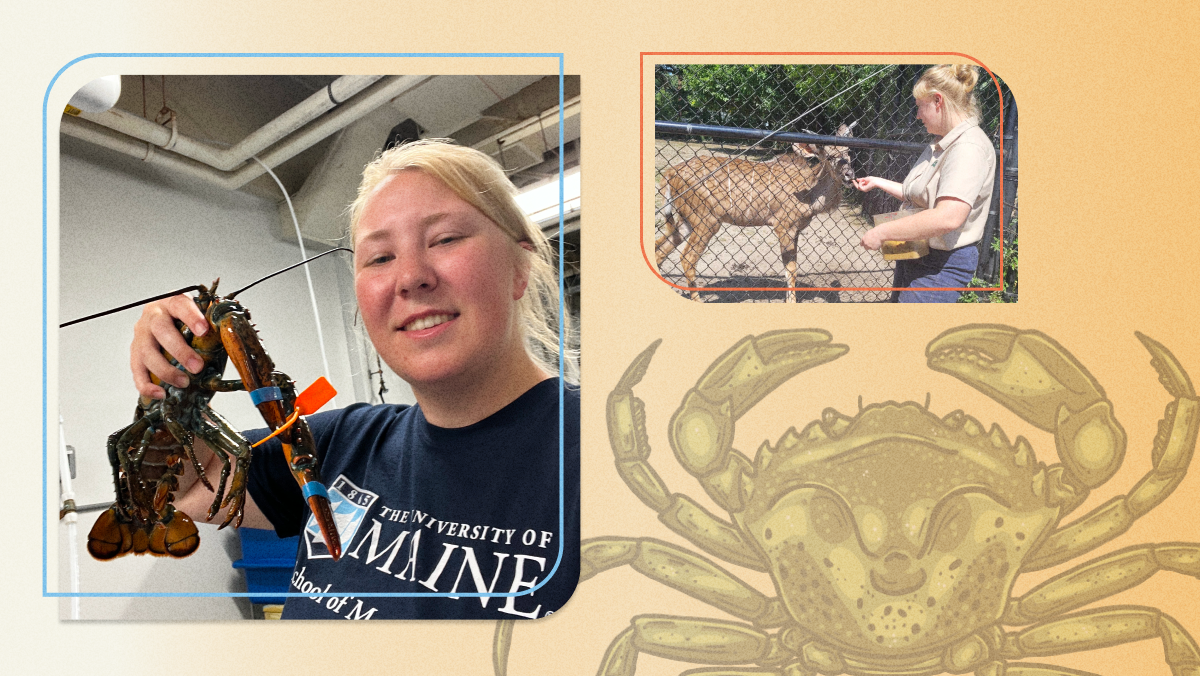
Madelynn deBest: Inspiring coastal conservation through creativity
Motivating people to protect hermit crabs, whelks, periwinkles or other animals that reside within the ocean tides can be challenging outside of coastal communities. That’s why University of Maine senior Madie deBest of Baroda, Michigan is using science communication and illustration to create a new field guide to encourage conservation.
As part of her Honors College thesis, deBest is writing and illustrating “A Field Guide to Intertidal Species of Maine. She aims to create a scientifically accurate and visually engaging resource that documents key intertidal organisms in the Gulf of Maine, including crustaceans, mollusks, algae and echinoderms such as sea stars and sea urchins.
“I want to make marine life approachable and inspiring. Visual storytelling helps people connect to the ecosystems around them,” said deBest, who’s studying ecology and environmental sciences with a concentration in marine ecology.
The field guide will serve as both a scientific reference and an educational tool and will be available in digital and print format.
A passion for animal conservation
During summer 2024, deBest completed an animal care internship at the Potawatomi Zoo in South Bend, Indiana — the state’s oldest zoo. There, she gained hands-on experience in professional animal care, behavioral observation and conservation focused management. Working alongside experienced zookeepers, she helped prepare meals for animals with specialized diets and clean and maintain animal enclosures. She also monitored animal behavior and welfare for various species, including poison dart frogs, snow leopards, giraffes and red pandas; and trained and fed river otters, zebras, diana monkeys and sand cats, among other animals.
“The internship deepened my respect for the complexity of caring for such diverse species. It reinforced my passion for combining animal care with scientific research and conservation outreach,” deBest said.
The following summer, deBest joined Florida Atlantic University’s Harbor Branch Oceanographic Institute, where she assisted in research using bioacoustics to study the foraging behaviors of shell-crushing predators. The experience expanded her technical skills in data collection and analysis while connecting her fieldwork to broader ecological questions about predator-prey interactions in marine systems.
DeBest said Amalia Harrington, assistant professor of marine biology and a member of her honors thesis committee, has supported and inspired her throughout this interdisciplinary project.
Outside of her academic pursuits, deBest has found her rhythm in the UMaine community, whether playing trumpet on Brass Night or cheering at hockey games — moments that helped make Orono feel like her “ home away from home.” She also enjoys exploring Maine’s outdoors, particularly Acadia National Park and the coastlines that continue to inspire her artistic and scientific work.
She is the recipient of the highest tier of UMaine’s merit scholarships, which recognizes excellence prior to enrolling, and the Visual and Performing Arts (VAPA) scholarship, which recognizes students who contribute creatively to the arts while pursuing academic excellence.
As deBest prepares to graduate, she said she is still exploring what comes next. Though she is certain of one thing: her future will involve working with animals, whether through research, conservation or care.
Story by Corey Nicholas, student news writer
Contact: Marcus Wolf, 207.581.3721; marcus.wolf@maine.edu