
From launch pad to leaderboard: Maine’s first satellite named a finalist in global contest
MESAT1, Maine’s first research satellite developed by the University of Maine and collaborators statewide, is a finalist for the SmallSat “Rookie of the Year” Award, which is sponsored by the American Institute of Aeronautics and Astronautics.
The public is encouraged to cast their vote online to boost MESAT1 to victory as the top rookie small satellite mission. Voting is free and open to everyone through August 12. MESAT1 is among seven small satellites vying for the title. The winner will be announced during the 39th Annual Small Satellite Conference from Aug. 10-13 in Salt Lake City.
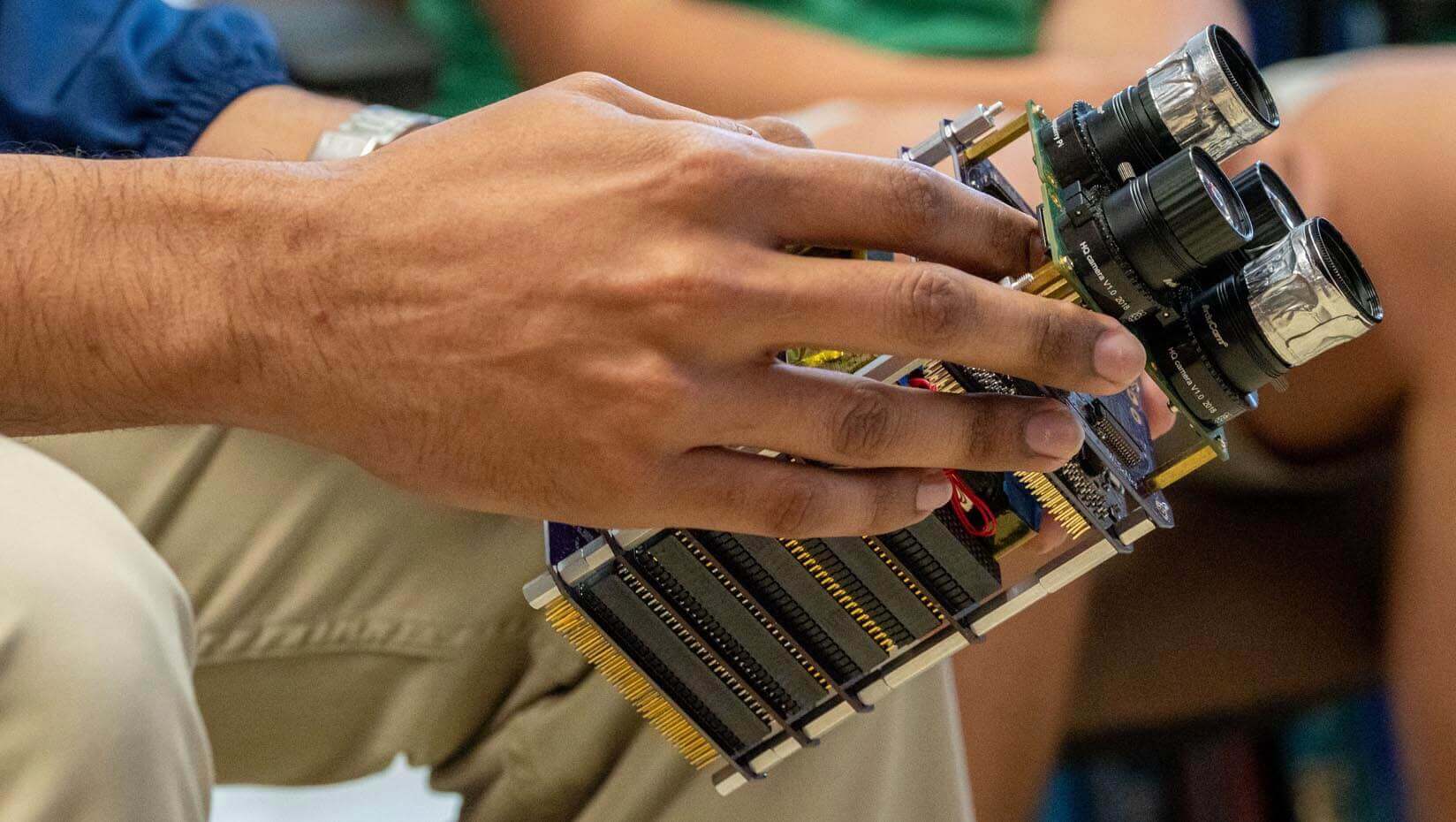
Launched into orbit on July 4, 2024, MESAT1 was developed to get students involved in space science. The cost-effective nanosatellite, which measures 11.8 inches, is outfitted with four multispectral cameras that were designed to capture climate-related Earth imagery for experiments designed by Maine K-12 students.
“Access to space data motivates and excites students to learn fundamental skills in mathematics and science and helps them see the importance of STEM careers,” said UMaine Vice President for Research and Dean of the Graduate School Kody Varahramyan, who led the establishment of UMaine’s Space Initiative. “Being selected as a finalist for SmallSat Rookie of the Year is a national recognition of what Maine students and their faculty researchers can accomplish together.”
Finalists for the SmallSat award include teams from the University of Arizona, the University of Nebraska–Lincoln and international missions from Senegal and Croatia. MESAT1 stands out as a mission that empowered K–12 students from Falmouth High School, Fryeburg Academy and Saco Middle School to contribute to space exploration.
MESAT1 was designed, built and tested by students and faculty at UMaine in partnership with the University of Southern Maine, the Wells National Estuarine Research Reserve and the Radio Amateur Satellite Corporation, with support from NASA and the Maine Space Grant Consortium. The satellite’s development and integration for launch was led by Ali Abedi, who formerly served as associate vice president for research and a professor at UMaine.
This effort is part of the broader UMaine Space Initiative, which is working to develop a skilled space workforce and grow Maine’s presence in the space economy, including plans for a future Maine SpacePort Complex.
“This recognition puts Maine on the map as a state that not only builds satellites, but also builds opportunities — for students, teachers, researchers and entrepreneurs,” Varahramyan said.
More information about MESAT1 is available online.