
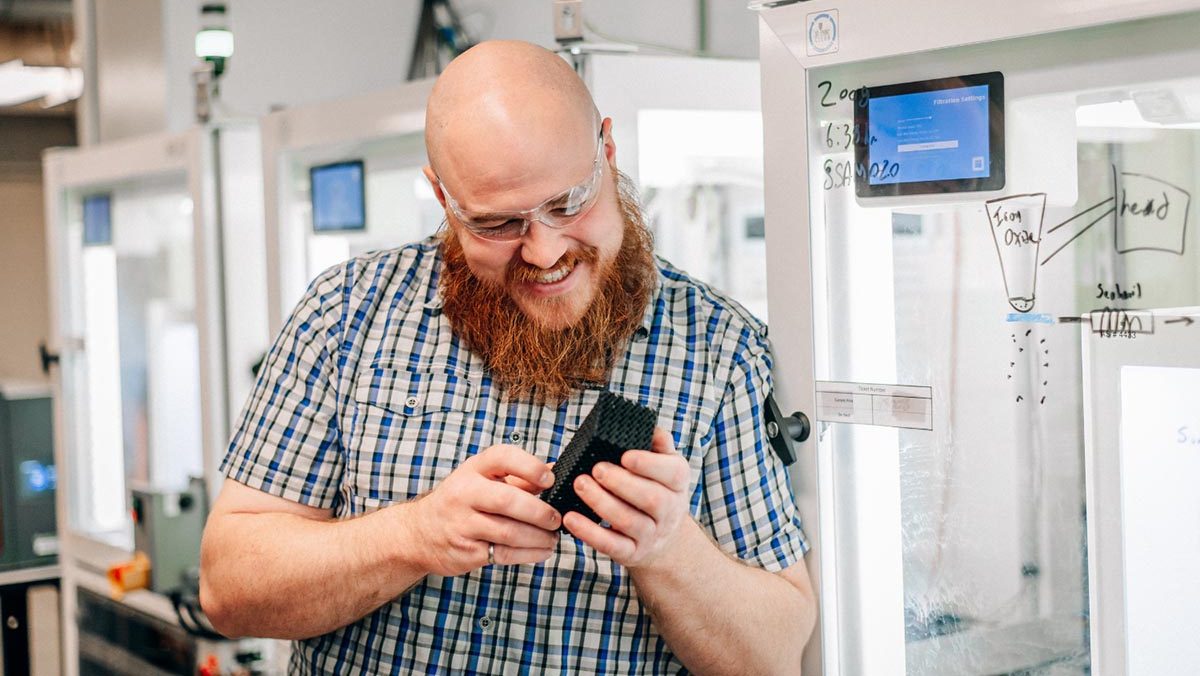
UMaine engineers find new method for developing stronger, lighter 3D-printed parts
Engineers at the University of Maine have developed a method to more accurately predict the strength of lightweight 3D-printed objects. This research, conducted at UMaine’s Advanced Structures and Composites Center (ASCC), will enable designers to create more robust and reliable printed components that can apply to a wide range of sectors, including aerospace, automotive and medical device manufacturing.
The research team integrated advanced computer modeling with physical experiments to better understand how printed parts will perform under stress. Their work focused on gyroid infill, an intricate, repeating internal structure commonly employed in 3D printing to minimize weight while preserving structural integrity. Computer simulations analyzed the gyroid’s response to forces before the team experimented on 3D-printed prototypes.
Philip Bean, research engineer at the ASCC; Senthil Vel, professor of mechanical engineering; and Roberto Lopez-Anido, professor of civil engineering, made up the research team. Their study, published in Progressive Additive Manufacturing, offers insights into how internal pattern contributes to a part’s overall performance.
Read the full story on the Maine College of Engineering and Computing website.
Contact: Taylor Ward; taylor.ward@maine.edu