
Estimating the Impact of Tradeoffs in U.S. EPRP Rulemaking Scenarios

Institution: University of Maine
Team: Materials Management
Sponsor: Environmental Research and Education Foundation
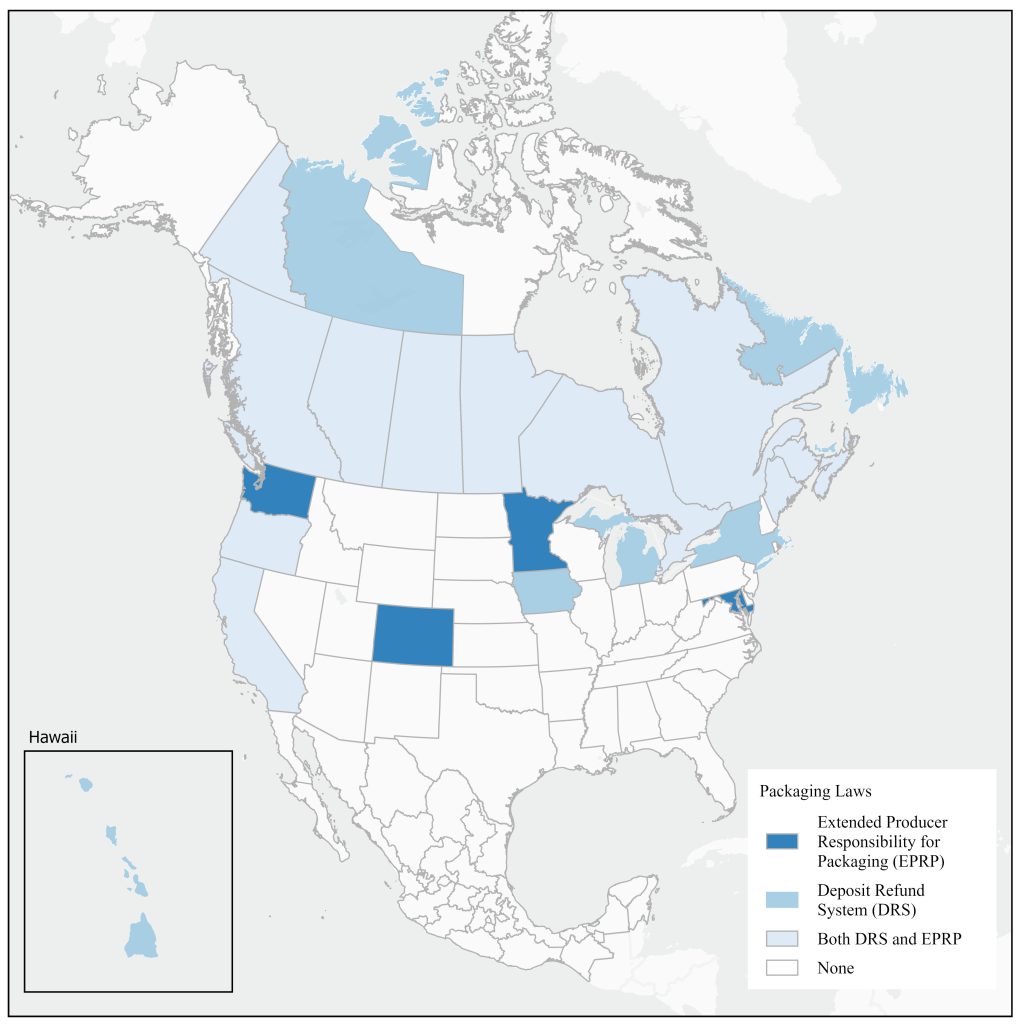
Several U.S. states have recently passed Extended Producer Responsibility for Packaging legislation (EPRP) which shifts the responsibility for the “end-of-life” management of packaging to producers — as a means to incentivize more sustainable packaging design. EPRP programs have improved the financial and operational capacity of waste management, but the potential for this policy approach to drive more sustainable packaging design remains uncertain. With several U.S. states currently establishing EPRP rules and additional states looking to adopt this policy approach to packaging material management, there is an immediate need to build a stronger understanding of the potential social, environmental, and economic tradeoffs associated with how programs: 1) define recycling; 2) set fees; and 3) determine criteria for measuring success. Without clear data on the potential trade-offs of these programs, there’s a risk that states could lock in long-term waste management infrastructures or incentivize packaging redesign without understanding the full benefits and risks.
Research Approach
This two-year project funded by the Environmental Research and Education Foundation will model six different EPRP scenarios to analyze the likely environmental, economic, and social impacts. The team will use life cycle assessments, general equilibrium modeling, and social impact analyses to evaluate each scenario compared to a baseline scenario without any EPRP policy in place. The research focuses on plastic packaging in the personal care product sector, as this industry is rapidly growing and often personal care packaging is not widely recyclable or recycled. The scenarios will vary based on:
- How recycling is defined;
- The fee structures for producers;
- The criteria for measuring programmatic success.
Goals and Expected Outcomes
The goal of this research is to contribute to the advancement of safe and just materials circularity through analysis of the environmental, economic, and social tradeoffs embedded in the rulemaking process of U.S. EPRP policies. Specifically, the team has three primary research objectives:
- Objective #1: Examine the potential for various EPRP fee structures, definitions of recycling, and performance measures to incentivize design for environment (DfE)
- Objective #2: Estimate how tradeoffs in EPRP policy design affect social, economic and environmental outcomes.
- Objective #3: Identify EPRP design scenarios most likely to ensure harmonization across jurisdictions and thus create stronger incentives for packaging redesign.
This research will provide policymakers with a better understanding of EPRP design trade-offs and potential outcomes to help create more effective policies. The findings are intended to help harmonize policies across states, which would create stronger incentives for producers to redesign their packaging to be more sustainable. The final deliverables will include a final report, policy briefs, and presentations for EPRP professionals and decision-makers.
Team Members
- Cindy Isenhour, Professor of Anthropology and Climate Change, UMaine
- Michael Haedicke, Associate Professor of Sociology, UMaine
- Jean MacRae, Associate Professor of Civil and Environmental Engineering, UMaine
- Reed Miller, Assistant Professor of Civil and Environmental Engineering, UMaine
- Jonathan Rubin, Professor of Economics; Director of Margaret Chase Smith Policy Center, UMaine
- Erin Victor, Postdoctoral Research Fellow, Mitchell Center for Sustainable Solutions
Advisory Board
- Dr. Reid Lifset (Yale School of the Environment) industrial ecologist, member of the UN International Resource Panel, and internationally renowned EPR scholar;
- Sydney Harris (Policy Director, Upstream) EPR policy expert with a focus on design for reuse, former Policy and Program Manager with the Product Stewardship Institute;
- Dr. William Gramlich (University of Maine Department of Chemistry) polymer scientist with expertise related to sustainable packaging design;
- Mike Belliveau (Founder, Bend the Curve) Environmental health and just-transition advocate, founding Executive Director of the Environmental Health Strategy Center;
- Dr. Suzie Boxman, Director of Programs at the Environmental Research and Education Foundation