B.S. Degree in Environmental Horticulture
The B.S. degree in Environmental Horticulture provides a strong foundation in the science of producing and managing plants for ornamental, food, or ecosystem benefits in a variety of settings such as public or estate gardens, residential or commercial landscapes, greenhouses, nurseries, and farm systems. A degree in Environmental Horticulture provides graduates with diverse career opportunities that channel specific passions into meaningful impacts on people and the places they live.
Students are encouraged to tailor their education to their own interests, which could include careers in controlled-environment agriculture, careers with a strong outdoor component, careers rich with creative expression, careers that solve human and environmental problems, careers that draw from local or regional flora to restore native landscapes, careers that enrich lives through medicinal or recreational plant production, or careers that build our collective knowledge through science and research.
This flexible program offers the opportunity to gain both theoretical scientific knowledge and hands-on practical experience in a diverse range of career skills:
- plant propagation
- sustainable plant production and management
- greenhouse and controlled-environment production
- landscape design
- nursery and landscape management
- food crop production
- plant and soil sciences
- scientific research
Program Learning Outcomes
- Students completing the program in Environmental Horticulture will demonstrate strong written, oral and interpersonal communication skills appropriate for an entry-level professional in the industry.
- Demonstrate scholarly writing by summarizing scientific literature, formulating individual ideas, and presenting written information clearly.
- Interact in a professional manner with community partners in a service-learning context.
- Students completing the program will be able to apply basic knowledge and skills in the field of environmental horticulture to practical, real-world settings as appropriate for an entry-level professional in the industry.
- Identify herbaceous plants, using scientific and common names, and spell both names correctly.
- Diagnose plant diseases using a microscope. They will understand principles of how disease occurs, conditions of disease epidemics, and disease management.
- Complete a field experiment to test a hypothesis addressing their research question, including appropriate control treatments, for comparison.
- Choose and describe appropriate shade tree species for use in the landscape based on the function and characteristics of the site.
- Demonstrate understanding of best practices for tree and shrub pruning, and will have the specific knowledge necessary to make pruning cuts, explain why cuts are made, and anticipate plant responses to pruning.
- Demonstrate the ability to grow high quality plants and document their ability to use environmental, nutritional, and scouting data recorded in the greenhouse to make decisions regarding plant production.
- Demonstrate the ability to measure scaled drawings with a scale ruler, apply measurements to a mathematical equation to calculate slope gradients and calculate quantities of cut/fill materials.
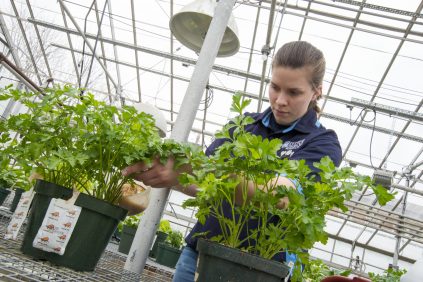
The Lyle E. Littlefield Ornamentals Trial Garden & The Roger Clapp Greenhouses, the University of
Maine’s horticultural research facilities, are located on the University of Maine campus.
The undergraduate program coordinator (bryan.j.peterson@maine.edu) welcomes questions about the major, how it can help you achieve your career goals, or how it might pair with other majors or minors!
Offer an internship opportunity to UMaine Environmental Horticulture students.