Engineering

Media highlight Friess’ NSF grant to support low-income engineering students

The Bangor Daily News, Piscataquis Observer and Penobscot Bay Pilot reported that Wilhelm Friess, associate professor of mechanical engineering at the University of Maine, was awarded $749,999 from the National Science Foundation for a project that supports talented, low-income engineering students called Building Bridges for Engineering Students (BBEST). “This program presents a unique opportunity to […]

Read more
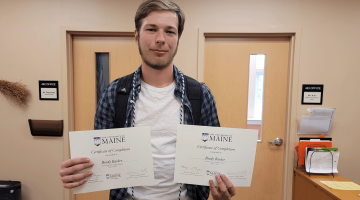
Brady Barker stands holding two UMaine Early College completion certificates

Holden student to enter UMaine with 64 Early College credits

“It’s not going to be easy, but it’s going to be worth it.” This is the best advice 17-year-old Brady Barker of Holden has ever received and he stands by it, especially as it applies to his experience in the University of Maine’s Early College program.  Barker started taking Early College classes as a first-year […]

Read more

Media report on SipBit

The Bangor Daily News, WFVX (Fox 22/ABC 7), Trendeepro, News Update, Tech and Science Post, Tech Xplore and other outlets reported that the University of Maine’s Nimesha Ranasinghe, assistant professor of spatial computing, and Chamath Amarasinghe, Ph.D. student of spatial information science and engineering, have invented a device that could launch new technology to facilitate […]

Read more

News Center Maine features Intermedia students making art with nanocellulose

News Center Maine interviewed Alex Rose and Augusta Sparks Farnum, graduate students in the University of Maine’s Intermedia program, about their work using nanocellulose as a material for their art projects. Rose said that one of the things that she likes most about using the material is that it’s environmentally friendly and non-toxic, while Farnum […]

Read more

Apul speaks to BDN about company working to remove PFAS

Onur Apul, assistant professor of civil and environmental engineering at the University of Maine, was interviewed by the Bangor Daily News for an article about ECT2 (Emerging Compounds Treatment Technologies), a Portland-based company conducting pioneering work in the removal of toxic per- and polyfluoroalkyl substances (PFAS), also known as forever chemicals. “As a Maine-based researcher […]

Read more

A photo engineering students in a classroom

Friess receives $750,000 from NSF to support low-income engineering students

During his tenure, Wilhelm Friess, associate professor of mechanical engineering at the University of Maine, has seen a pattern of talented first-generation, low-income engineering students leaving the program — or dropping out of college altogether. Often, their leaving the program has less to do with their potential talent as engineers than the socioeconomic odds that […]

Read more

Media highlight UMaine research using artificial intelligence to monitor forests

The Bangor Daily News, Penobscot Bay Pilot, Boothbay Register, Science Daily, Scienmag, Bioengineer, Verve Times, Earth.com, Phys.org and other outlets reported on a study by researchers at the University of Maine suggesting that artificial intelligence could be a cost-effective and energy-efficient tool to monitor and manage Maine’s forests. “AI can learn from the environment, predict […]

Read more

Four UMaine students complete Bath Iron Works internships

Four University of Maine students recently completed the General Dynamics Bath Iron Works (BIW) summer internship program. Katie Arsenault, Parker Swanson, Max Moore and George Bradbury worked across the yard in various departments.  Arsenault is a senior majoring in management with concentrations in business information systems and international business. She interned with BIW’s Human Resources […]

Read more

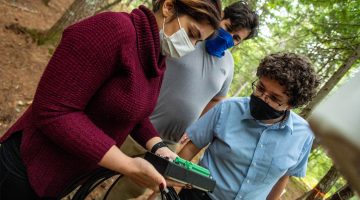
A photo of researchers looking at technology in a forest

Artificial intelligence can be used to better monitor Maine’s forests, UMaine study finds

Monitoring and measuring forest ecosystems is a complex challenge because of an existing combination of softwares, collection systems and computing environments that require increasing amounts of energy to power. The University of Maine’s Wireless Sensor Networks (WiSe-Net) laboratory has developed a novel method of using artificial intelligence and machine learning to make monitoring soil moisture […]

Read more