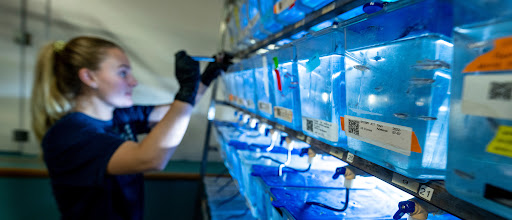
Zebrafish Lab

UMaine’s Zebrafish Facility is critical to the majority of Research Project Leaders (RPLs) supported by the COBRE grant. Each year, 12 UMaine faculty members, along with their technicians, undergraduate students, and graduate students, use the facility to support a wide range of research activities. These faculty represent several UMaine units, including the Department of Molecular and Biomedical Sciences, the School of Biology and Ecology, and the School of Marine Sciences. Zebrafish are used by UMaine researchers to study numerous disease processes, such as influenza, muscular dystrophy, and Candida fungal infections. The facility also supports research in disciplines such as electrical and computer engineering, where faculty are developing devices and technologies to prevent and treat human disease.
The Zebrafish Facility, located on the first floor of Hitchner Hall, expanded and doubled its space in 2025. The facility is equipped with the Aquatic Habitats for Accelerated Bioresaerch (AHAB) fish rearing system (Aquatic Habitats, Apopka, FL), which consists of five-foot-wide, five-level stainless steel racks that accommodate multiple tank sizes (3- and 10-liter). UV-sterilized water is delivered to each tank through independent valves, and tanks feature self-cleaning bottoms. The system’s optically clear effluent design and low-maintenance filtration help maintain high water quality, significantly reducing disease and mortality.
Read more on the CORE zebrafish fish facility page.


Funding for this project included $300,000 from the COBRE grant toward construction costs, a contribution from the University of Maine Vice President for Research, a supplemental NIH grant to COBRE Principal Investigator Clarissa Henry, and cost-sharing from the University of Maine to outfit the facility with racks, tanks, and water-handling equipment.
Studying zebrafish to improve human health