Many Mainers earn their livelihoods from harvesting bounty — including blueberries and lobsters — from the land and sea.
And Samuel Belknap and Kourtney Collum, the first students to enroll in the University of Maine’s new anthropology and environmental policy doctoral program, want to preserve those storied traditions, as well as the state’s natural resources.
Belknap and Collum say the doctorate program, which focuses on “understanding human society and culture in cross-cultural perspective and their pivotal role in implementing successful environmental policy,” is an ideal fit for their interests.
“It is so applicable and has an interdisciplinary framework,” says Collum. “I can look at issues holistically.”
Collum favors a multifaceted approach. She double-majored in anthropology and environmental studies at Western Michigan University, and earned her master’s in forest resources at UMaine.
Belknap agrees. He earned his undergraduate degree in anthropology and a master’s in Quaternary and climate studies, both from UMaine. “No problem is one-dimensional and no one person can solve everything,” he says.
His doctoral thesis, “Abrupt Climate Change and Maine’s Lobster Industry,” proposes collaboration between lobstermen and policymakers to better protect the state’s iconic industry, especially in the wake of abrupt environmental changes.
Experienced lobstermen possess valuable information, says Belknap. They have knowledge of the industry, concerns about both climate change and fishing regulations, and about how they’ve adapted their behavior in response to both.
Policymakers will be better informed and better positioned to craft policies customized for various situations if they routinely involve lobstermen in the regulatory process, Belknap says.
Belknap, who grew up in Damariscotta, Maine, knows his way around a lobster buoy. He learned to haul traps from his grandfather, a retired physician.
“I grew up lobstering,” Belknap says. “My wife jokes that I’m clumsy because I learned to walk on a boat, not land.”
Belknap worked as dock manager at his family’s lobster pound prior to starting his doctorate and respects lobstering as a way of life.
Abrupt climate change could threaten that way of life for the roughly 5,000 lobstermen in the state, as well as coastal communities in Maine and around the planet, he says.
Last summer, warmer water temperature in the Gulf of Maine contributed to lobsters molting a month or more earlier than usual, which resulted in a glut of crustaceans on the market. And then the price per pound plummeted.
“It’s humbling,” Belknap says of how quickly a temperature fluctuation of 1.5 to 2 degrees caused the drastic ripple effect. Another sudden change in temperature might have the opposite effect on the lobster population, he says.
Belknap doesn’t have to look far in space or time to see examples of that.
In September 1999, huge numbers of lobsters died within a few days in Long Island Sound. It devastated the local industry, which languished for more than a decade. Scientific reports have indicated warmer ocean water was — and remains — a culprit.
And last summer, lobsters in water off New York, Rhode Island and Connecticut were afflicted with a shell disease, with warming ocean water was again cited as a factor.
How policymakers and Maine lobstermen work together to deal with abrupt climate changes could be a model for other fisheries regionally, nationally and globally, says Belknap.
Practical application of knowledge is also important for Collum, whose doctoral dissertation will explore the impact of the declining bee population on wild blueberry growers and the growers’ ability to conserve wild pollinators.
Because many crops rely on insect pollination to produce fruits and vegetables, the global decline of bees – due to pesticides, habitat loss and disease — threatens food security and the livelihood of farmers who produce food.
The lowbush blueberries that grow in Maine are completely dependent on insect — mostly bee — pollination to produce fruit. Without bees, there are no blueberries for Sal — or anyone else.
Commercial honeybees are crucial for the intensive agriculture practiced in the U.S, says Collum. But research suggests, through conservation efforts, native bees can provide a significant amount of pollination without the cost associated with renting commercial hives, she says.
Last year, Maine blueberry growers imported 70,000 commercial honeybees to pollinate about 60,000 acres of wild blueberries, she says. The busy bees trucked to Maine generally start their trek in California, where they pollinate almonds, and make multiple work stops en route.
The cost to blueberry producers to pay for pollination has risen significantly, says Collum, bringing into question whether the practice is financially sustainable.
She’ll therefore explore the ability of farmers to integrate the use of both wild and commercial bees to pollinate crops and increase the yields.
Because Maine has more than 240 bee species — at least 40 of which pollinate blueberries, Collum says it’s a good place for farmers and researchers to collaboratively figure out the best practices to protect, promote and utilize wild, native bees to pollinate crops.
Collum will explore obstacles that growers in Maine and Canada have to increasing their use of wild bees to pollinate lowbush blueberries. She’ll also study what influence government policies and programs have on the way growers manage pollination of crops and how growers can adapt to changing ecological conditions.
Growers of other crops that want to transition to utilizing wild bees, where applicable, could apply the findings, she says.
Collum, who grew up in Monroe, Mich., near the border of Ohio, is used to working in the field and on the trails.
She fell in love with Maine when she was a college intern working on a trail crew at Baxter State Park in Millinocket. As a field coordinator for Rocky Mountain Youth Corps in Colorado, Collum battled the pine beetle infestation. And she worked on an ecotourism project in New Zealand, building trails, battling invasive gorse and planting native trees.
Collum urges people to know where their food comes from, to build relationships with local farmers and to support those doing their best to reduce chemical inputs. She also encourages people do what they can to protect bees, including not using pesticides around their homes and planting bee-friendly gardens.
Collum and Belknap both want to make a positive difference in the state they love and ensure that ensuing generations of lobstermen, farmers and foresters have the opportunity to make livings from the land and sea.
Contact: Beth Staples, 207.581.3777
The Bangor Daily News published a University of Maine press release about graduate students in the Communication Sciences and Disorders Department providing speech therapy services to underserved clients in rural areas through virtual sessions.
University of Maine research fellows have been assisting the Maine Governor’s STEM Council create a comprehensive strategy to promote science, technology, engineering and mathematics initiatives through an effort funded by UMaine’s Office of the Executive Vice President for Academic Affairs and Provost.
Laura Millay, a student in the master of science in teaching program through the Maine Center for Research in STEM Education, or RiSE Center, and Johanna Barrett, a research fellow at the Margaret Chase Smith Policy Center and student in the master of arts program in economics and international environmental policy, are providing information and resources to the council on how to create a strategic plan and data dashboard.
Daniel Laverty, a science teacher at Mattanawcook Junior High School in Lincoln who is also a master of science in teaching student through the RiSE Center, assisted in the initial gathering and presentation of data.
The STEM Council was signed into law and formed in 2011 when members were appointed by Gov. Paul LePage, according to Millay.
The council is composed of volunteer representatives from organizations, departments and businesses across the state, all with differing STEM perceptions. Without a clear mandate or any funding, members have created subcommittees to determine their role and find direction, Millay says.
One of the subcommittees is tasked with looking at successful STEM councils and programs in other states. UMaine’s Executive Vice President for Academic Affairs and Provost Susan Hunter, a subcommittee member, decided to recruit UMaine research fellows and provide funding for their efforts, according to Millay.
In the summer of 2012, Millay, Barrett and Laverty researched STEM initiatives and strategies used to promote them in states that are comparable to Maine.
“There are lots of STEM initiatives going on all over the place, but the idea of a council is to pull all of those together and coordinate efforts and clarify a strategy for STEM,” Millay says.
Millay believes STEM education is necessary in advancing energy, developing technology and supporting economic growth while protecting the environment.
“You can see the importance of STEM all around us,” Millay says. She believes many societal problems could benefit from STEM innovations by allowing for development without pollution and waste. Millay also says STEM education is necessary for economic growth in Maine by expanding industries and providing well-paid jobs for qualified workers.
“Because STEM education is about learning by doing and exposure at an early age to people already engaged in those fields, it can foster the necessary creativity, curiosity, drive and discipline required to be successful,” Barrett says.
As a prospective high school science teacher, Millay’s interest in the project is based in education.
“I’m inspired because I always had an interest in science and had what felt like a really unfulfilling experience with science in college, and it seemed like what I learned in grade school and high school was a poor match with what I expected to do in college,” Millay says.
Barrett, who says she is “not an academic at heart,” is more interested in identifying the cultural norms related to education initiatives and likes the intersection between culture and economics.
“From an economic standpoint, STEM education is the path by which future workforce needs are met,” Barrett says. “Students who have a solid background in science, technology, engineering and math are better equipped to meet the needs of the technology-intensive labor industry.”
Millay, Barrett and Laverty presented last summer’s findings to the STEM Council during a daylong workshop. Currently, the state does not have a comprehensive strategy for STEM initiatives. Millay and Barrett hope the information they provide can help the council create a road map for where they are headed.
The researchers also helped the council write a request for funding that went to the governor and legislature. That request is still being processed.
Millay and Barrett are working on a mock-up of a data dashboard they plan to present to the council this summer. Creating a dashboard connects to the concept of data-driven decision making, or using data to inform policy, Millay says.
A data dashboard would be an interactive website available to policymakers, researchers and the general public that would organize STEM education information in one place. Data on the website could be categorized to answer questions based on topics such as location or school, and linked to objectives to offer success indicators or benchmarks on reaching goals.
Making this information readily available would also help educate the public on the data’s importance, Millay says.
“Data becomes powerful and reliable when it is consistent and thorough,” Barrett says. “This goes back to the cultural component — consistent, reliable data requires that people are willing to participate and give information.”
Data collection is also needed to monitor the council’s progress. The longitudinal data can display trends and identify successful efforts in STEM education.
The Maine Department of Education currently has an online Data Warehouse where some STEM statistics are available, but doesn’t offer a lot of useful data for crafting STEM policy or illustrating which initiatives work over time, according to Millay.
The website includes facts on student achievement in math and science as well as where students go after high school and what careers they choose. Information missing from the database includes public perceptions, success indicators and instruction quality, the researchers say.
Millay and Barrett are researching data on students, workforce, achievement, interest and teaching practices. They intend to learn what information is and isn’t available and what would be useful in crafting policy. By looking at other states, they also plan to determine the best way to use, present and make publicly available the findings.
An example of new information that could be compiled would be the percentage of high school teachers in STEM subjects who have a degree in their field.
“Having that kind of data collected could really help show if there is an issue that needs to be addressed,” Millay says. “And we’d be able to tell if some of the things we are trying are working or not. Without the data it’s kind of impossible to say.”
Barrett says she is proud of the research the team has completed so far.
“I like research that produces tangible outcomes rather than a paper on a shelf,” Barrett says. “I feel we succeeded in giving the Maine STEM Council a solid understanding of where Maine stands in the national STEM landscape, and we are providing policymakers and business leaders with real and feasible recommendations about what kinds of initiatives are working here and what factors ought to be considered when implementing and measuring success.”
Contact: Elyse Kahl, 207.581.3747
A new University of Maine training program for graduate students in Communication Sciences and Disorders (CSD) is expected to reduce the cost of providing speech therapy services, while reaching out to underserved children and adults in rural areas throughout Maine — or around the world.
The university’s Communication Sciences and Disorders Department has developed a Web-based speech therapy telepractice training program to give graduate students the competencies that are revolutionizing the delivery of health care worldwide. It is now accepting speech therapy clients who would benefit from the remote access of telepractice.
“We have created one of the first nationwide speech therapy telepractice training programs,” says Judy Walker, a UMaine CSD associate professor who developed the program in collaboration with colleagues in the Speech Therapy Department at Waldo County General Hospital (WCGH) in Belfast.
The UMaine program is one of only a few programs in the country that offers speech therapy telepractice training at the college level in an emerging service model for delivering health care through evolving technologies. Speech therapy telepractice involves almost no travel expense and expands the reach of therapy services to more people in Maine, where an overabundance of people in need of speech therapy is compounded by a severe shortage of speech therapists, Walker says.
“Telepractice is not only efficient in reaching people, but also cost-effective,” Walker says.
Nationally, at least one study estimates that telemedicine services provided via broadband Internet would save $700 billion nationally over the next 15 to 20 years, according to Walker.
The program uses a secure, password-protected Web-based platform that allows virtual face-to-face therapy between service providers and clients. Clients can be assisted by designated “e-Helpers” — family, friends or caregivers — according to Walker. All that is needed is a computer with a webcam and broadband Internet access, located in a private setting, such as a home, school, clinic or community center.
“In addition to overcoming barriers such as geography, weather and transportation, we can also bring in family members and caregivers to participate in the therapy from their own computers in any location,” Walker says. “With this service delivery model, anyone involved in a child’s or adult’s therapy program can actually view or participate in the session, regardless of where they are,” Walker says.
The UMaine graduate training program in speech therapy telepractice, based in the Madelyn E. and Albert D. Conley Speech, Language and Hearing Center in Dunn Hall, complies with American Speech-Language-Hearing Association guidelines for demonstrating competencies and skills in speech telepractice services, which standardizes the training of the UMaine graduates.
That’s important, according to WCGH Speech Therapy Department Director Michael Towey, who oversees the hospital’s 5-year-old speech therapy telepractice, on which the UMaine program is modeled. Competency standards have not been well defined nationally, says Towey, a UMaine alumnus and adjunct CSD faculty member assisting the university with its telepractice training curriculum.
Industry credentials reassure clients that telepractice therapists are competent, he says. Towey says the UMaine speech therapy telepractice training program is among the first to establish training standards for therapists at the college level.
Waldo County General Hospital’s speech telepractice program is provided by staff professionals, who have served people from Canada to Russia and Taiwan, in addition to more that 40 Maine communities between Kittery and Fort Kent. It is one of only a handful of speech therapy programs in the country with Training Program Accreditation from the American Telemedicine Association, according to Towey, and the only one that allows therapists to work with clients in home settings rather than at designated clinics, he says.
Walker along with Casey Monnier, a CSD staff speech pathologist and lecturer, and WCGH staff offered the first telepractice training class in August 2012 to 10 CSD graduate students, including Taylor Rodgers of Standish and Janet Ciejka of Brunswick. Following the class, Rodgers and Ciejka applied their new skills in two semesters of clinical practicum providing telepractice speech therapy to clients under the supervision of Walker and Monnier. A new cohort of 12 CSD graduate students are currently in a telepractice training class this month and will be involved in applying their new telepractice skills in clinical practicum during the next school year.
Prior to graduation, Rodgers had been providing speech therapy to a woman from southern Maine, who as the result of a stroke in April 2012, had difficulty finding the words to communicate with her family for much of the spring and summer. Speech therapy telepractice sessions began in the fall 2012, involving one adult daughter videoconferencing from Rhode Island, another daughter at her mother’s side in southern Maine, and Walker and Rodgers in Orono. Now, the woman can retrieve many nouns and other words (verbally or in writing using e-Tools) as Rodgers displayed digital materials that are unique to this client on the computer screen where all participants can see- bread, rice cakes, butter or milk, for example.
Therapy by videoconference is working better than the daughters expected, they say. Their mother is progressing faster as a result of more frequent therapy sessions and outside practice of activities involving the daughters and their mother between online sessions with Rodgers and Walker.
“I had a telephone conversation with my mother last week and I understood everything she was trying to say,” the southern Maine daughter says of her mother.
Therapy at home also ended a “convoluted and complicated” transportation problem when her mother was visiting a therapy clinic, says one daughter, a nurse.
“I was driving her to therapy two and three times a week, and we had to arrange transportation. I felt I was losing touch because I wasn’t there for all the sessions,” she recalls. It was worse for the daughter in Rhode Island, a school bus driver who can now participate in therapy sessions with her mother between her shifts at work. “Being so far away, I feel so much more involved now,” she says.
For the mother’s part, starting telepractice speech therapy “was wonderful,” she says. “It’s helping me.”
Rodgers, who recently received a master’s degree, is convinced the new telepractice skills will give UMaine speech-language pathologists an edge in the job market.
“I think it’s a really exciting opportunity the University of Maine makes available to us,” Rodgers says. “I have friends in speech pathology at other universities and they really don’t have anything like this, and this seems to be the future direction of speech pathology.”
The University of Maine, Madelyn E. and Albert D. Conley Speech, Language, Hearing Center is accepting new clients for speech therapy telepractice services this summer and fall. Telepractice is covered by many insurance plans, including MaineCare. For more information or to make an appointment, call the Conley Speech, Language Hearing Center, 207.581.2006, or visit the telepractice website.
Contact: Margaret Nagle, 207.581.3745
Educators and parents avow that Reading Recovery — an early intervention, short-term, one-on-one prevention initiative for first-graders having difficulty reading and writing — opens doors to learning and creates opportunities for children.
The thousands of children who enjoy reading and are reading well are proof.
Brian Doore, assistant research professor in the University of Maine’s College of Education and Human Development, figured out a way to strengthen the life-changing initiative by analyzing Reading Recovery data within a comprehensive intervention model.
Doore and his wife, Stacy, a UMaine doctoral student in spatial engineering and a research associate at the Center for Research and Evaluation at UMaine, designed the prototype for Comprehensive Intervention Model for Maine (CIMME) — a Web-based data collection entry system for educators.
Teachers plug in a student’s data, including instructional hours, number of absences, books read, average text level gain, average writing vocabulary gain, as well as notes and comments. With CIMME, teachers are able to make up-to-the-second instructional decisions to best help the student.
The system displays children’s learning trajectories in various forms, including line charts and motion graphs.
Kit Cuddy was lead programmer on the CIMME project and Quansheng Song supervised. Cuddy, Song and CRE director Craig Mason refined and added functionality to the system so it could be offered to schools throughout Maine and in nine other states, Doore says.
Often times, says Doore, educators utilize summative assessments — think midterms and finals. These tests seek to determine whether students learned — past tense — the material.
This data collection system provides a formative assessment — in real time. “We’re focused on what they are learning,” Doore says.
Because the graphs show the child’s reading knowledge at that moment, educators can determine what instructional strategy will be most beneficial at that moment in time.
“The right question (for teachers) is, ‘What does the child need to learn and what do I need to teach next?’” Doore says.
For Doore, a former special education and regular education teacher, the objective is “for all children to make progress and be successful.”
Because teachers, teacher leaders and administrators in different locations can simultaneously view the information on their computers, they can collectively brainstorm about how best to proceed.
The data provides a detailed picture of individual literacy interventions and that becomes the catalyst for coaching conversations around how to accelerate students’ learning.
Teachers can follow a student’s long-term progression in one school system and, if a student moves, Doore says educators in the new school can immediately access the data so there’s no gap in services for the youth.
“It’s an empowering model instead of a deficit model,” says Mary Rosser, director of the University Training Center for Reading Recovery at UMaine.
“Rather than contemplating what we could have, should have and would have done, it’s an opportunity to look at where we are we now and what can we do, in the moment, to accelerate learning.”
In order to increase access to the system, Doore and Rosser have teamed up with partners from across the country to submit multiple federal grants.
Additional funding, says Doore, would allow CIMME to be available to more students and teachers across the country and support improved outcomes and accelerated learning for children through educators’ increased ability to engage in systematic, data-based, instructional decision-making.
Contact: Beth Staples, 207.581.3777
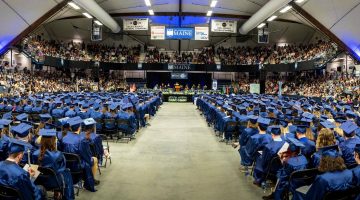
The Associated Press, Bangor Daily News, WABI (Channel 5) and WLBZ (Channel 2) were among several news organizations to cover the University of Maine’s 211th commencement. 1,665 students graduated Saturday and more than 12,000 people attended the ceremonies.
Upward of 12,000 people attended the University of Maine’s 211th Commencement at Harold Alfond Sports Arena May 11 and heard remarks by alumnus Lawrence Bender, the producer of films that have won a total of six Academy Awards.®
This academic year, 1,665 students — 1,333 undergraduate and 332 graduate students — earned degrees from UMaine.
A 10 a.m. ceremony was held for graduates in the College of Business, Public Policy and Health; the College of Liberal Arts and Sciences; the College of Education and Human Development; and the Division of Lifelong Learning. Graduates in the College of Engineering and the College of Natural Sciences, Forestry, and Agriculture were recognized at a 2:30 p.m. ceremony.
UMaine President Paul Ferguson, who presided over the ceremonies, encouraged the students to invest their talent, success and great achievements in enriching the world and improving the quality of life of those around them. The hope, he said, is that the students’ experiences and education at UMaine have inspired them to dare and to “achieve greatly.”
“You can be confident that your UMaine education represents the very best of Maine and that you, in turn, represent the very best of Maine,” Ferguson said. “It is with great pride that I remind you that UMaine is now forever a part of your identity, just as you are the legacy of the University of Maine.”
UMaine awarded an honorary degree to film producer Lawrence Bender, whose noteworthy projects such as “Inglourious Basterds,” “Pulp Fiction” and “Good Will Hunting” have been honored with 29 Academy Award® nominations, including three for Best Picture. His film, “An Inconvenient Truth,” which raised unprecedented awareness about climate change, won the Academy Award® for Best Documentary Feature.
In his remarks, which included a standing ovation, Bender said he would not have the life he lives today if not for his University of Maine experience, and he urged the students to find success through consistent hard work and persistence.
“How can you achieve greatness? I would say three basic things,” said Bender, who graduated from UMaine in 1979 with a degree in civil engineering. “One, you must find your passion. Two, failure must be a possibility. And three, never give up, especially when you are failing.”
“The ability to allow yourself to fail is the ability to allow yourself to go full on and to break boundaries. Many times it’s only by failing that you find the real truth. And this is not esoteric, this is basic to the heart of all entrepreneurism.”
Other Commencement speakers included students Emma Burgess Roy of Auburn, Maine, a graduating senior in international affairs, with a concentration in women’s studies; and Lindsay LaJoie of Van Buren, Maine, a graduating senior in food science and human nutrition.
LaJoie is the 2013 salutatorian. The 2013 valedictorian is Spencer Hathaway of Turner, Maine, who received two bachelor’s degrees — economics and business administration in accounting.
Also honored at Commencement, as well as at a Faculty Appreciation and Recognition Luncheon today, were four faculty members in physics, insect ecology, finance and computer science. Professor of Physics Robert Lad, director of UMaine’s Laboratory for Surface Science and Technology is the 2013 Distinguished Maine Professor, an award presented by the University of Maine Alumni Association in recognition of outstanding achievement in the university’s mission of teaching, research and public service.
Professor of Insect Ecology Francis “Frank” Drummond is the 2013 Presidential Research and Creative Achievement Award recipient. This year’s Presidential Outstanding Teaching Award recipient is Professor of Finance Richard Borgman. Professor of Computer Science George Markowsky is the recipient of the Presidential Public Service Achievement Award.
University of Maine System Board of Trustees members Samuel Collins and retired Adm. Gregory Johnson, a UMaine alumnus, delivered greetings from the board in the morning and afternoon sessions, respectively.
Alumna Samantha Lott Hale, chair of the University of Maine Alumni Association Board of Directors, welcomed the new graduates to the ranks of the more than 105,000 University of Maine alumni worldwide.
Contact: Margaret Nagle, 207.581.3745
Growing up in Kars, a heavily wooded city in northeast Turkey, Alper Kiziltas appreciated nature and understood the importance of natural resources at an early age. That interest in forestry science and its effect on his country led him to the University of Maine in 2007 to pursue graduate research in the School of Forest Resources.
Three years later on a trip back to Turkey, Kiziltas met a carpet manufacturer with a growing concern over nonbiodegradable waste. Kiziltas wanted to find a solution not only for the businessman, but for the country, environment and future generations.
“My biggest concern is to find uses for recycled materials to keep the environment beautiful for younger generations,” says Kiziltas.
Kiziltas’ award-winning research in UMaine’s Advanced Structures and Composites Center in collaboration with Professor Douglas Gardner has focused on the use of natural fillers such as microcrystalline cellulose, wood flour, hemp, flax and kenaf fibers as opposed to conventional reinforcing fillers such as glass fiber, carbon fiber, nanoclay and silica. He is exploring new heat-resistant automotive plastics from these natural materials, which he has determined can stand the stress of high temperatures and are low-cost, low-density, strong, renewable, recyclable and biodegradable.
Kiziltas will continue his research at Ford Motor Co. in Dearborn, Mich., when he starts a six-month internship in August.
Last year, Kiziltas received an Automotive Composites Conference & Exhibition (ACCE) Graduate Scholarship Award from the Society of Plastics Engineers for his research proposal focused on cellulose-filled recycled carpet for under-the-hood applications for the automobile industry.
Other recognition he has received for his preliminary research results include the Dean’s Undergraduate Mentoring Award at UMaine’s 2013 Graduate Academic Exposition and first place for his oral presentation and third place in the commercialization competition at the 2012 GradExpo. He also won first place in the poster competition in the 2012–2013 SPE Automotive Composites Conference & Exhibition (ACCE) for his project having the greatest potential effect on ground transportation.
Most recently, Kiziltas was named the 2013 outstanding Ph.D. student in UMaine’s College of Natural Sciences, Forestry, and Agriculture.
In 2010, Kiziltas submitted the “Under the Foot to Under the Hood” proposal to the Republic of Turkey, Ministry of Science, Industry and Technology. Out of more than 700, it was chosen to receive $60,000 in funding if he returns to Turkey and opens his own company. The competition is open to students from Turkey until five years after earning an undergraduate, master’s or Ph.D. degree.
Kiziltas earned an undergraduate degree in forest products engineering from Karadeniz Technical University in Trabzon, Turkey, and in 2006 was awarded one of two full scholarships from the Republic of Turkey’s Ministry of National Education to pursue graduate studies in wood sciences and technology in the United States.
In August 2009, Kiziltas earned a master’s degree from UMaine’s School of Forest Resources and became the first UMaine student to earn a graduate certificate in innovation engineering. This August, he will start his internship with Ford, and will receive his Ph.D. from UMaine in May 2014.
Kiziltas hopes to convert the nylon used in carpets to a form that could be used by automobile manufacturers by mixing the recycled nylon with the natural fillers.
Many scientists think natural materials can only be used in thermoplastics with a low melting point, Kiziltas says. However, he thinks UMaine is the only research institute that can heat cellulose at such high temperatures, opening the door for more uses of the materials.
Kiziltas says according to carpet industry estimates, about 4–6 million tons of carpet are disposed every year worldwide, with less than 5 percent of the disposed materials being recycled and less than 1 percent being reused. Nearly 95 percent of nonbiodegradable carpet waste ends up in landfills, taking up space that could be used for other materials.
Carpet is generally made up of a face fiber and backing. About 65 percent of carpets sold in the U.S. are made of nylon, making it the most popular face fiber because of its versatility, moldability and resistance to high temperatures and harsh chemicals. Even though nylon performs the best among synthetic fibers, it is also the most expensive.
Demand for nylon in the automotive industry is expected to increase because of government regulations requiring fuel economy upgrades. Lightweight nylon can help make cars lighter, more efficient and environmentally friendly, according to Kiziltas.
Kiziltas believes nylon from carpet waste can fill the demand in the automotive industry once properties from the materials are converted to meet required standards.
After speaking with automotive manufacturers, Kiziltas learned the market requires a high specific strength and modulus, low density and inexpensive reinforcements for nylon. From his master’s thesis research, he knew cellulose fiber reinforcement could be a suitable candidate to mix with the recycled nylon and found natural fibers-filled nylon composites could be produced for under-the-hood applications where conditions are too severe for other plastics.
The reused nylon could be used in simpler automobile applications, such as dashboards, engine covers and side panels, that require less modification, Kiziltas says, but adds that he and his team “like a challenge.”
Kiziltas, who lives in Orono with his wife — who is also a UMaine graduate student — and their two young children, says he would like to return to Turkey to continue his research with the scholarship he was awarded, but he may wait a few years to do so.
“I would like to work in a research institute to mentor young scientists while using my background to make new materials,” Kiziltas says.
He has already mentored and supervised more than six students in the field of natural fillers-filled thermoplastic composites for automobile applications. One of his mentees, third year civil engineering student Alex Nash, won the Society of Plastic Engineers (SPE) 2013–2014 Extrusion Division/Lew Erwin Memorial Scholarship.
Kiziltas says he used to want to be a professor, but after taking the innovation engineering courses at UMaine, his image of his future began to shift as he discovered his passion for creating new materials with moneymaking potential.
In the long term, Kiziltas would like to return to Turkey to help his native country become more developed and scientifically advanced. He also hopes to help build a relationship between Ford Motor company and UMaine while doing his internship at Ford’s research facilities this summer.
“I don’t want to see my degrees on a shelf. I want to see them put to use in the industry,” Kiziltas says.
Contact: Elyse Kahl, 207.581.3747
Two University of Maine graduates are the recipients of prestigious Dean John A. Knauss Marine Policy Fellowships awarded by the National Sea Grant College Program, according to Maine Sea Grant at UMaine.
Katherine Farrow of Cousins Island and Erin Wilkinson of Saco have joined 47 fellow graduates from throughout the country to work on marine policy in Washington, D.C. The one-year fellowships provide an opportunity for recent graduates to apply their scientific background to marine and coastal policymaking at the national level.
Since 1997, 12 of the Knauss Fellows have been from Maine, according to the National Sea Grant website.
Farrow completed her undergraduate studies in economics at UMaine in 2009, and earned two master’s degrees in global policy and resource economics and policy from the university in 2011 and 2012. She has worked as an assistant to the director of the UMaine School of Economics, and also collaborated with Maine Sea Grant and the National Sea Grant Network to survey and advance best practices for conducting economic impact evaluations of Sea Grant research, extension and education programs.
Farrow grew up on Casco Bay, where she first became aware of the intricate connections between ocean and coastal ecosystems and coastal economies. She also has worked as an island caretaker and field volunteer for the Maine Island Trail Association, a stewardship organization that cares for a recreational boating trail that links islands along the entire coast of Maine. For her Knauss Fellowship, Farrow is working as a fisheries economist for the National Oceanic and Atmospheric Association (NOAA) National Marine Fisheries Service Office of Science and Technology.
Wilkinson received an undergraduate degree in marine sciences from UMaine in 2008, and completed her master’s degree in marine sciences at the University of New England in 2012, where she examined ecological relationships between predatory fish and lobster in the Gulf of Maine. During her graduate studies, she worked closely with recreational fishermen in Southern Maine to raise awareness about striped bass research and to facilitate local angler contributions to research efforts.
Prior to her graduate work, Wilkinson participated in numerous research projects through internships and research technician positions with the Gulf of Maine Research Institute, UMaine’s Darling Marine Center and Aquaculture Research Center, the University of Georgia Marine Institute on Sapelo Island, Ga., and MariCal Inc., an aquaculture research facility in Portland, Maine. In addition, she spent 13 months working at the Amundsen-Scott South Pole Research Station on Antarctica. Wilkinson’s Knauss Fellowship position is with the NOAA National Marine Fisheries Service Office of Sustainable Fisheries.
The Knauss Fellowship was established in 1979 for students interested in ocean, coastal and Great Lakes resources and the national policy decisions that affect those resources. Qualified graduate students spend a year with “hosts” in the legislative and executive branch of government in Washington, D.C. The program is named in honor of one of the founders of the National Sea Grant College Program, former NOAA Administrator John A. Knauss. More information about Knauss Fellowships is online.
Contact: Beth Bisson, 207.581.1440; beth.bisson@maine.edu
The 2013 Stanley Sue Distinguished Diversity Lecture will be presented Friday, April 12 by psychologist Doug Kimmel, speaking on, “Smoke, Mirrors, and Fairy Dust: Using Psychology for Social Justice.”
The lecture begins at 1:30 p.m., in 105 Corbett Business Building. The Stanley Sue Lecture Series, an annual event sponsored by UMaine’s Diversity Committee of the Doctoral Program in Clinical Psychology, focuses on speakers who work with diverse populations.
Kimmel will be speaking about his work with LGBT and aging populations, and social justice. Kimmel has worked extensively with several divisions of the American Psychological Association and authored books, chapters and journal articles.
After serving on the faculty at City College in New York City from 1970-98, Kimmel moved to coastal Maine.
For more information or to request disability accommodations, contact Ethan Rothstein on FirstClass.