
Consequences of the changing autumn season for Maine’s valuable mountain ponds
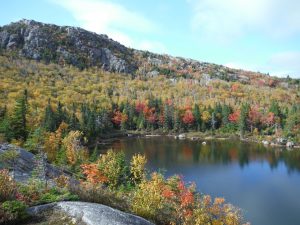
Shifting Seasonality: Consequences of the changing autumn season for Maine’s ecologically and recreationally valuable mountain ponds
Sponsor: Maine Water Resources Research Institute 2023 (104b)
Institution: University of Maine
Team Leader: Jasmine Saros, Professor of Paleolimnology and Lake Ecology, School of Biology and Ecology and the Climate Change Institute, University of Maine
Team Members:
- Sean Birkel, Assistant Professor and Maine State Climatologist, the Climate Change Institute and Cooperative Extension, University of Maine,
- Julia Daly, Associate Professor of Geology, University of Maine Farmington
- Amanda Gavin, PhD Student, Ecology and Environmental Sciences and the Climate Change Institute
- Rachel Hovel, Assistant Professor of Biology, University of Maine Farmington
Partners:
- Sarah Nelson, Director of Research, Appalachian Mountain Club
- Bryan Wentzell, Executive Director, Maine Mountain Collaborative
- Rex Turner, Outdoor Recreation Planner, Maine Bureau of Parks and Lands
- Kyle Warnock, Executive Director, Queerly ME
Mountain ponds are sentinels of regional and global environmental change and are recreational hotspots that contribute to Maine’s tourism economy; however, the strength of climate change in the mountain regions and its impact on the water quality and recreational value of these ponds remains unclear. Past climate trends indicate notable climate shifts in the region surrounding Maine’s mountains, particularly significant air temperature warming in July – October. These months capture the timing of two critical events for lake ecology: autumn mixing and the lead up to ice formation. The strength of autumn mixing and timing of ice formation may determine the availability of oxygen at the onset of ice cover and can impact ecological processes, including algae blooms, water clarity, and water quality within the lake for the following year.
This project will focus on nine mountain ponds (>600 m above sea level) in Maine that have over a decade of water temperature monitoring and over three decades of water chemistry monitoring. The ponds are critical water sources for hikers and backpackers traveling along the Appalachian Trail and other recreationally important areas in Maine. Many ponds are stocked with brook trout to support a backcountry recreational opportunity. The relatively pristine and wilderness setting of these lakes contributes to Maine’s reputation as a wilderness destination with an outdoor recreation industry worth 2.9 billion dollars. However, the conservation status of these ponds varies: two of the nine ponds lie completely outside conserved areas; and some ponds and their watersheds are entirely protected within conserved mountain ranges of ecological reserves.
The goal of this project is to bring together an interdisciplinary team of scientists and stakeholders to address the effects of climate change on mountain ponds. We have developed six diverse objectives that ultimately fit together to support science-informed conservation decisions. 1) A high-elevation weather station will be set up in one mountain pond watershed to evaluate the accuracy of high-elevation climate model for the region. 2) We will document changes in autumn lake mixing and ice formation trends over the past 10 years using historical water temperature data and examine the potential impact of autumn and winter lake changes on water quality. 3) To engage the broader community with this project, we will develop an inclusive and accessible citizen science initiative to inspire hikers to share photos of mountain ponds during the winter. These photos will be used to validate the ice formation dates inferred from water temperature monitoring. 4) We will map the conservation status of all 90 high-elevation lakes in Maine and 5) host a focus group with mountain pond stakeholders to learn more about conservation priorities for mountain ponds. 6) Finally, to put the lake changes of the past 10 years into perspective, we will collect diatom fossils from the sediment of one mountain pond and reconstruct lake thermal structure of the past 100 years.
Project Report
In Maine, mountain ponds are keystones of backcountry recreation and refugia for native, cold-adapted species (Nelson et al. 2021). This unique ecosystem has received scientific focus as sentinels of acid-rain (Gavin et al. 2018) and climate change (Nelson et al. 2021); however, the impacts of shifting seasonality on limnological processes remains unclear. Further, conservation partners in Maine identified that research-driven strategies are missing from mountain pond conservation. As such, this interdisciplinary project seeks to understand mountain ponds as a socio-ecological system and integrate climate-limnology research with a conservation gap analysis. Our synthesis of climate-limnology research demonstrates that rapidly changing autumn and winter seasons have implications for ecologically significant processes in lakes. Although we found that end of summer stratification and onset of autumn mixing are highly variable across lakes and driven by lake morphology and water clarity, ice-on was driven by November air temperatures and highly coherent. Extreme weather events, such as hurricanes, heat waves, and windstorms, drove anomalous thermal structure events. 15 photos from community scientists contributed to validating ice-on data from water temperature sensors. We found that 47 of the 90 mountain ponds lie within conserved or tribal-owned areas. In partnership with the broader Maine conservation community, we created a database and map of all mountain ponds and the respective watershed’s conservation status. This comprehensive data product is a valuable resource for both scientists and land-managers in Maine to inform conservation priorities based on identified vulnerabilities.
Products
- Maine Mountain Ponds. 2024. https://mainemountainponds.org/ice-phenology/. Developed by Hovel and Daly and UMF research assistants.
Presentations
- Amanda Gavin. Shifting Seasonality: consequences of the changing autumn season for Maine’s ecologically and recreationally valuable mountain ponds. Maine Sustainability and Water Conference. March 2024. Augusta, Maine. Academic, government, and resource manager audience.
- Gray, S.* and R. A. Hovel. 2024. Zooplankton sensitivity to climate-linked conditions in high-elevation lakes. Maine Sustainability and Water Conference, March 28, 2024, Augusta, ME. (poster). Academic, government, and resource manager audience.
Awards/Achievements
- Winner, best undergraduate poster award 2024 Maine Sustainability and Water Conference. Gray, S.* and R. A. Hovel. 2024. Zooplankton sensitivity to climate-linked conditions in high-elevation lakes. Maine Sustainability and Water Conference, March 28, 2024, Augusta, ME.