
High School Student Handbook
Aspirations and Concurrent Enrollment Courses
Welcome to Early College!
We’re so excited to have you join our Early College program! This opportunity gives you a head start on your college journey by allowing you to earn college credit while still in high school. Whether you’re taking classes online, on campus, or at your high school, you’re now part of a program designed to help you explore your interests, challenge yourself academically, and build confidence in your abilities.
Early College courses are real college courses, with the same expectations, rigor, and support you’d find as a full-time college student and more! By participating, you’ll learn how to manage your time, stay organized, communicate with professors, and navigate college systems, all while saving money and reducing the time it takes to earn a degree.
This guide is designed to help you navigate your Early College experience. Our team is here to support you every step of the way. From understanding how to register and access your course materials, to finding help if you get stuck, we’re committed to helping you succeed. This is your opportunity to experience what college is really like, and we’re so glad you’re here.
Let’s get started!
Kari Suderley
Director, Early College Programs
University of Maine
kari.suderley@maine.edu
Early College Program
The University of Maine has a long history of being a leader in supporting Early College programming. Our signature online program, Academ-e, launched in 2006.
Qualified students may earn a lifetime total of 18 tuition-free credits. They may take more than this at a reduced tuition rate. With an online portfolio of over 70 course offerings each summer, fall, and spring, students have the opportunity to engage in a wide variety of courses online and on campus.
All high school students must apply for their courses in our statewide application system that is shared by the University of Maine System (ExplorEC) and MCCS (OnCourse). Applications require the following items to be considered a complete application:
- Signed Student Acknowledgement
- Signed Parent Consent
- School Counselor recommendation with GPA listed and any documentation of prerequisites (Out-of-state students will have a separate form to provide to their school counselor)
- First-time home-schooled students must provide a transcript of previous coursework
Our Early College tuition rates are:
- Concurrent Enrollment: $60 per credit
- Online or campus: $155 per credit (as of Fall 2026)
Students who pay tuition to attend their high school, live outside of Maine, or go over their 18-credit cap are considered self-pay and pay the rates stated above.
Early College Benefits
The University of Maine Early College program truly values our high school students, and believes that their participation in Early College courses is an amazing opportunity providing them with countless benefits. Some of the main benefit reasons include:
- Getting a head start on college. Early College course credits go directly onto a student’s college transcript. These credits are also generally transferable to higher learning institutions outside of the University of Maine System.
- Increasing the likelihood of students graduating high school, enrolling in college, and earning a college degree. Our team has conducted years of research to verify student success and matriculation data.
- Enhancing curriculum options in high schools, especially in under-resourced areas. Students have course options available to them that they may not have otherwise.
- Providing opportunities to explore interests or fields of study before entering college. Through targeted programs such as our Early College Pathways, a specific set of courses focused on a particular career field or area of study, students explore interests with purpose and intentionality.
- Improving study skills, increasing confidence, and lessening anxiety about the transition to college.
- Lowering college debt. In taking advantage of tuition-free and/or reduced tuition credits, students have the opportunity to save themselves and their families a substantial amount of money.
- Earning dual credits on a college and high school transcript, for the same course. Concurrent Enrollment courses become part of a student’s permanent high school and college transcript. For other online or in-person course options, a student’s high school will make the final determination of it they will accept an Early College course onto the student’s high school transcript.
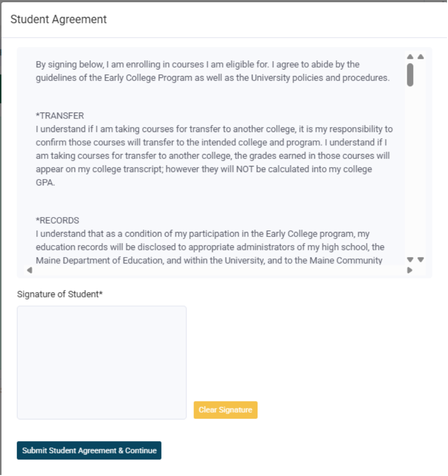
- Sign Student Agreement: The first item to complete is signing the student agreement. This agreement includes acknowledgment of university policies, including the Student Code of Conduct, Academic Integrity expectations, and Title IX policies. Students accept responsibility for their conduct and understand that violations may result in disciplinary action, including dismissal from university programs. The full text of this is found on the University of Maine system website.
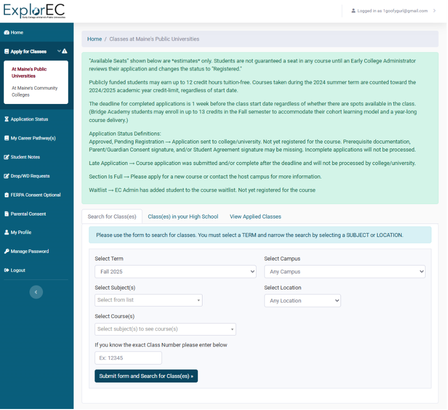
- Search for Course: After signing the agreement, students will be brought directly to the search page. They can also access this later by clicking “Home” on the side bar to go to the dashboard and “Apply for Classes”. Use the “Search for Courses” tab if applying for an online or in-person course. Use the “Classe(s) in your High School” tab if applying for a concurrent enrollment course taught through a high school.
- Select and Apply for Course: Find the intended course and check this off before clicking “Apply for Selected”. This will submit an application. Students can also confirm that they submitted their application by clicking on “View Applied Classes” and seeing their status as APPLIED.

There are some important steps in ExplorEC for students to complete before they are registered in their UMaine concurrent enrollment course. If they have any questions regarding these please reach out to our team at um.earlycollege@maine.edu.
- Parental Consent Sign Off: Student’s parent/guardian, listed when the application portal account is created, must sign off for their student to be registered in an Early College course. Parents/guardians acknowledge program expectations, student responsibility, and university policies as a condition of participation. The full text of this agreement is found on the University of Maine system website. This must be signed each semester a student applies for courses. Students cannot be registered for any course without their parental consent completed.
Navigate to the “Parental Consent” page through the homepage or through the navigation sidebar. On this page a student can either submit a parental consent request, which will automatically email a link to their parent/guardian, or they can navigate to “Sign Parent Consent” for their parent/guardian to sign this directly.
- Guidance Counselor Approval: The student’s high school guidance counselor, who is automatically notified of their course applications through the application portal, must also approve their course selection before they can be registered. Once they have approved a course, the application status will change from APPLIED to APPROVED, PENDING REGISTRATION .
- Registration and Course Completion: Once a course status has changed to REGISTERED, the student is enrolled in their UMaine Early College course.
The ExplorEC account is only used for applying for and dropping/withdrawing from courses. Once students are registered for a course they are assigned a System student account that they will use to perform activities related to their course. Before an account can be used it must be activated and this must be done right away because activation keys expire!
Once we register students for a course, we will send them the following email with activation instructions. These emails are sent weekly on Fridays.
Email Sender: ums.ec.activate@maine.edu
Subject Line: Time Sensitive – Activate Your UMS Account
Students need to activate their System account, which will allow access to the following:
- MaineStreet (External Site): Student Records (View and Request transcripts, View and Pay Your Bill, View System Admissions status)
- System Gmail (External Site): Official means of communication with System staff and faculty/instructors.
- System Campus Portal (External Site): Single sign-on access to all System resources.
- Brightspace (External Site): Online Classroom (For Courses Offered by System Faculty/Instructors)
This activation step is critically important even if a class is a concurrent enrollment course offered through a student’s high school. The concurrent enrollment course may involve accessing the platforms listed above in order to connect with the UMS resources available to the Early College student (ex. course evaluations and transcript records).
If students need further assistance with account activation, contact the IT Help Desk by phone (required) at 1.800.696.4357. For Help Desk hours and other resources please click here (External Site).
If students have questions about course registration or course content, please contact the host university Early College Office. Contact information for all universities can be found here (External Site).
If a student gets to the point where they no longer want to take an early course, started the course and realized that it is not what they expected, or found they aren’t performing as well as they had hoped, they may have reached a point where dropping or withdrawing from this course is the most responsible option.
We encourage students to discuss their desire to drop or withdraw from a course with their school counselor and/or parent. School counselors will be notified when students submit a drop/withdraw request, but their permission is not needed to process drops/withdrawals.
Engaging in the following behaviors will NOT lead to a drop/withdrawal and students will be given a grade of an F or an L (equivalent to an F) on their permanent transcript:
- Not attending the course in person.
- Not logging into the course online.
- Telling their school counselor or high school teacher they want to drop or withdraw.
- Telling their instructor they want to drop or withdraw.
- Emailing or leaving a message for the early college office.
Helpful Resources:
How to Find Drop/Withdrawal Deadlines in your MaineStreet Student Center: Step-By-Step Guide
How to Submit Drop/Withdrawal Requests through ExplorEC: Video Tutorial, Step-By-Step Guide, Automated Emails Related to Drop Requests
There is only one way to drop or withdraw from a course and that is by requesting it in ExplorEC (as shown below).
- Navigate to Drop/WD Request: Navigate to the ExplorEC Dashboard and click “Continue“ on the “Drop/WD Requests” button.
- Select Course: Select the course to drop or withdraw from using the drop-down menu.
- Explain Drop/WD Reason: Click on “Please explain why you want to drop or withdraw from the course*” field and enter a response.
- Submit Drop/WD Request: Once finished, click “Submit Request.”
- Successful Request: If submitted correctly, a green banner will appear that says, “Successfully submitted request. You will be notified when the request had been processed.” Once processed the course status will be changed on the student’s ExplorEC portal account.
Course Prerequisites
Some courses require students to take certain prerequisites to enroll in a specific course. Usually, the prerequisite(s) are listed with the course that the student is applying for and these listed prerequisite(s) must be met to enroll in the course.
Condensed Session Courses
Seven-week (or shorter) condensed session courses are not recommended for Early College students. High school Juniors and Seniors with a proven track record of success in previous college coursework may apply for these sessions. Due to the page and workload of these courses, students wishing to enroll in these sections will be required to sign up for and attend an online course prep session to ensure they fully understand expectations. Winter session courses are not available to Early College students.
Content Maturity
Within the Early College programs, we strive to provide our students with exceptional opportunities to take a variety of courses that may be of interest to them or that fulfill general education and academic program requirements. As such, students may be exposed to sensitive subject matter content which may include, but are not limited to, content that explored diverse perspectives and topics on race and ethnicity, gender, and gender-based violence, religion, politics, human sexuality, and various other topics of diversity, equity and inclusion. If students are not comfortable with being exposed to the materials or viewpoints as described in the syllabus or assigned content, we encourage them and their family to make independent decisions about continuing enrollment in the course.
Career and Academic Program Advising
Early College students may request Career and/or Academic Advising through the UMaine Early College Program. UMaine Early College has a designated Early College Advisor to assist students with reaching their post-secondary goals. They offer services such as course and pathway planning, prep sessions before the start of the term to make sure students are set up for their course(s), and can provide resources such as connections with tutoring services or college admissions representatives.
UMaine Early College Pathways
Early College Pathways consists of a specific set of courses, approximately 16-18 total credits, focused on a particular career field or area of study, along with core curriculum courses. Pathways are designed to align to majors, careers, and general areas of study that students may be interested in, allowing them to explore those interests with purpose and intentionality though Early College. These pathways are optional and it is not required for the student to complete a pathway. More information on UMaine Pathways including what is available can be found on our Pathways webpage.
Students can utilize a number of UMaine’s student resources for free! These resources can be found on our UMaine Early College webpage: Early College Student Resources.
- Academic Support
- Math Prep
- Library: Raymond H. Fogler Library at the University of Maine is the largest research library in Maine. With your access though UMaine, you can use this resource for your college and high school coursework. Access these resources on the library webpage.
- NetTutor: NetTutor is an online tutoring service we provide for free to Early College students. Log on for 1-on-1 video tutoring, submit a simple question, or get a paper reviewed. Available 24 hours a day/7 days a week. Learn more on the System Early College webpage.
- Writing Centers: Assistance on writing projects through in-person, zoom, or email.
- IT
- Student Accessibility Services: Some of the services provided or coordinated for students with disabilities include testing accommodations, note takers, ordering alternate format texts, classroom relocation, and advisement on disability issues. Learn more on the SAS webpage.
- Student Life and Experience Resources
- MaineCard
- Parking Pass: If you are attending a live course on campus and will need a parking pass, please contact Parking and Transportation Services at: um.parkingservices@maine.edu.
- College and Career Advising
- UMaine Early College Adviser: Learn more about connecting with the UMaine Early College Advisor on our webpage.
- JMG (Jobs for Maine’s Graduates): High School students who have used JMG will also have support available as UMaine undergraduate students.
- Let’s Get Ready: A text-based peer mentor program for high school students to assist them through the college application process. Students entering their junior year of high school are automatically enrolled in the program. Students may opt out, but this is strongly discouraged due to the benefits of the program.
- Policy
- Title IX: Information on laws and federal guidelines, university policies, filing a report, and external resources.
- Student Conduct Code
- Academic Integrity
- Guide to Early College Lingo
- System Early College Webpage
Early College & University Policies
Academic integrity is based on honesty. All students of the university are expected to be honest in their academic endeavors. All academic work should be performed in a manner that will provide an honest relfection of the knowledge and abilities of each student. The University of Maine System Academic Integrity Policy has listed out the specific and uniform standards of academic integrity that will apply to all courses on all universities within the system.
The Americans with Disabilities Act (ADA) prohibits discrimination against people with disabilities in employment, transportation, public accommodation, communications and governmental activities. The ADA also establishes requirements for telecommunications relay services. The Act has since been amended by The Americans with Disabilities Act Amendments Act of 2008 (ADAAA) that redefined disability and instituted several other provisions.
The University of Maine Office of Equal Opportunity ensures access for people with disabilities to the academic, employment, and cultural life of the University. It is important to note that the laws and procedures that govern support for students with disabilities are different in college than in high school. Colleges do not offer special education, rather they provide accommodations. An accommodation is any change in the learning environment or in the way things are customarily done that enables a person with a disability to have equitable access to the University experience.
At UMaine, Student Accessibility Services is the department which is responsible for providing necessary accommodations to students and disabilities in accordance with ADA. Students may request accommodations for the course(s) each semester. Students are encouraged to request accommodations early once they know their schedule for the upcoming term, since this process can take up to several weeks to implement. You can learn more about the accommodations process here.
Students who are not eligible for Maine Department of Education Aspiration funding due to student ineligibility or excess credits are responsible for tuition costs in addition to any course-specific fees, including textbook costs. Starting with the Class of 2027, qualified students may earn a lifetime total of 18 tuition-free credits. All excess credit costs will be charged at the current discounted Early College rate. Students are also responsible for textbooks, any required course materials, and course-specific fees (as applicable). All charges that a student incurs for participation in Early College are expected to be paid by the last day of their course. Refer to the System Bill Payment Instructions for further details on how to pay a bill.
A complete application in ExplorEC needs the following components: Parental Consent, Guidance Approval, and Student Agreement. By signing these agreements, the parent and the student agree to abide by the guidelines of both the Early College Program and University policies and procedures. This includes course transfer, grades, tuition & fees, course content guidelines, drop/withdrawal policies, conduct, and more. Copies of these agreements can be found on the University of Maine System Early College webpage for your reference.
Family Educational Rights and Privacy Act protects all of a student’s educational records and Maine’s public universities will not release information to parents or others unless FERPA consent is granted by the student for each individual within their ExplorEC account. After the student has completed this authorization, it will remain in effect until it is revoked. Once signed, it will authorize Early College personnel throughout the University of Maine System to release information to the authorized individual(s) regarding the student’s educational records.
All colleges must follow federal financial aid rules. Many Maine students attend college using Pell Grants and/or federal loans. While most early college activity has no real impact on financial aid, students and families should be aware of these areas:
- Satisfactory Academic Progress:
- Grades: Failing or withdrawing from too many courses can impact the student’s financial aid eligibility if they continue at the college where they earned those grades
- Courses: Taking too many courses outside of a college program will limit financial aid eligibility
- Full-Time Enrollment:
- Taking too many courses that fill general education requirements may limit the student’s ability to be full-time once they get to college, which may limit financial aid eligibility
The University of Maine uses a letter-grade system ranging from A to F. Faculty members have the option of adding + (no A+) and – grades to the basic letter grades. There is no University-wide grading scale. Each instructor determines the points or percentage associated with each letter grade and provides this information in the course syllabus.
The qualitative value of the five basic letter grades is defined as follows:
A = Excellent work.
B = Good work.
C = Satisfactory work.
D = Poor work that does not adequately prepare students for more advanced work in the discipline. Grades of D contribute to total credit hours earned but may, or may not satisfy course prerequisites and/or graduation requirements for majors, minors or other academic programs.
F = Failure. No credit is earned for a failed course.
Final grades must be entered in MaineStreet by professors within 2 weeks of classes ending for the semester. Note: Early College offices are not responsible for grades not entered in a timely manner by instructors. Grades for concurrent enrollment courses will be available on a student’s high school transcript. If students need their grades sooner, they can view them any time after they are posted by logging into their MaineStreet Student Center. Additional details regarding this can be found on the University of Maine Early College webpage: Grades Policy.
Considerable care is taken to ensure that grades entered on a student’s permanent record are accurate. Any student who suspects that an error has been made should take up the matter with the Registrar within six months of the completion of the course. Any student may appeal a grade by contacting the instructor. If this does not produce satisfactory results, consult the Student Handbook on the UMaine website for detailed grievance procedures.
Whether or not credit for a college course will be awarded towards a student’s high school diploma is at the sole discretion of the student’s high school. Students should check with their school counselor or school administration to determine if a course counts toward high school graduation.
Under the DOE High School Aspirations Tuition Waiver Program, the majority of courses taken through Early College are guaranteed to transfer within the University of Maine System and Maine Community College System. The way transfer courses reflect on a student’s transcript depends upon the degree program the student has chosen to take. Please note that transfer is not guaranteed at private or out-of-state colleges and universities.
The Maine Department of Education(DOE) Aspirations program will now cover the cost for students to retake a course if they earned a D, F, W, or L grade (once per course). Having a failing grade on a college transcript can have several implications including college application, and federal financial aid, and it means that they start their college journey on academic probation. This policy requires students to remediate their F or L grade to prevent the above-mentioned consequences. Further details of this policy can be found on the University of Maine System Early College webpage: Course Retake Policy.
Students can request a transcript by contacting an individual university or by using their University of Maine System MaineStreet account. It is the student’s responsibility to confirm that courses taken at another institution will transfer to their intended college or program. Refer to the instructions on how to view/request transcripts using an active System account on the System Early College Transcripts page. Students can also request their UMaine transcript from the registrar’s office.
Early College students are expected to adhere to the University’s Student Conduct Code. Please refer to the link to the full Student Conduct Code.
UMaine prohibits discrimination based on sex, and so we have a number of policies in place that prohibit discrimination, procedures to address any instances, and measures to prevent recurrence. Title IX is a general term used to refer to several laws and federal guidelines that pertain to discrimination based on gender. More information on University Policies, Filing a Report, and more is on our UMaine—Title IX Information webpage.
Questions?
Email um.earlycollege@maine.edu.