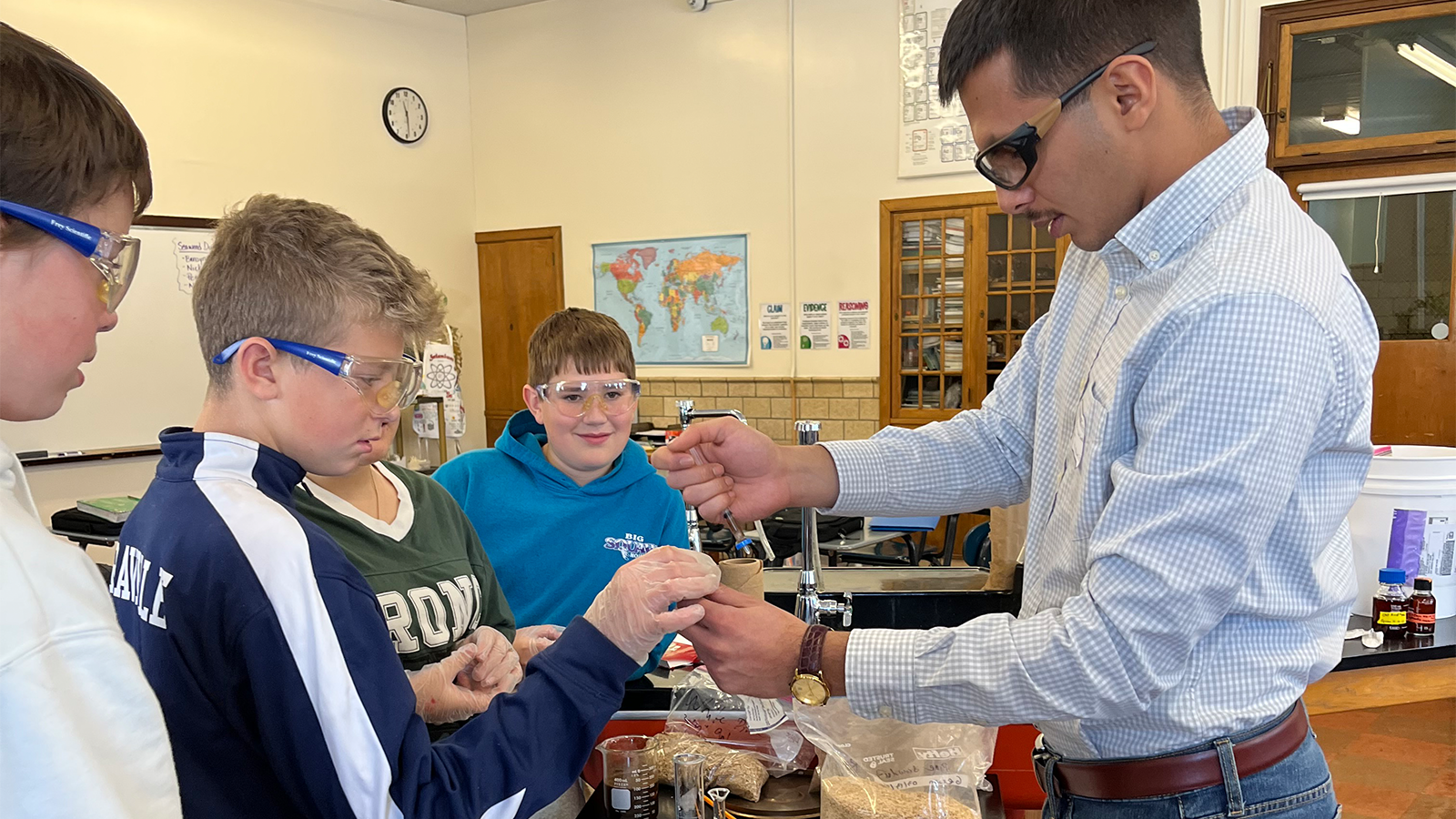
As a leader in bioproduct development, researchers at the University of Maine are constantly developing new and innovative ways to use wood and wood byproducts as stronger, more sustainable alternatives to traditional materials. Ehsan Ullah Sardar, a Ph.D. student with the National Science Foundation’s Maine-FOREST project, is part of this effort.
After earning his chemical engineering degree in Pakistan in 2018 and spending several years working in industry there and in Saudi Arabia, Sardar began to rethink what he wanted from his career. Watching former classmates leave for graduate school in the United States, he decided to apply as well. He dedicated to come to UMaine for an opportunity to work on a research project closely aligned with his undergraduate capstone.
“I originally came here just to do a master’s and then get a job, but I was having so much fun with the work that I decided to stay and do a Ph.D,” he said with a smile.
Sardar’s project focuses on developing new ways to make cellulose nanofiber directly from wood and other biomass, starting from raw material instead of purchased pulp. This can be utilized in thin film packaging and bio composites.
“Lignin is like a binding matrix that holds the tree together. We are trying to see what impact would lignin have on the properties of cellulose nanofiber,” explained Sardar.
He is testing how keeping more lignin, the natural glue in wood, changes the properties of cellulose nanofiber and how these lignin‑rich fibers can be blended with common plastics to create stronger, more sustainable composite materials.
To test that, he prepares cellulose nanofiber from three different sources and compares how each behaves.
Sardar’s process begins with raw biomass, different kinds of wood and recycled paper products, which he converts into different pulp using equipment at UMaine’s pilot plant in Old Town. From that pulp, he produces cellulose nanofiber and deliberately keeps varying the amount of lignin to study changes to the fiber’s properties. He repeats this with three feedstocks: pulp he makes directly from wood, material supplied by TimberHP (a Maine‑based manufacturer of wood‑fiber insulation) and recycled cardboard from a paper mill, then compares the resulting nanofibers. Finally, he blends these different cellulose nanofibers with plastics such as polypropylene (PP), polyurethane (PU), and polylactic acid (PLA) to create and test composite materials that aim to be both stronger and more sustainable than conventional plastics.
“The challenge comes down to chemistry: bleached cellulose nanofiber is hydrophilic and attracts water, while plastics like polyethylene are hydrophobic and repel it. That mismatch keeps the fibers from dispersing evenly and bonds weakly with the plastic, resulting in poor properties of the bio composites. We are trying to incorporate lignin-containing cellulose nanofiber to address this challenge and enhance the properties of bio composites,” explained Sardar, “We want to use cellulose nanofiber to improve the properties of plastic, and then we are using that lignin that was derived during my reactions to give it a much better coupling.”
Because there are so many possible combinations of fiber source, lignin content and plastic type, he is also collaborating on an artificial intelligence component to guide experiments. Under the supervision of his advisor, Assistant Professor Chemical Engineering Sampath Gunukula, Sardar is working with fellow graduate student Md. Hafizur Rehman, Assistant Professor of Electrical and Computer Engineering Prabuddha Chakraborty, Professor of Renewable Nanomaterials Mehdi Tajvidi and Director of UMaine’s Process Development Center Dr. Colleen Walker to incorporate artificial intelligence and machine learning models into his project, so that known material properties can be used to predict promising biocomposite formulations instead of relying only on thousands of trial‑and‑error experiments.
In addition to his lab work on lignin‑containing cellulose nanofibers and polymer composites, he helps design and lead “lab to classroom” activities that bring simple versions of his biomass experiments into school science classes. Sardar is committed to making sure younger students can see themselves in science and engineering.
“What we’re trying to do is educate the next generation about STEM, especially engineering and let them know that chemical engineering, and a place like UMaine, are actual options right here in Maine. If they see that early, staying in Maine to build a future in it becomes a real option, not something they have to leave the state to find,” said Sardar.
For him, those classroom visits are as energizing as any breakthrough in the lab. Many of the students initially think of wood only as fuel or as something you build cabinets with.
Through his activities, he wants to broaden that view and show them that wood can also be turned into sustainable products, biofuels and other advanced materials.
Hopefully, as sustainable materials advance and awareness grows, more people, especially children, will develop a mindset that values caring for the planet.
By Yoana Karageorgieva, research media intern