Celestial Fish ’25 thought she had her future mapped out after high school. She started architectural engineering at Southern Maine Community College, what she said was the logical next step. When burnout set in, Fish took a break from school. Then the COVID-19 pandemic hit, and she decided to spend a year in Alaska taking outdoor leadership classes.
Along the way, she rediscovered a part of herself that she had nearly forgotten.
“When I was a kid, I loved the ocean. I was always saying to everybody I was going to be a marine biologist when I grew up,” Fish said. “But you’re like five or seven or 10 at the time, and it goes on the back burner.”
At the University of Maine, Fish found a way back to the ocean and the chance to explore the kind of future she once imagined.
The UMaine campus is about an hour from the coast — an unlikely location for a marine sciences hub. But that distance and region-leading affordability is exactly what gives the program an edge.
As early as the spring semester of their sophomore year, students can live, study and conduct research at the Darling Marine Center in Walpole. Their learning grounds are far removed from busy tourist beaches and urban waterfronts. The center sits on a quiet stretch of the Damariscotta River, where students can see the ocean from their dorms and access research vessels, laboratories and field sites.
These experiences reflect UMaine’s commitment to learner-centered R1, hands-on, real-world research learning opportunities, where undergraduate students work directly with faculty and industry partners to tackle challenges facing Maine communities.
Maine’s coast may not be the warmest, sandiest or most biodiverse, but it offers something equally valuable: a resilient working waterfront and seasoned blue economy. Students learn to conduct research in demanding conditions — from diving in icy waters to studying marine life adapted to one of the North Atlantic’s most dynamic environments.

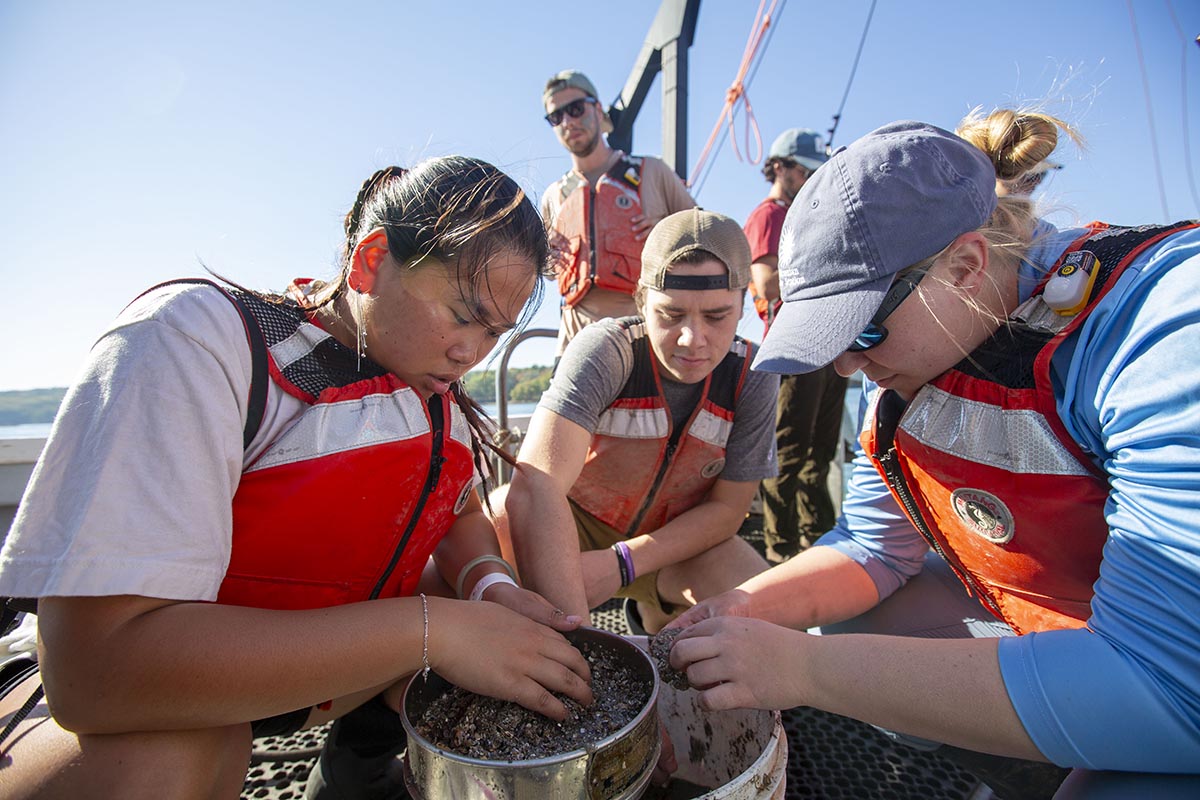

That environment was both unfamiliar and transformative for Emily Stricklin. Growing up in the Midwest, Stricklin said her experiences with the ocean were limited to the occasional family vacation. But she embraced the opportunity to step outside her comfort zone.
Stricklin, like Fish, saw her future in a new light when the pandemic hit. She was living in Chicago at the time and pursuing musical theatre. The city’s dense population fueled strict restrictions and indoor isolation.
“I decided that I wanted to work outside for the rest of my life,” Stricklin said. “I wanted to be in nature, where I’m happy, where it’s peaceful, and I wanted to make a difference in working there, not just to be in it, but to help.”
Once she got to UMaine and started the marine sciences program, associate professor of chemical oceanography Margaret Estapa hired her to be a research assistant. Estapa’s lab is where Stricklin first began tackling microplastic pollution and where she decided to make the switch from marine biology to oceanography.
Her proximity to the ocean during Semester by the Sea has helped her pursue her own active research in the field. She’s exploring whether spectrophotometry, a study that measures how light interacts with substances, is a reliable method of detecting microplastics in the ocean and whether temperature has an effect on their presence.
“It’s very hands-on and very immersive down here (at the Darling Marine Center), which I really like. You get a lot of experience and build a lot of skills very quickly,” Stricklin said.
Building a coastal community
In addition to research projects and courses, Semester by the Sea students can participate in group trips and activities planned and led by program coordinators. After spending two semesters in the program, Fish worked as its residential coordinator during the fall 2025 semester after she had graduated that May. She and the students went to an apple orchard, corn maze and botanical garden with holiday lights and spent a day on the open ocean in a sailboat.
But Fish said those activities aren’t what really bond the students together. It’s more about the day to day experiences.
“You’re such a small group, and the way that your day is structured: you eat every meal together; you have all the same classes together. You get really close, really fast,” Fish said.
That makes the outings, the research and the experience as a whole more impactful.


Wge Ellis has been a part of the School of Marine Sciences for nearly 23 years. Now the associate director of the school, he has helped grow enrollment in Semester by the Sea from about 10 students to over 30 in the fall semesters. UMaine’s College of Earth, Life, and Health Sciences established the undergraduate marine sciences program in 1996. Just two years later and with support from the college, the Darling Marine Center began building a dormitory and dining facility — Brooke Hall — as a way to bring students to the coast. Semester by the Sea started shortly after that.
“We don’t have the ocean in Orono, but because we don’t, we’ve created something pretty unique, pretty special, for a whole semester,” Ellis said.
Faculty members don’t worry about what time of day high or low tide is. Class meets for a whole day, and students get unlimited access to a range of coastal ecosystems, from the three miles of hiking trails on campus to an entire river estuary. Coursework spans oceanography, ecology, aquaculture, scientific diving and data analysis, while ongoing research includes exploring fish diets, kelp forests, microplastics, life cycles of scallops and larval lobsters.
“You will get more hands-on experience and time in the field in one semester than some of these institutions on the coast will give you in four years,” Ellis said.
The School of Marine Sciences offers scholarship funds to help students participate in the program.
Fueling Maine aquaculture
Some of the first UMaine graduates who studied at the Darling Marine Center as graduate students went on to launch oyster aquaculture businesses along the Damariscotta River in the 1970s. Today, the river produces roughly 80% of Maine’s oysters and supports a thriving aquaculture industry.
Through Semester by the Sea, students are able to work alongside many of these companies while completing their coursework. According to Ellis, the experience often convinces students — many of whom come from out of state — to stay and build careers in Maine’s aquaculture industry.
That was the case for Katie Conklin, a marine sciences student from Connecticut. An aquaculture systems course she took her junior year in Orono helped her land a summer internship with Mook Sea Farm, an oyster hatchery on the Damariscotta River. Conklin continued working with the company as a part-time hatchery assistant during her senior year while participating in Semester by the Sea. After graduating, she will remain with Mook as a full-time hatchery technician.
While living at the Darling Marine Center, her work and proximity to the river estuary has also informed her senior capstone project, which is exploring the impact of nearby oyster hatcheries on wild populations of oysters. She, like all students who take part in the spring semester of the program, will get to witness the coastal ecosystem — and young wild oysters — emerge from winter dormancy.
Leadership is brainstorming options for summer programs that could integrate internships directly into coursework, strengthening connections between the classroom and the state’s aquaculture industry.
For students like Conklin, Fish and Stricklin, the program offers more than hands-on research experience. It opens pathways to careers along Maine’s coast and the chance for students to pursue their own blue horizons.

Contact: Ashley Yates; ashley.depew@maine.edu