The National Science Foundation’s Established Program to Stimulate Competitive Research (EPSCoR) aims to increase research capacity and geographic diversity in STEM fields, enabling broader participation by individuals, institutions, and states and territories. At the University of Maine, EPSCoR grants have enabled new projects and research opportunities centered on the state’s unique natural resources and socioeconomic attributes, with a strong emphasis on the forest sector. Since 2008, Professor of Forest Biometrics and Modeling and Director of the Center for Research on Sustainable Forests Aaron Weiskittel has championed these programs at UMaine and, throughout his career, has demonstrated how EPSCoR projects dynamically build on past work to benefit the state. At the core of his work is the intersection of data science and forest management, creating new ways to analyze forests, the sector, and communities that inform pathways to beneficial economic growth and sustainable forest management.
As the country’s most forested state, Maine requires a multifaceted approach to resource management. Forests must be managed to sustain growth while allowing timber and other wood products to be harvested. Weiskittel first became involved with EPSCoR in 2008, when he began his affiliation with the Forest Bioproducts Research Institute (FBRI) at UMaine. FBRI was established in 2006 as part of an EPSCoR grant to advance Maine’s progress in the bio-economy by leveraging forest products. A large part of Weiskittel’s work there focused on reframing the narrative on these products.
“One of the challenges that we face with the forest sector is just people. People don’t really like seeing trees harvested, and I think we’re all taught at an early age that cutting a tree is a bad thing. So I think a lot of what we deal with is not necessarily technical issues, but more societal and policy issues,” said Weiskittel.
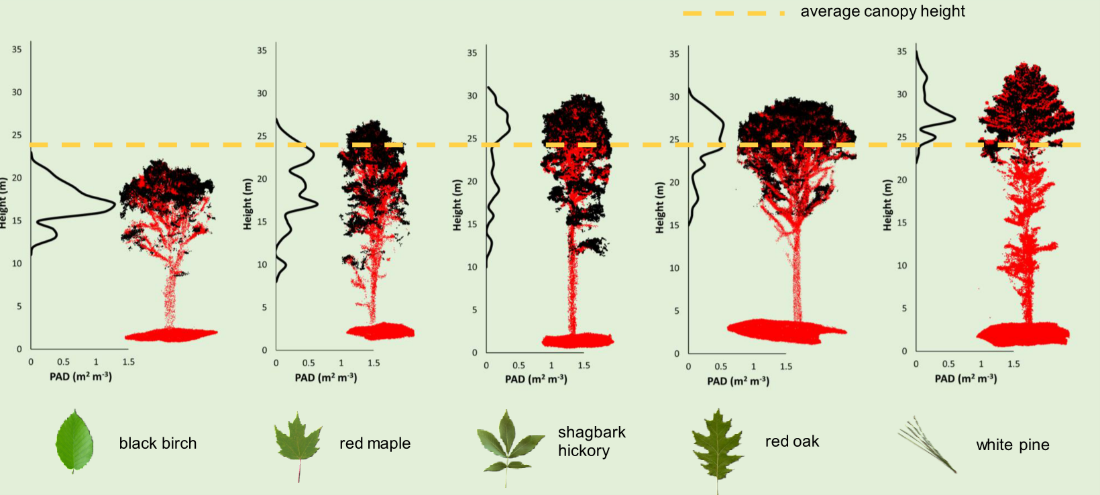
More recently, Weiskittel led the multi-institutional NSF EPSCoRTrack-2 INSPIRES project, Leveraging Intelligent Informatics and Smart Data for Improved Understanding of Northern Forest Ecosystem Resilience (Award #OIA-1920908), which laid the groundwork for cross-disciplinary forest management and increased regional capacity. As a Track-2 grant, INSPIRES highlighted the value of collaboration with regional partners, enabling Maine to share expertise and learn from other jurisdictions. Awarded in 2019, INSPIRES fostered collaboration among Maine, New Hampshire, and Vermont, with a focus on strengthening relationships with similarly forested states that have a vested interest in the forest sector. A key aspect of this work was increasing monitoring efforts by developing new technologies. The INSPIRES project team furthered this task by developing new remote sensing technologies to assess forest conditions in real time and by creating models for future use. Remote sensing is an important tool for forestry, as it provides easier access to data. Many research sites are densely forested and lack cell service, making on-site data collection challenging. The challenge of data collection and the use of new technologies in forestry is part of Weiskittel’s current work with Maine-FOREST, an EPSCoR project that began in 2024. This research track, along with his prior work with FBRI, has led Weiskittel to consider how Maine can better conduct research, prepare for changing forests, and optimize output.
The culmination of Weiskittel’s previous work with UMaine EPSCoR grants is manifested in his role as primary investigator and manager of the NSF E-RISE Maine-FOREST project (Award #OIA-2416915). Maine-FOREST highlights research on emerging technologies in the forestry sector that grow Maine’s capacity to measure and manage important aspects of forests. This grant is dedicated to advancing Maine’s forest-based economy through four intersecting themes: Environmental AI, Cellulosic Nanomaterials Bioproducts, Rural and Tribal Resilience, and Smart Rural Development. With this project, a diverse team of researchers across the state is working together to increase Maine’s position as a leader in forest-sector technology and innovation.
“The overarching goal is, how do we do this in Maine? How do we take disruptive technologies like AI and some emerging uses of wood fiber to make new products, and how do we do that within the context of doing that in Maine? We’re dominated by a lot of rural communities, as well as the number one challenge that everyone in the state seems to be having, which is workforce development,” said Weiskittel.
Currently, Weiskittel is helping UMaine embark on a new, exciting chapter in forestry. The university is a finalist for place-based development and research under the NSF Engines Initiative. “This is a bold, new program for NSF, which is very interested in research that is relevant to the local economy and the state itself,” said Weiskittel. The Engine program awards a sizable investment to institutions working to improve their state through economic development and research aligned with a specific theme. UMaine is one of 15 finalists nationwide to advance to the final round of the program.
The mission of UMaine’s engagement in the Engine program continues all of Weiskittel’s work, “It’s the integration of our emerging new products, technologies, and AI, which are really going to drive the management of our forest, at the same time it’s developing and expanding the use of invaluable tools like LiDAR and other remote sensing platforms,” said Weiskittel. Along with related programs under UMaine’s Center for Research on Sustainable Forests and Weiskittel’s past work and continued efforts to better Maine’s forest sector, the future is bright and growing.