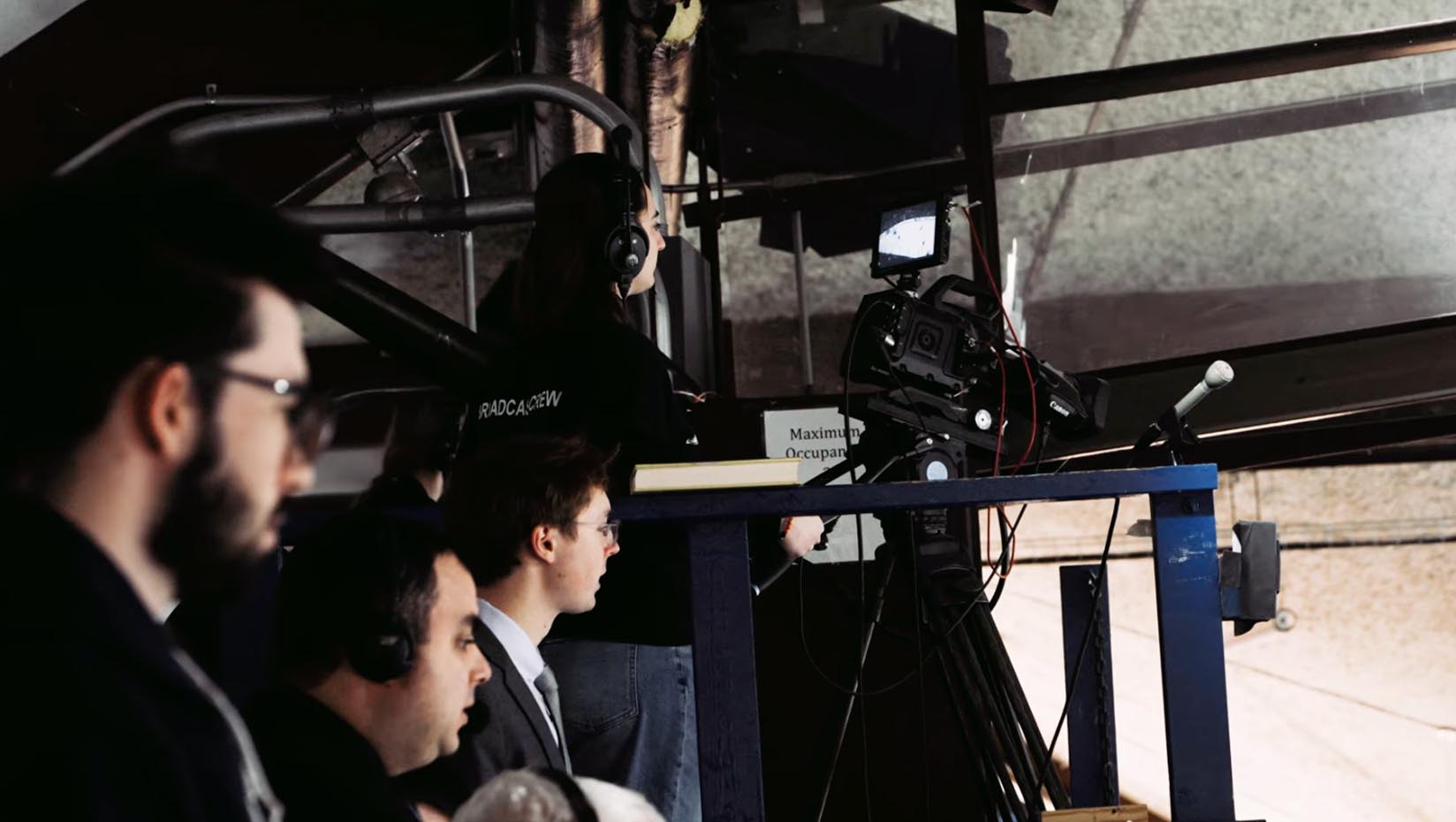
The puck drops, the crowd erupts and the game moves in a blur. High above the ice at Alfond Arena, a student camera operator tracks the play, anticipating the next pass, the next shot, the next moment viewers will see.
For the students behind the scenes of University of Maine hockey broadcasts, there is no pause button.
At UMaine, those moments are not captured by professionals alone. Students run the cameras, manage audio, cue replays and help shape a live broadcast seen far beyond Orono. The production doubles as a training ground, placing students in real-time roles that mirror the demands of professional sports media.
Most UMaine hockey games are broadcast on ESPN+, giving students experience producing content for a national audience and reinforcing the university’s commitment to learner-centered education.
“When I’m on camera, I get really into the game because you’re following the shot, so you have to be,” says Emma Beauregard, a student camera operator from Bath, Maine. “You might notice on my camera shots they’re often shaking after a goal because I’m so excited.”
For Beauregard and others, the role blends instinct and emotion with technical precision. Operators track the puck, anticipate where the play is headed and quickly find the player who scored — all in real time.
That intensity is part of what draws students in.
“It’s probably one of the most fun jobs I’ve ever had,” says Thomas Bubniak, also a student camera operator from Jefferson, New Jersey. “It’s just been a blast. Every year I get to do a lot of really cool stuff.”
What looks effortless on screen is anything but.
Behind each broadcast is a coordinated production involving camera operators, replay, audio and commentators — many of them students — working together under constant time pressure.
“There’s just so much more than just the video,” says Marissa Tripp, UMaine’s broadcast and video production assistant. “There’s audio, there are commentators. There are so many people involved.”
Tripp says many students do not realize the scale of the operation until they are part of it. The experience goes beyond learning equipment; it requires thinking like a member of the production team and making decisions in real time.
“It’s a live show, so anything can happen,” she says.
That responsibility is part of what makes the work meaningful. Students are not just filming plays, they are shaping how fans experience UMaine hockey, especially those watching from home.
“It’s nice to think that the shot I’m seeing, that I’m so excited about, is also making other people excited, too,” Beauregard says.
For Bubniak, the atmosphere inside Alfond Arena — particularly in the student section — adds another layer to the experience.
“There’s really nothing quite like doing that,” he says. “It’s loud. The energy up there is great.”
Capturing that energy and translating it for viewers is at the heart of the broadcast.
Ryan Loeffler, assistant athletic director for broadcast and video production, says that focus is intentional. Students are expected to produce work that meets professional standards while gaining real-world experience.
“I do my best to teach my students the standards that I was taught with,” Loeffler says. “I really love inspiring the next group of sports producers and directors.”
He says the goal is not just to document the game, but to recreate the experience for those watching at home.
“I do my best to bring that experience to their living rooms,” he says.
For those behind the camera, the reward is not just the experience — it is knowing their work shapes how the game is seen, felt and remembered.
“A lot of times fans are created when they come to the game,” Tripp says. “But to stay a fan, the broadcast helps keep that going.”
Contact: David Nordman, david.nordman@maine.edu