University of Maine
Commencement
May 2026
Jump to…
Graduate School Ceremony Speakers

Amber Boutiette ’17G and Patrick Breeding ’19G
Co-founders of Marin Skincare
Amber Boutiette and Patrick Breeding are sharing their journey from graduate students to business owners at the 2026 University of Maine Graduate School commencement ceremony, which recognizes students who earned doctoral, master’s and education specialist degrees, as well as certificates of advanced study.
Graduate students spend years taking courses, completing research and passing exams, but the most important thing they gain is not reflected on a transcript. For Breeding, it was about learning how to learn — how to seek new information, take it in and understand it.
He and Boutiette earned bachelor’s and master’s degrees in biomedical engineering from UMaine in 2017 and 2019 before going on to launch their business one year later. Since 2020, Marin Skincare has grown into a national brand, expanding its product line and forming retail partnerships with companies including L.L.Bean and Sea Bags.
“You have no idea where you’re going to go or how much you’re going to grow,” Boutiette said. “It’s such a beautiful, scary and exciting part of life.”
Marin was born from research Boutiette and Breeding conducted as students with Lobster Institute faculty members on marine glycoproteins, a natural byproduct of lobster processing used in skincare to help repair the skin barrier.
Breeding said their biomedical engineering program taught them how to think first with principles, see from the bottom up and understand how all parts work together. Boutiette echoed that perspective, saying their UMaine education taught them to break down complex challenges and apply knowledge across disciplines.
Their path to entrepreneurship was not linear. As students, they explored multiple ventures and immersed themselves in UMaine’s startup ecosystem, supported by mentors and programs that encouraged innovation and experimentation.
That mindset continues to guide how they define success and what they hope to share with graduates.
“Curiosity is the most important thing,” Breeding said. “There’s value in stepping back and asking, ‘Who do I want to be? What do I want to do?’”
Boutiette encourages graduates to trust both their training and themselves, to use the skills they’ve learned and their intuition.
Undergraduate Ceremonies Speaker
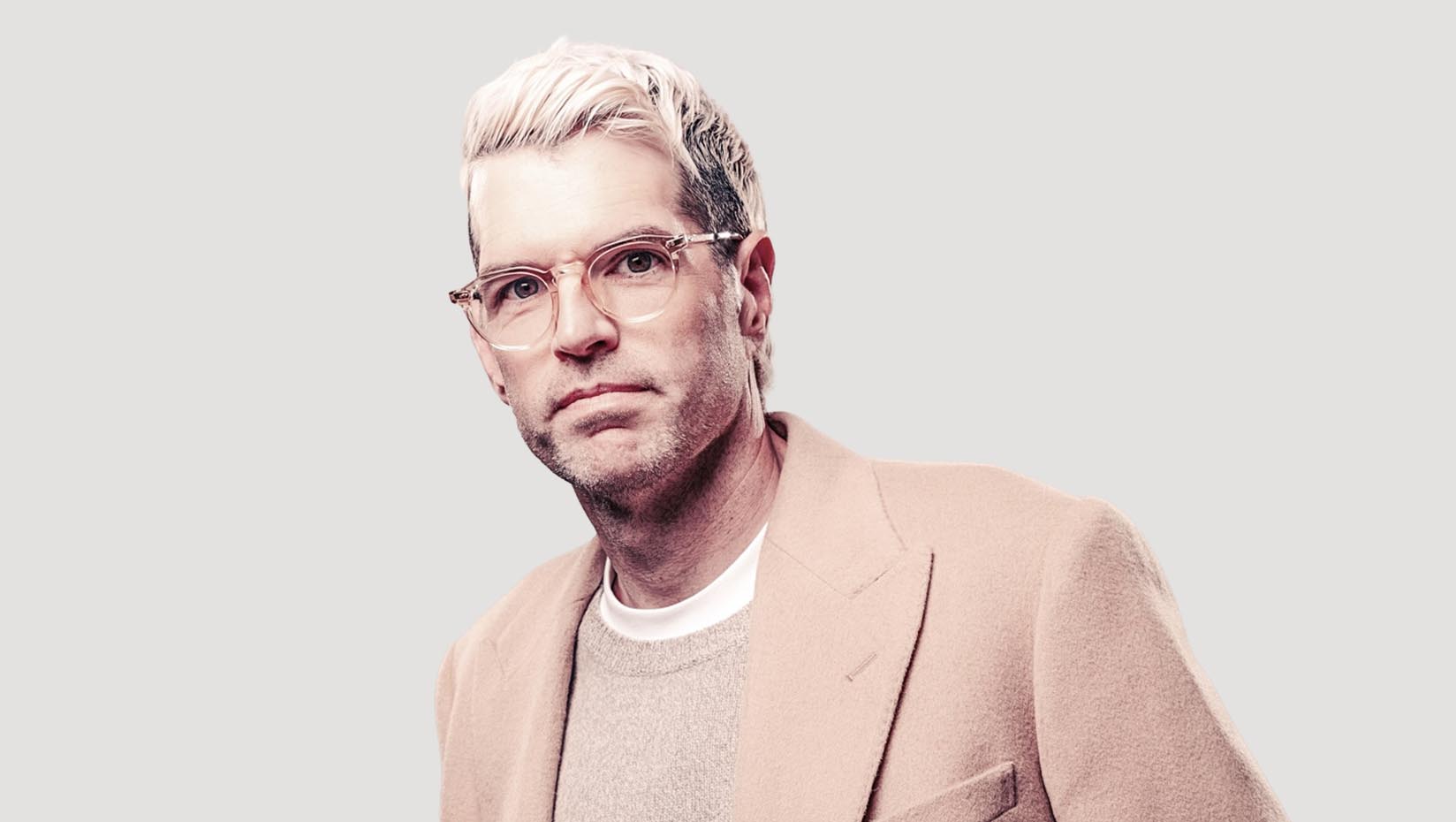
Timothy Simons ’01
Actor
Having spent much of his career delivering lines on television and film sets, actor Timothy Simons will take a different stage this spring as the University of Maine’s 2026 undergraduate commencement speaker.
For Simons, a 2001 UMaine graduate and native of Readfield, Maine, the invitation carries personal meaning.
“UMaine is where I found theater,” he said. “I wasn’t an actor in high school.”
As a student in Orono, Simons discovered both the Division of Theatre & Dance and a creative community that helped shape his career. He said working with the late theater professor Sandra Hardy played a pivotal role in his development as an actor.
“That’s where my love of theater and acting first started,” Simons said. “I can kind of connect every dot of where I am now to being at UMaine and stumbling across the theater department there.”
Simons studied theater at UMaine before building a career in television and film. He is best known for his role as Jonah Ryan on HBO’s political satire “Veep,” which ran for seven seasons and won multiple Emmy Awards. More recently, Simons received a Critics Choice Award nomination for best supporting actor in a comedy series for his role as Sasha in the Netflix series “Nobody Wants This.”
He has remained connected to the university and helped establish the Sandra E. Hardy Theatre Scholarship Fund, which honors his former professor and supports theater students.
Looking back on his time in Orono, Simons said he appreciated the mix of a large public university and a close-knit campus community, one full of students with a wide range of interests.
“They always say that as actors you have to know a little about a lot of stuff,” Simons said. “Having access to people whose interests were completely opposite of mine was always really fun.”
From Simons’ time to now, the campus community — despite its ranging interests — finds ways to connect, including what Simons called the first day of spring when temperatures finally reach the mid-40s. He recalled everyone walking around in shorts, in a good mood, skipping class to gather on the mall, finally out from under the “boot of winter.”

[background music]
Ron Lisnet: Welcome to “The Maine Question” podcast, from the University of Maine. We are doing something a little bit different for this episode. We are in the Cyrus Pavilion Theater on the campus of the University of Maine, where a lot of theater productions and classes happen. We’re going to switch it up a little bit for this episode.
I’m here with Allen Adams from the School of Performing Arts and from the College of Liberal Arts and Sciences.
Allen, we had a chance to catch up with one of the more up-and-coming famous alums, you have to say, from the university, Tim Simons, class of 2001, who is making a name for himself in the TV and film industry. He’s going to speak at commencement this year. Boy, it was a fun time talking to him.
Allen Adams: No, it was really great. It’s really exciting to have someone like Tim come back and address the student body in general. I think it’s particularly nice for our School of Performing Arts students to get a chance to see someone who has been in the same classrooms and walked the same hallways that they have, who has gone on to really significant success in the industry.
Ron: Tim Simons certainly had some classes and performances in here and took a lot of classes from a former theater professor, now passed away, Sandra Hardy, who I know you know as well.
Allen: Sandra was still just a force to be reckoned with here in the theater department. She was one of those passionate instructors that, obviously, leaves a real impact on the students.
She was someone who…she could be challenging, which I would argue all the best teachers are. You shouldn’t be able to live completely comfortably all the time in a learning space, particularly a space where you’re learning about theater because theater is an inherently challenging art form.
For you to be able to fully invest yourself, you have to be able to confront things that are a little stickier, a little tougher, a little harder for you to process. Sandra was one of those instructors who definitely made those demands of you but was also very much on your side.
It felt like Tim had a similar relationship with her, and I know so many of his cohort and my cohort when we attended, whether we were in her classes or being directed by her or what have you, it was one of those things where it was hard sometimes, but the results were inevitably worth it.
Ron: They don’t call it drama for nothing.
[laughs]
Allen: Amen to that.
Ron: If you look at his resume or the films and TV shows he’s been in, it’s like 30 films and 30 TV shows. He’s not an A-lister, but he’s a B-lister or headed in that direction, right?
Allen: You look at the projects that he’s doing and the sorts of people that he’s working with, and it’s clear that he’s someone that talented people like to work with. I think that’s really indicative of what he brings to the table as a performer, yes, but also as a person.
The sorts of things he does tend to be these — and we talk about it a little bit — but these ensemble-driven bits. To be introduced into and become a part of one of those groups, you have to be someone who plays well with others. He clearly is that because of just the sheer amount of impressive ensemble work that he’s done over the last 10 years, say.
Ron: Let’s just get a little bio information before we get into talking with Tim. He graduated from Maranacook High School, which I think is in Readfield, Maine.
Allen: Readfield, yep.
Ron: They’re the Black Bears, too.
Allen: Well, look at that.
Ron: Look at that.
Allen: Synchronicity.
Ron: Right. He graduated from UMaine in 2001. Probably his biggest claims to fame have to be the show “Veep” on HBO, where he played Jonah, the White House liaison. Sort of an obnoxious character, but that was his big break and his first role in TV. He’s a regular with Julia Louis-Dreyfus on an HBO show. That’s big.
Allen: No, that’s a big deal. It’s funny because I remember being very excited when I heard that Tim had landed that role because I had seen him in a couple of pretty prominent commercials.
I think the first big one that I remember, he played the Wingmaster in a KFC commercial. It’s just like this dude with sauce all over his face. It’s like, “Hey, I know that guy.” Then the big one for me that was everywhere for a stretch, the GEICO commercial where he played Abraham Lincoln, where what if Honest Abe was too honest?
Look it up. I’m not going to make the joke, but you should check it out because it’s very funny. Then he lands on a show like Veep, and is wonderful, and is hanging with all of these comedic heavyweights and holding his own. You watch that, and you’re like, “This dude’s going places.” As it turns out, he is. He was, is, and will be.
Ron: Nobody Wants This” is his current series on Netflix, which is doing really well, and in which he was nominated for a couple of awards for. We talked to him about his career and how he found his way where he is now.
We talked about what Hollywood is like now, the business and AI, and also what he hopes to talk to the graduates about coming up at commencement on May 9th.
Allen: He was pretty great about not giving any…We obviously want you to listen to the podcast, but no spoilers. He was pretty tight-lipped about the specifics of his speech. Made some vague allusions to the stuff that he was going to talk about. As far as specificity, you’re just going to have to go and find out.
Ron: Check it out. This is the first time we’ve had a cohost on The Maine Question.
Allen: Yeah. Here I am. Look at me.
[laughter]
Ron: We appreciate you taking part. Right now, we’re going to go to our chat with Tim Simons.
Tim, thank you so much for taking the time. We know you got a busy schedule. It’s great that you’re able to carve out a little time for us.
Tim Simons: I appreciate it. I appreciate you having me.
Ron: This is a quirky coincidence, but around the time we found out that you’re going to be speaking at commencement, I was actually in a show in the pavilion. Backstage, as both you and Allen know, when anybody is in a show, they write their name on the wall. There’s all kinds of quirky stuff up there. [laughs]
Around one of the door jams, there’s a note from you. I’m going to say the PG version of what you wrote there. Basically, something along the lines of, “If I hit my head on this door one more time, I’m going to [inaudible] myself.” [laughs] I got a kick out of that because I just saw that just as I was learning you were coming, and I had to relay that story back to you. Do you remember that?
Tim: I don’t remember writing that, although I do remember that the backstage of the pavilion was not built for people my size. I came back, or I was on campus not super long ago, and I had forgotten that we used to sign the ceiling and the wall down there.
I found a really good friend of mine, Chris Ashmore, who is a couple of years older than I was. His nickname was Diesel. I found a place where he had spelled out diesel in gaff tape. Some of it had fallen off and just left the traces of the glue. I don’t know. It was great.
Ron: Allen, you’ve performed in there, too, right?
Allen: Sure. A number of times. Tim, did you ever take any performance classes with Sandra in the Pav?
Tim: Yeah.
Allen: More of that. I think the last actual show I did was when J. Skrillex was doing his masters?
Ron: Yes.
Allen: This would have been, God, 25 years ago?
Tim: Yeah.
Ron: For those of you who don’t know, the Pavilion Theater on campus is that octagonal building behind the library. It used to be a sheep barn, and is a really cool theater space. I’m six three, and Tim, you’re taller than me, so it’s not built backstage for people like us. That’s for sure.
Tim: It’s also one of my favorite theater spaces that I’ve ever performed in. It is a really, really special theater. What you can do with it and the feeling of being in the audience there, I don’t know. It’s a really, really special place.
Ron: This is great that you’re able to come on with us here. If I had told 18-year-old Tim Simons as he came on campus that one day he would be speaking at a graduation ceremony, what do you think he would have said back?
Tim: Somebody else canceled.
[laughter]
Ron: Many people canceled, right?
Tim: Yeah. Many, many people. It is a funny thing. UMaine means a lot to me. I’m really proud of the fact that I went there, and I have a lot of nostalgia for it, and I miss it. You don’t expect that because truly, you’re also just like, “Well, they’ll just ask somebody smarter.”
[laughs]
Ron: We’d love to talk to you about your days here and some of what you’re doing now. Maybe the place to start is can you talk about earliest memories of performing or the first time you connected with an audience and made somebody laugh or made the room go silent? What’s your first memory of being a performer or an actor?
Tim: I got started at UMaine. Most of my memories of performing, or at least the early ones, are there. I acted out a lot. Growing up, was pretty disruptive in class and largely pretty unfocused. There was a certain, I think, performance aspect to that. I remember really wanting to win the lip sync contest at my elementary school. I think my sixth-grade year, I finally did.
This is such a dumb actor thing, but I think I even remember in fourth and fifth grade when they would give the award to a sixth grader, I was like, “I did way better than that guy, this whole thing.” There was no integrity. In the Readfield Elementary lip sync contest, they had no integrity.
Ron: It was cutthroat. The fix was in for sure.
Tim: You knew if you won that, good things were coming. That was going to put you on the path. The machine was going to get behind you. My earliest memories of performing and when I actually thought being an actor would be something I’d be interested in were…Do they still do the underdogs and the upper dogs, the 10-minute plays and the 30-minute plays? No, they don’t?
Allen: No. They do something the same way.
Tim: No. That’s a bummer.
Ron: It is.
Allen: One of my favorite times in there was, oh god, one of the directing students asked me to do “Krapp’s Last Tape,” the Beckett. Like you were saying, the Pav is a perfect space for that sort of thing.
Tim: I just remember there was a grad student named Claude Giroux. We were very much in that mid-90s to early 2000. Everything had to be edgy and crazy. It had to be about yelling. I think I did an Eric Bogosian upper dog that he directed.
I do remember thinking, growing up, I would go see Shakespeare, Moliere and whatever, and be like, “Yeah, I had a good time with that,” but that doesn’t speak to me personally. That’s great, but I have no interest in this. I feel like that was one of the first times that I was like I feel like this is keying into a worldview that I’m into.
I feel some of my worldview, my sense of humor, or the things that interest me or scare me represented in this. It’s the first time that I saw something that I felt like there is a version of theater. There’s a version of acting that I can connect with and it isn’t just Shakespeare, which I do love, but has never been the thing that drew me in to the point of I can’t wait to do more of that.
Ron: It’s all storytelling, but it’s just figuring out what your preferred way is to tell your story.
Tim: Yeah.
Allen: Obviously, you moved on to doing main stage stuff and all that. Are there any shows from that stretch that you have particularly fond memories of, or memorable experiences, or anything like that?
Tim: The first play that I was in was “Unidentified Human Remains and the True Nature of Love” that Claude directed. Claude was from Vancouver Island. He knew a lot of Canadian playwrights that were doing this more challenging stuff. I do remember that when that play opened, we had lines down to the library entrance for the five nights that we performed the show.
For whatever reason, people had heard about it, and it was. There was a serial killer in it. There was heroin use. There were prostitutes. I feel like I ended up being half naked in it. I also was proud of the show, and that was fun.
Claude did a one-man show called “Wild Abandon” that I was in that he directed. We used one of the spaces in the actual theater building, one of the classrooms. We retrofitted it for five or six days.
That one felt fun because we went back and forth between how can Pav, how can Pav, how can Pav. He was like, “No, there’s other spaces here. We should be doing stuff in other spaces, we have access to this. Why aren’t we doing it?” That one was memorable. “Cabaret” that Sandra directed my senior year, that was a big one.
Allen: I saw that show. You were great in that.
Tim: You did?
Allen: Yeah. I saw that one. You were in “Glengarry,” is that correct?
Tim: I was.
Allen: I saw that production as well.
Tim: I played the classic you’re a college junior playing…I was playing Shelly Levine, who’s supposed to be a 65-year-old failed salesman.
Ron: World-weary salesman. [laughs] You’re 25 years out. That’s quite something. An overnight sensation, 25 years in the making. Was there a grand plan, or did you just wing it? You said, “I’m moving to LA, and let’s see what happens?” How’d this all go?
Tim: It was all winging it, man. There is no grand plan. There were subsets of grand plans that added up to one accidentally. It was mostly responding to finding out what I wanted to do. I knew I wanted to do this. That was at the base of it. I knew that in order to do it at the level I wanted to do it, I would need to move around.
I knew that. I’ll always have to have another job if I stay in Maine. I loved growing up in Maine, but even from a young age, I always was like, “I’m going to try to go to a city.” I felt like that was a thing that I wanted. After I graduated, I thought maybe that I’d kick around from regional theater to regional theater.
I thought it would be fun to, “Oh, maybe I’ll be able to get to the point where I could do a show at the Guthrie at Minneapolis for five months and then move to another place.” Out of college, I got a job at working at the Lexington Children’s Theater in Lexington, Kentucky as an intern.
I went there and then went back to these big combined auditions that you would do. They’re the SETCs. You go and you audition for 90 theaters at once. I ended up getting a job at the theater at Monmouth, which is a rep Shakespeare theater.
Ron: Your backyard.
Tim: Yeah. It’s two towns…That’s where I would see Shakespeare and Molière growing up. I got a job at that theater at this audition in Memphis and moved back home, stayed close to the theater, but I was close to family.
It was while I was there, I had an incredible time. That was one of the best summers of my life. Also, it made me realize, I was like, “Oh, I don’t think this moving around thing is for me.”
I was like, “I want to go someplace where I can have a home base, where I start to know people, where I’m working with the same people. I’m not having to meet new ones every three months or whatever.”
Chicago, you remember my friend Diesel, who I mentioned earlier, Chris? He had moved out there for the theater scene. Chris and another woman, I think, who was in the same year as him, named Kristen, she had moved out there, and they both said incredible things about Chicago and the theater scene there.
I had always liked that idea that new plays were written and they had this incredible storefront, grimy theater scene that had a do-it-yourself ethos that I dug. I did the one-way plane ticket thing, and Kristen’s boyfriend, now husband, picked me up at the airport. I had two bags, a one-way ticket.
He picked me up at the airport. I crashed on her couch for a month and a half, on Kristen’s couch for a month and a half, until I was able to save up enough money for an apartment.
Then after a little while, same kind of thing. When I was there, I realized that I was more interested on camera work. Not that I don’t love theater and not that I still don’t want to eventually go back and do it again, I just liked the form of it. I liked the idea of being on sets.
I came up doing theater, but I was a movie and TV kid. I worked in a video store. I really enjoy the form of it, and I really enjoy the actual process of performing it. That was like, “Well, all that work’s in LA.”
My wife and I had gotten engaged, and I was like, “Well…” She always knew that I wanted to move to LA to do this when we met, and so she was like, “OK. Let’s go. We’ll get married. We’ll have a clean break.” We moved to LA in 2008.
I had never been to Los Angeles before. I was 30 years old, and I didn’t have any connections to the industry. I did this the exact way that people say, never move to LA. They say you should only move there if you have a job, if a job takes you there. You have to have a connection to an agency.
Those are things that they say. I didn’t have either of those, and I had literally never been to the city before. I was that’s where it is, and so I should go there. Then I just started making it up out here, too, and it all just snapped into place a little bit.
Ron: Talk about getting the role on Veep. Was that the big break, the “I’ve made it” moment?
Tim: It was definitely the big break. It was definitely the break. That was the first television show that I had ever performed on. I’d had a job where I was working as a session director for commercial casting companies.
If you’re going to have a Tide commercial, the casting director would call in 200 people. At the beginning of the day, we’d go over what it would look like. I would run the tech and the camera, and I would direct the actors.
Being like, “You got to come in, you pick up the Tide bottle and be like, ‘Oh, that looks like a good product.’ Then put it in your shopping cart, and you walk out.” I had had this run of actually getting cast in commercials. I became really comfortable in front of the camera by doing that and seeing what stuff worked and what stuff didn’t.
A friend of mine saw a commercial that I was in that he thought was funny, and he showed it to Allison Jones, who was the casting director. She’s a very well-known comedy casting director.
Pretty much anybody in comedy over the last 25 years or longer, she’s discovered. Pick a name. She found them. She cast “Arrested Development.” She cast “The Office.” I think she cast “Parks and Rec.” She cast Veep.
I had gone in there maybe four or five times for day player parts on The Office and never got cast in one. Then she called me in for Veep, and it was for a series regular. Like an actual this is your job job on a big show that Julia Louis-Dreyfus was in.
At the time, I just thought, “This is cool. She’s calling me in for a big part, not just for a day.” That’s like a vote of confidence.
I thought, “Well, this is good. That bodes well for the future that I’ll ultimately get cast on something, but it won’t be this.” Then it just ended up being that one. It was kind of a fluke of somebody with no credits and who had never worked for any length of time on a set. It just worked out.
It’s one of those things that you realize, and it’s a comfort when you don’t get jobs, which is that sometimes a part’s just for you. I feel like that was a good example of that, of it didn’t really matter that I didn’t have credits, so it didn’t matter.
I just did well in the audition. There was something inherent about that part that worked for me personally. The comfort in that is that when you don’t get a job, you also get to say it wasn’t for you. The person that got it was actually the right person that got it.
Ron: I don’t know if you would agree with this as a common thread, but both Veep and Nobody Wants This, the show you’re on now on, they’re on Netflix, very much an ensemble. It’s a group of actors getting together.
Allen, you’ve been in this situation before too, being part of an ensemble. Can you talk about that dynamic? The sum of the parts is greater than all the individuals are bringing to it.
Tim: It’s honestly like you’re a little bit of a spoiler for one of the things I’m going to talk about in the commencement speech, which I am in the process of writing and slowly freaking out about.
Sandra was a big believer in ensemble. That was the main thing that she taught. There’s that whole thing about love the art in yourself, not the art in yourself. No. Love the art in yourself, not yourself in the art.
That thing was a big part of her ethos, of if you are able to work together in an ensemble, if you think of things as things more than just an individual, the show will be better.
I always found a lot of comfort and support in that because I think I’ve always felt a little…maybe just because I got started late, I didn’t have…It always felt a little bit odd. It is weird to say that because I was probably 19 when I started.
There were people who had been on stage who had been doing this. They were like, “I wanted to be an actor when I was seven.” They’ve been on stage a lot. I felt a little bit new to it. There was a comfort in that idea of ensemble when you’re nervous to know that you have a group of people that have your back. That is a huge thing.
I did notice very early that…You’re absolutely right. It does apply to Veep, and it does apply to Nobody Wants This in that trust among the ensemble of actors is huge.
Especially me, first job on Veep with Tony Hale is there, Julia, Matt Walsh, who I had taken classes at Upright Citizens Brigade when I first moved to Los Angeles, and he was one of the founding people of Upright Citizens Brigade.
These are people whose work I have admired for a really long time. They also believed in that. That is also a huge part of the Chicago theater ethos that I come out of. We had a really wonderfully chaotic shooting style on Veep that required everybody in the ensemble having each other’s back.
If you dropped a line, we weren’t going to get mad. We were going to pick you up. We were going to somehow feed it to you. We’re going to make a joke and somehow get the scene back on track.
That trust in the people that you’re performing with only makes the thing you’re doing better. That unselfish but selfish thing of if you promote ensemble, the entire show will be better and you will look better.
If you make it all about you, not only is everybody going to hate you, but you might look worse. It can be a very selfish but unselfish thing.
Allen: Were you in any of these shows? Were these any improve-heavy environments, or were you bound more closely to the script?
Tim: In the case of Veep, there was a rehearsal process, almost like a script workshopping process that Armando, who is the showrunner and creator, that was very much a part of his process, where you would get together weeks before you would start shooting.
Even in the case of the first season, we had shot the pilot, and then over the summer, everybody in the cast flew to London, they had written five scripts. We would go to this conference room in a hotel, and we’d read it.
Then we put it up on its feet for the day. We’d work on scenes. We’d improv in scenes, and the writers would go away and take some of the stuff that we had found as a group and write it in. Then we’d do it again, and they’d take some of that, and they’d write it in.
I was never an improviser in Chicago. Second City was never particularly interested in sketch or improv there. I had done a little bit of it in LA going through Upright Citizen Brigade. I felt like I had learned a little bit more about it.
If I had just moved from Chicago without doing UCB and got cast on Veep, I would have been a terrible improviser. We were bound by scripts when we got to set. It was mostly scripted, and the idea is you always do it as written.
With comedies in general, there always needs to be a sense of discovery. There is always a sense of the space that you’re in can change a joke. The blocking can change jokes. There has to be a certain amount of improvisation inherent.
I think that’s both comedy and drama. Improvisation that doesn’t get to a joke is also improvisation. Then there is that part of you do it as scripted a few times, and then people have ideas. Actors have ideas. Writers have ideas. Directors have ideas.
You try that out. Then eventually, we all trust each other enough that sometimes even without telling people, you’ll throw stuff out in scenes, or instead of going up to video village and talking to the director and trying to explain a joke for three minutes, you can just be like, “Well, I’m going to throw it into the scene.” If they laugh, it works, and if they don’t laugh, then it didn’t work.
Ultimately, improvisation became a part of the process. It’s the same on Nobody Wants This. Very much a scripted show, but I think there’s a trust in the actors that if we throw stuff out, it’s coming from a good place.
Allen: It circles back to that idea of ensemble, like you were talking about. When you have that group and everybody is comfortable and everybody trusts, then you can get weird. You feel comfortable taking risks, I guess.
Tim: Yeah. Taking risks always opens up the possibility of looking stupid. If you’re in a group of people that would judge you for looking stupid, then you don’t want to take a risk.
Ron: Shifting gears just a moment, the Hollywood film and TV biz, help us make sense of what the heck is going on. I think like all of us, we struggle. It’s like, how many platforms do I have to have? Give us the inside skinny on…What does it take now for a good TV show or film to get made? Is it more complicated? Are you as perplexed as we are?
Tim: I’m probably as perplexed as you are. My understanding of the actual business of this, I would say, is still pretty thin. It’s a funny thing for all that we’ve talked about, like the benefits of risk and what that can do. It is a weirdly very risk-averse business. They don’t want to take chances on something unproven, which is why you see so much IP-based stuff.
The god’s honest answer is I don’t really know. I don’t know. It’s never quite made sense to me. As an audience member, I appreciate things that take risks, but the people in charge of making things don’t love doing that because that could lose them money. When it comes to the different platforms, there’s a good and a bad. There is an oversaturation of stuff right now.
Before the strike, I think there were something like 600 scripted television shows. One great thing about that is that means that there are 600 shows where actors, writers, and crews can be employed. That’s incredible. What makes it harder then is for stuff to break out and the actual financial success of things then becomes harder.
If you look at the numbers, shows that would get canceled in the ’90s. A television show that comes on, they’d be like, “Oh, yeah, that show got canceled because it only had 17 million people watching it every Thursday night.” If they had 17 million people watching it now, it’d be the most successful show you had ever heard of. It would be the biggest show in the country.
The audiences are a little bit more disparate. When it comes to Nobody Wants This, I always thought it would do well. Kristen Bell and Adam Brody are beloved figures. I always figured it would do pretty well.
The fact that it broke out like it did, you can’t plan for that. That was, in a way, timing or truly completely accidental that people found it. It’s somewhat impossible to plan for something to break out like that. The business, I don’t understand it. I don’t know if I ever will. I’m just trying to keep the lights on.
Ron: The next hurdle to try to figure out or the next conundrum to try to figure out is AI and what is that going to do to live actors on film and TV. Have you run across any of that?
Tim: It’s definitely a concern. Talking to a relative of mine who’s younger and understands that world maybe a little bit more, there’s the thing of use AI to find a better cancer treatment. That rules. Hell, yeah, that’s great. She put it in this way of, some AI is just good coding, and that’s what it is.
Generative AI that takes the work that humans did at one point and makes it into this slop garbage that doesn’t even really count as entertainment.
Ultimately, I am worried about it only in the way that it takes jobs from people. Also, I’m not worried about it because inherently, I don’t think audiences will give a [bleep] if they see a fully…That is inhuman.
The reason that people find their way to art is to feel more human and to see some sort of representation of themselves in it and made by other humans, with all of their problems and all of their foibles or whatever. That’s why people come to it.
It very much feels like something driven by tech psychopaths as a way of making money, forgetting that audiences will reject it. Maybe that technology improves to a point where you might not be able to tell the difference, but audiences are going to know the difference. They’re going to know.
Ron: We’re definitely not there yet.
Tim: No. We’re not there yet. Also, me personally, I’m never going to watch an AI-created…Why? Why would you watch something written by computers and performed by computers?
That’s the thing where I think inherently, even audiences that have never even considered the idea, who do not think about film and television as much as I do, if they don’t know anything about the business, inherently, they don’t even want that. They might watch it by accident.
Ron: Until they figure it out.
Tim: Until they figure it out, and they’ll just be like, “Oh, yeah. There was something off about that.” It’s like, “Yeah, because humans didn’t make it.”
Ron: The hair was just a little too perfect, or the skin was a little too perfect.
Tim: Yeah.
Ron: I was looking at your IMDb or Wikipedia, and the list of credits, I was like, “Wow. This guy has done a ton of stuff.” You have like 25 films and 30 TV shows. Do you ever just stop for a minute and go, “Wow. I’ve done some stuff”?
Tim: Short answer is yes, and the longer answer is no, I guess. I’m really proud of the stuff that I’ve been able to do. I can look at that and say, “Wow. I’ve actually been able to work with some people I’ve admired, whose work I’ve admired. I’ve done a lot of work that I’m really, really proud of that has managed to make its way to a wide audience.” All that stuff is incredible.
One thing that makes me happy is that is always where I wanted to be. I like doing this job. Being able to be not only employed but employed regularly was always the point.
Ron: You’re a working actor, right?
Tim: That’s what I wanted to be. Also, coming up in theater, there was always that part of me that was like…I wanted to be able to do a lot of different…What makes me really happy, if you look at it as a list, is that tonally and content-wise, it’s all pretty different.
There’s comedies in there, there’s dramas, there’s weird stuff, there’s big stuff, there’s small indie stuff. That makes me happy, that that was one of the goals, and being able to achieve that.
One of the reasons the longer answer is no, is there’s the Mainer part of me, which is like, “Yeah, but you got to keep working, got to keep doing it. Don’t rest on your laurels or whatever, and keep finding another challenging thing.” That work ethic underneath it is the thing that I like.
I don’t go back and look at the list too often. I try to keep my eyes trained forward because I don’t want to get like, “Oh, it all went great,” because then it puts it in the past tense.
Ron: Remember when I used to do that?
Tim: Yeah. Remember when I used to do that? I’m like, “No. I want to keep doing it.”
It does make me really happy, though, that I’ve been able to not only achieve it, but achieve that thing that I wanted to do of doing a lot of different things and not either allowing myself to be pigeonholed or having helped people see that you can’t put me in a box as a performer. That’s what I always wanted.
Allen: Is there a project that you worked on that people might be surprised that you hear about a lot from other people? I ask this question only because yesterday was round one of the NFL draft, and I figured you’re probably hearing about “Draft Day.”
Tim: Yeah. There are. The things I get recognized most for are Veep and Nobody Wants This, but Draft Day is one that…Again, Ivan Reitman. I was a huge “Ghostbusters” fan growing up, and I got to work with Ivan Reitman who directed that movie. Right there, that one was really fun.
That was, I think, the first big movie that I had ever been cast in. It was a special thing. It didn’t light the world on fire when it first came out, but it has had legs.
There are some times where if I meet somebody and they’re like, “You look familiar. I know I’ve seen you in something,” and they don’t pull up Veep or Nobody Wants This quickly, I usually say, “Is it Draft Day?” They’ll be like, “Yeah. That is it.”
That movie’s had some legs, and that is really fun. That is definitely the one that comes up the most when I think about deeper cuts of stuff that I’ve been in.
Allen: Because it does feel like it’s the thing that people who work in football seem to really like that movie, which I think is indicative of good work on everybody’s part.
Tim: Yeah.
Ron: You’re six five, right? Are you six five?
Tim: I’m six five.
Ron: You’re hard to hide. I’m sure people say, “Wow. You’re taller than I thought,” right?
Tim: Most of the time, they think I’m shorter.
Ron: Really?
Tim: Yeah. They’re like, “You’re shorter.” Basically, they’re like my height gets played up in some things. Especially compared to Kristen Bell and Julia Louis-Dreyfus, who are on the more diminutive side, I think I look so much bigger that they think they’re going to meet me, they’re going to be like…they expect somebody freakishly tall.
I feel like I’m just on the side of fitting into normal human society. When they see that, they’re like, “You don’t seem quite as tall as I thought you would be.”
Allen: You probably can fit in an airplane seat.
Tim: Yeah. I probably can. I barely do, but I can fit in one.
Ron: Were you a post player for the Maranacook Black Bears?
Tim: I was.
Ron: Back to the basket.
Tim: They were like, “Bang around inside.” I was like, “Man, I don’t want to do that.”
Ron: You want to shoot threes, right?
Tim: Yeah, I want to shoot threes, but I was bad at that, too.
[laughs]
Ron: There was a scene in Nobody Wants This where you were playing basketball. I saw it.
Tim: Yeah. I gave it up a long time ago. I played basketball all the way through high school. I grew up in a small town and I was tall. I wasn’t really given much of an option of not doing that.
It did make me though happy when I’ll get comments every once in a while. They’ll be like, “You know how to play?” I’ll be like, “Yeah, don’t worry about it.”
[laughter]
Tim: They’ll see those basketball scenes in Nobody Wants This, and they’ll be like, “Oh, OK.” I’m like, “Yeah, man.”
Ron: You talked a little bit about what you’re putting in your “speech” for commencement. Just give us a thumbnail. What’s the themes? Any messaging that you’ve formulated yet, or is that still under construction? What do you hope to share with them?
Tim: It’s definitely still under construction. We’ve actually touched on a few things already. Ensemble is a big one. Risk is going to be another one. Risk and reward is going to be another one.
It’s still in a rough draft stage, but there is that thing of trying to find a balance of saying something that you think might help as a takeaway, also understanding that their lives are all their own.
Not just to be like an old man yelling at clouds, talking to a younger generation. There can be a disconnect there. I’m going to try my best, man.
[laughs]
Ron: Weirdly, this is the thing for having a very public-facing job. This is not the thing where I feel like I…If I were to plan it out, I don’t think this is necessarily the thing that I think I’ll be most successful at. Public speaking, despite having a public-facing job, is not my strong suit.
Ron: Because it’s not you normally, right?
Tim: Exactly. I am somewhat nervous about it. I don’t know. If I’ve got an audience, I am going to try to make them laugh. I got some jokes in there.
Ron: Do a top 10 list or something.
Tim: Throw out a quick top 10 list. I’m going to try to find something that undercuts that idea of giving advice because underneath that, there’s also that thing of, ” [bleep] for you, man.”
[laughter]
Tim: You’re going to give me advice? What do you know?” I’m like, “You’re right, I’m some dumb idiot.” There is that part, too. Ensemble, risk, stuff like that. I do have one dig at AI in there, so we’ll see.
Ron: Good. Give them hell.
Tim: Yeah.
Allen: We touched on this, the idea, but is there any advice that you would offer to the students who are considering pursuing your particular path, or just in general, the idea of what comes next?
Tim: Specific to the industry, what we touched on before, it’s a very different industry than it was when I was coming up. There wasn’t a world of me staying in Maine and having a path to what I wanted to do. You had to get to New York. You had to get to Los Angeles. You had to get to Chicago. That’s where they cast things.
There is a different world there now of access, essentially, to distribution. What’s in my head when I’m saying this is a lot of the young horror directors who are now directing studio horror movies are people who started making their own horror movies and put them up on YouTube, and they found an audience, or you start making sketches.
You start filming stuff yourself. The bar for entry is a lot lower because now everybody has video cameras on their phones and editing equipment. It’s no longer having to have an editing bay that can splice film. Most people have access to most of the stuff that professionals use already. That barrier for entry is a little bit different.
My advice for the business specifically doesn’t match up with whatever path I had to take. Inherently, I do think there are things underneath it that are a little bit more universal, like the idea of you got to work for it and you have to take risks. That underneath there is something that applies now and has applied for hundreds of years.
Ron: Perseverance and resilience too, no matter what you pursue.
Tim: Being willing to hear the word no over and over again. That’s a big one. You get a lot more nos than you do yeses, and you got to keep walking forward.
Ron: Looking ahead, what’s next? Do you envision yourself directing, writing, creating your own thing, whether it’s a film or a TV show, or are you are you happy to just be a working actor and then keep doing that until they tell you no?
Tim: It’s both of them. Even during Veep, I wrote stuff then. I’ve sold shows before, none that that ever came to fruition.
In the process of developing TV shows and movies, that is a part of the business now that was different from when I was a kid, from when I was coming up, that idea of developing stuff for your…It’s a bigger part of the business debt now to try to build your own work. That is something that I’m doing. That is something that I’m interested in.
I don’t think that I’m the best writer in the world, so I find myself very much partnering with good writers. That always works a lot better for me. Yeah, that is definitely something that I’m actively doing at this point.
At the same time, there is a part of me that is…I liked that thing of directors directed, writers wrote, and actors acted. That was the world that I came up in. There is that thing of, “Yeah, hire me on something,” and that feels cool too.
Ron: This is great. We appreciate you so much. Allen, any other insightful…
Allen: There were a couple of small things. I was going to ask you, any favorite spots on campus that you remember that perhaps might be a surprise to some folks?
Tim: Good question. God. The Pav was special. I might have been the main mask president. There was a vice president maybe. I had a key to the Pav, so I could just hang out there. There was definitely one time, not a huge party, but a small party I threw in the Pav when I shouldn’t have, and that was fun.
The Penobscot stoop at Penobscot Hall, that was a big one. There is a fire escape that was a good hang. I think that might have been on Balentine Hall. I think there was a fire escape that you could get up to over there.
That little section of campus, that was where I hung out the most. Was it Gannett, Penobscot, and Balentine? That quad was great. Did a fair amount of…Back in the day, the upstairs of…Is it still there? Not the brew pub. Was it Bear Brew Pub?
Allen: It’s a Starbucks now. [laughs]
Tim: Is it?
Ron: Yeah, in the Union.
Allen: The Bear’s Den?
Tim: No. I did love the Bear’s Den. They would do hardcore or indie band shows in the Bear’s Den. That was always really fun. No. In Orono, there was the Bear Brew Pub.
Allen: Bear Brew Pub. It’s an arcade now.
Tim: It’s an arcade? Then what was that place, was it in Orono or Veazey, the place where you could buy beer in a boot?
Allen: The Oronoka.
Tim: The Oronoka. Yeah, the Oronoka. That place ruled, too.
Allen: Yeah. It burned down some time ago. I believe there’s a dermatologist’s office.
Tim: Oh, no. It burned down?
Allen: Yeah.
Ron: They don’t serve beer at the [inaudible] .
Allen: You can’t be that surprised.
Ron: Right. [laughs]
Tim: I guess I shouldn’t be surprised. That was part of its charm, the sense that it could burn down at any moment.
[laughs]
Allen: I remember you talking to Dave from our office about the first sunny day in the spring, hanging out on the mall and taking your shirt off when finally, the winter broke.
Tim: The day that the winter broke was always special because everybody would skip classes. It was like, “We are just going to be hanging out outside and enjoying this.”
[background music]
Tim: God. It’s wonderful.
Ron: Listen, thanks so much for taking the time, Tim. We’re looking forward to seeing you at commencement. Good luck with everything. We’re going to be watching.
Tim: Thank you very much. I’m excited for it. I got to get working on that draft again so I don’t collapse in front of thousands of people.
[music]
Honorary Degree Recipient

Carol Ancilla Dana
Penobscot Language Master
The University of Maine is awarding an honorary Doctor of Humane Letters to Carol A. Dana, one of the foremost stewards of the Penobscot language, whose decades of work have been central to its preservation and revitalization.
Dana, a language master with the Penobscot Nation Cultural and Historic Preservation Department, has spent decades teaching the Penobscot language and helping pass it on to younger generations. She has taught learners of all ages, from early childhood students to adults in the community.
Dana earned a bachelor’s degree in education from UMaine in 1991 and a master’s degree in education in 2008. She also holds certification in second-language instruction.
She helped develop a standardized writing system for Penobscot, recorded audio resources for learners and played a key role in creating an English-Penobscot/Penobscot-English dictionary. She has also developed educational materials for students from early childhood through grade school.
Dana is a published poet, storyteller and traditional artist. Her books include “When No One Is Looking” and “Return to Spirit and Other Musings.” She helped bring traditional Penobscot stories to wider audiences through bilingual publications, including the multi-volume “Still They Remember Me: Penobscot Transformer Tales.”
In 2010, Dana received a lifetime achievement award from the Algonquian Language Conference for her dedication to preserving and teaching the Penobscot language.
Distinguished Maine Professor

Mohamad Musavi
Senior Associate Dean and Professor of the Maine College of Engineering and Computing
Mohamad Musavi, senior associate dean and professor of the Maine College of Engineering and Computing at the University of Maine, is the 2026 recipient of the Distinguished Maine Professor Award.
Since 1963, the UMaine Alumni Association has presented this honor to a UMaine faculty member who exemplifies the highest qualities of teaching, research and public service. Faculty members widely recognize this award as the most prestigious faculty honor at the university.
Musavi is an internationally recognized scholar, educator and academic leader whose career at UMaine spans more than four decades of sustained excellence. A professor of electrical and computer engineering, he has played a transformative role in strengthening engineering and computing education at UMaine while elevating the university’s research reputation at state and national levels.
In the late 1980s, Musavi helped pioneer early educational and research opportunities that introduced students to foundational knowledge now central to today’s AI-driven world. Many of his students went on to contribute meaningfully to the advancement of AI technologies in industry, research and public-sector organizations.
Musavi’s scholarly contributions span AI, neural networks, smart grid and power systems, robotics, computer vision and STEM education. He has served as principal investigator or co-principal investigator on more than 50 externally funded research projects, securing nearly $13 million in support from leading organizations such as the National Science Foundation, NASA, the U.S. Department of Energy and numerous industry partners. His work has resulted in an extensive publication record with more than 2,700 citations and an h-index of 22, demonstrating the lasting influence of his contributions across multiple disciplines.
Musavi is widely recognized for his profound impact as an educator and mentor. Across his career, he has supervised and supported more than 100 graduate and undergraduate students in research projects — building pipelines of talented engineers, scientists and innovators who now contribute to the workforce in Maine and beyond. He has also developed numerous undergraduate and graduate courses and founded multiple educational and research laboratories.
Musavi received the 2014 Engineering Service Award and has been a committed advocate for engineering education and outreach throughout the state. He also served as president and board member of the Maine Engineering Promotion Council.
In addition to his service at the university, Musavi worked closely with a team of Bangor High School teachers and helped develop the first STEM Academy in Maine, a program that later became a national model for STEM-focused secondary education.
For his contributions to strengthening K-12 STEM education, he received the K-12 STEM Literacy Educator-Engineer Partnership Award from the Institute of Electrical and Electronics Engineers’ U.S. unit (IEEE-USA) in 2014.

[background music]
Mohamad Musavi: Curiosity is everything. Is the beginning of everything. If I see something that I don’t know, I’m curious to see what has made that functional, what has made it, and why that’s happening.
Trace Harris: He was working on AI before I was born. And that enthusiasm is always there. He’s always looking towards, you know, the next proposal, the next project. It is inspiring to see, especially since he’s been doing it for so long.
Musavi: The common denominator in my research and my activities over these last 40 years has been what we know as artificial intelligence.
Of course, I was teaching foundational knowledge in neural networks, robotics and computer vision.
Dongshoon Kim: He has a soft, but at the same time a pressuring voice or a charisma. He asks very essential questions about the ideas or theoretical concepts that I come up with so that I can look back what I have achieved or that I thought that I knew and I really find that useful.
Musavi: The reason I came to university rather than going to industry was my ability to teach. It is a valuable profession. It gives me the ability to transfer my knowledge to my students and in the process make them better people and educated people who can actually go on to support their own family and their societies.
Every day I come here around 7:30 and I never get tired. This award not only has been very satisfying to me at a personal level but also has validated what I have been doing in the last 40 years. Honestly.
Harris: Probably a long time coming. I think he has many accolades that preceded him. I think he’s had a lot of great initiatives done at the university that have benefited a lot of people.
Musavi: I’m not trying to slow down. I don’t know what would happen to me if I slow down [laughs].
[music]
Presidential Awardees

Outstanding Teaching
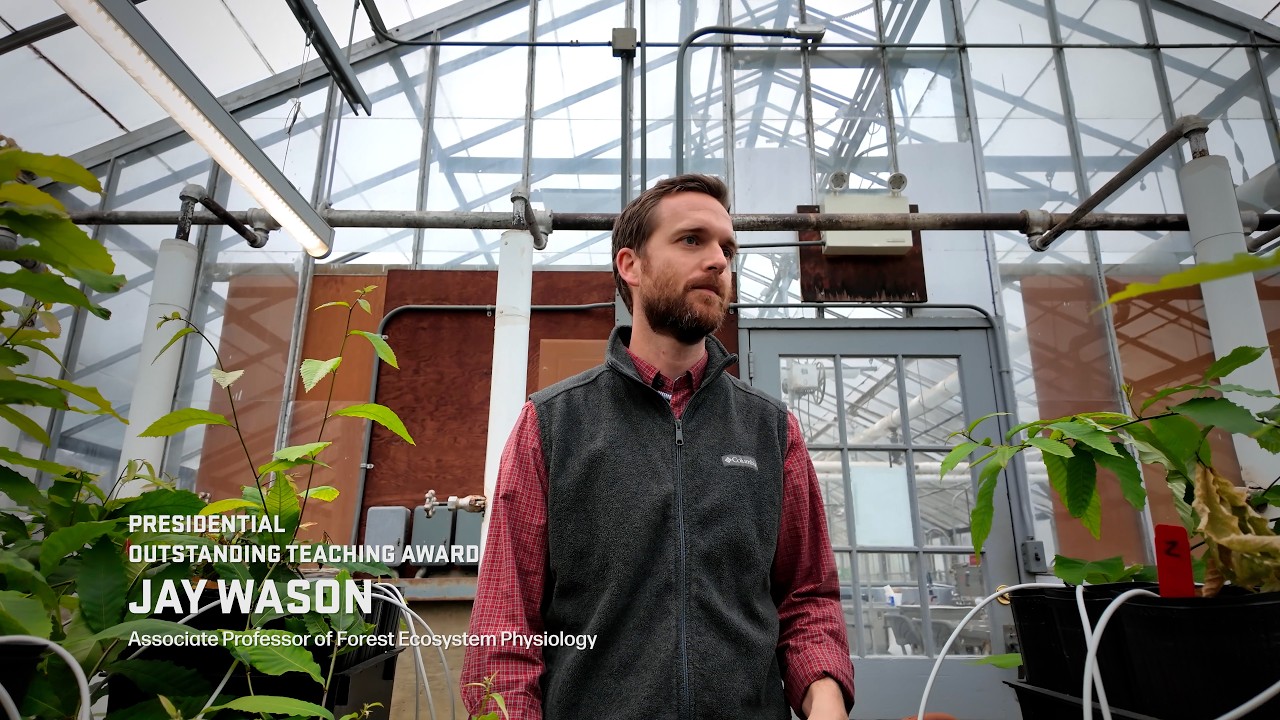
Jay Wason
Associate Professor of Forest Ecosystem Physiology
Jay Wason, associate professor of forest ecosystem physiology in the School of Forest Resources, is recognized for advancing student learning through teaching and mentorship.
Since joining the University of Maine in 2018, Wason has taught undergraduate and graduate courses in forest biology, plant structure and function, and research methods. His teaching emphasizes scientific thinking and applying knowledge to new problems.
His courses incorporate hands-on laboratory work, group activities and opportunities for students to design experiments and analyze data. These approaches support active learning and encourage students to engage directly with course material.
Student evaluations consistently highlight his preparation, clarity and enthusiasm, as well as his ability to help students understand complex topics.
In addition to teaching, Wason mentors undergraduate and graduate students and contributes to instructional development within his department.
[background music]
I came to the University of Maine in 2018, and I really wanted to come to Maine because of its strong connection to the natural world.
I stayed in Maine not only because of the great things we do here in the School of Forest Resources, but also because it’s a great place to live and a great place to have a family.
My classroom is active, hands-on, and intentionally challenging, both for the students and for me.
Even though my classes might be called things like “Tree Biology
or “Structure and Function of Woody Plants”, one of the major goals I have for my students is to learn how to approach complex and seemingly impossible questions as a team. This is a skill that I hope will serve them, whether they’re studying forests or whether they’re in any other career after they graduate.
It can be hard to focus on major milestones when every day you’re working hard in your classroom to teach your students.
But the moments that stand out the most to me are the small human moments. Like when a student comes to me and thanks me for believing in them at a time when they really didn’t believe in themselves, or when I overhear students talking about one of my courses and I hear that it was maybe the most challenging course they took at their time here in the university, but also that it was the one in which they learned the most.
And what every professor really dreams about is when the students start asking questions about things related to their material but that’s not going to be on the exam. Those rich discussions start to show that we’ve prepared our students to join the world and have rich discussions about the material that we’re talking about, and beyond.
When I think about how UMaine has made a difference in my life, I really think about the people and the community that has supported me here. Working with those people every day has allowed me to continue to do the hard work that we do to teach and train the next generation of students.
It’s an honor to be given this award. It helps to reaffirm all of the effort that I put into my teaching really makes a difference, not only to the other colleagues I have here at the university, but also to the students, and it gives me energy to continue showing up for them every day.
[music]

Research and Creative Achievement
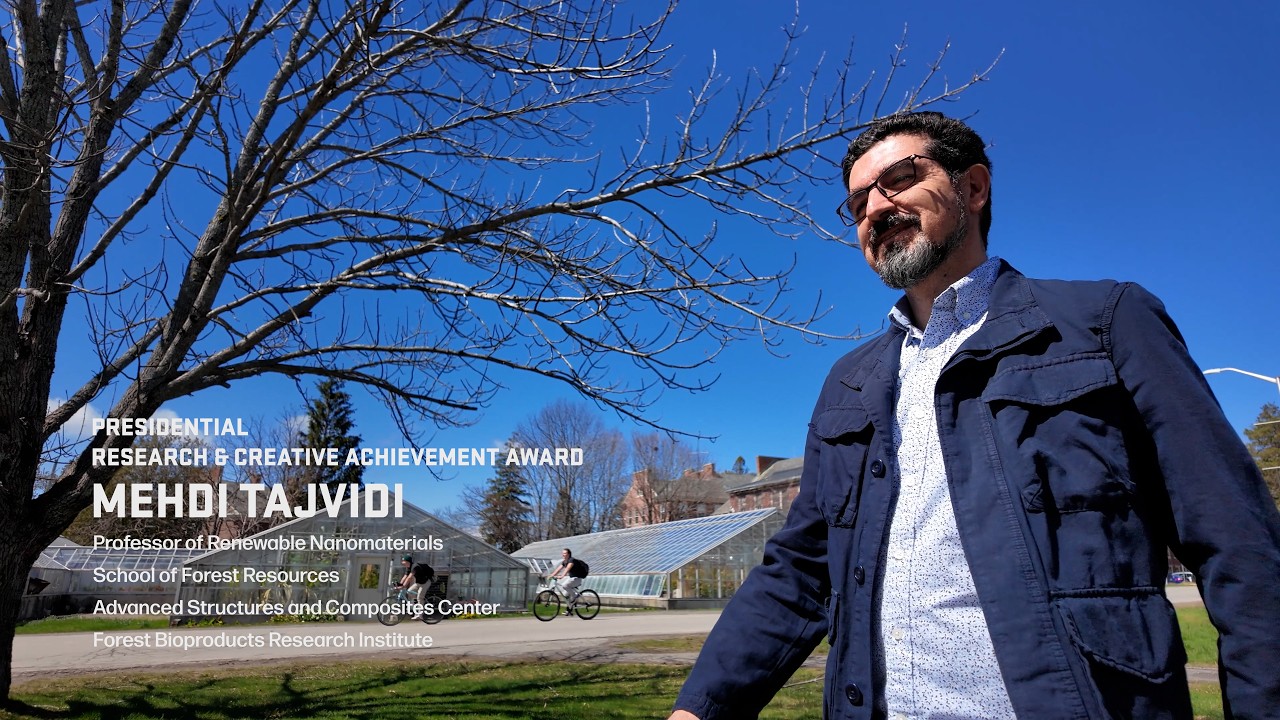
Mehdi Tajvidi
Professor of Renewable Nanomaterials
School of Forest Resources, Advanced Structures and Composites Center and Forest Bioproducts Research Institute
Mehdi Tajvidi, professor of renewable nanomaterials in the School of Forest Resources and Advanced Structures and Composites Center, is recognized for internationally distinguished research and scholarship. The award honors faculty whose work contributes knowledge to issues of local, national and global significance.
Since joining the University of Maine in 2013, Tajvidi has focused on the production, characterization and performance of renewable nanomaterials and their composites. His research centers on cellulose nanomaterials for applications including coatings, packaging and building products, spanning work from foundational science to industrial trials.
Tajvidi’s lab has developed bio-based alternatives to synthetic materials, including technologies to replace formaldehyde-based resins in building products and PFAS in molded fiber packaging, as well as foam products used in packaging. He has also launched a line of research in mycelium-based biocomposites, using fungal materials to produce low-density insulation and packaging products.
His work supports collaborations with Maine-based and national companies and contributes to new product development in the forest products industry. He also mentors graduate students, postdoctoral researchers and undergraduates who have gone on to careers in academia, industry and national laboratories.
Medhi Tajvidi: I arrived at the University of Maine in 2013.
I personally found UMaine one of the most collaborative institutions I’ve ever been to.
I really found this place like home.
My research focus at the University of Maine is to find applications for cellulose nanomaterials. Over the past ten, twelve years I’ve been mostly focusing on two performance criteria for these materials, using them as binder and as barrier. I call them my two B’s.
Basically, we found that we can use these materials as a replacement for adhesives that contain formaldehyde. We can use them also as barrier materials to replace PFAS.
This line of research of using cellulose nanomaterials as a binder actually started as a small observation in the lab. We call it Contact Dewatering. Basically enables us to remove water very rapidly from this mixture.
But what Maine actually changed in my professional career, it was the scale. That was why I changed from small volume applications to large volume applications, especially to help the forest products industry that is on the decline, and all the pulp and paper industry that are losing their markets.
So this is the biggest research award that you can get at the University of Maine. So certainly it means a lot. But rather than just thinking about myself, I think this is also a testament to the team that I have built over the years here. This could have never been done without the collaboration that I have at the University of Maine with the Advanced Structures and Composites Center, the FBRI, the Product Development Center, PDC, and of course my home, School of Forest Resources and the team that I have built here in my lab with all my post doc graduate students and undergraduate students who have been actually doing the research while I was not doing the actual work.
[music]
Public Engagement Achievement
Darren Ranco
Professor of Anthropology and Chair of Native American Programs
Darren Ranco, professor of anthropology, faculty fellow in the Mitchell Center for Sustainability Solutions, and chair of Native American Programs, is recognized for public engagement that applies academic expertise to enhance the public good.
Since returning to Maine in 2009, Ranco, a Penobscot Nation citizen who grew up in Orono, has worked with Wabanaki Tribal Nations on environmental and cultural issues. His work includes leadership on responses to the emerald ash borer, an invasive species that threatens ash trees used in traditional basket making. His efforts contributed to agreements among tribal nations, the state and federal agencies.
He has also supported tribal climate resilience and land return efforts, working with communities to develop priorities, establish baselines and create plans to address environmental change.
Ranco has contributed to strengthening relationships between the university and tribal communities, including efforts to support collaboration and culturally informed research practices.
His public engagement includes educational initiatives supporting the development of Wabanaki studies curriculum, public talks, working with legislators to support environmentally and culturally sound legislation, and participation in projects that address community needs.

[background music]
Darren Ranco: I came to the University of Maine in 2009. Although, I grew up here in Orono. I went to Orono High School, class of 89. Go Red Riots.
For me, coming to UMaine was coming home. My father’s family is from Indian Island and my mom’s family is from right here in Orono.
For me, my public engagement comes from my sense of service. The Land Grant mission is a part of that. Like that, we’re here as a university to serve the people of Maine and beyond. As a Penobscot Nation citizen, of course, service to my community, to my tribe, everything from development of curriculum for Wabanaki studies across the state, advocating for certain changes in law that will protect our cultural and natural resources, developing memoranda of understanding. These are all the things that sort of define for me my public engagement and service.
We’re walking across campus now, I think a significant achievement is the work we were able to do around Penobscot language signage across campus. That’s been a real shift in our understanding that this is a university on Penobscot Territory and that we have particular words and understandings for this place that go back well before the university itself.
I’m really engaged in the land return movement. That’s where my research is right now. To me, that’s part of why I get up every morning. It’s a really important part of my research and my public engagement.
The University of Maine has made, you know, such an impact. The opportunity to return home and do the kind of work that I do has been an opportunity to me to reflect that ethic of service, that ethic of responsibility and care for the people and places that I love.
You don’t do things like this for the awards, you do it for the joy of making a difference, to serving the public, serving your community and the people that you love is honestly the best award I could possibly get.
[music]

Innovation
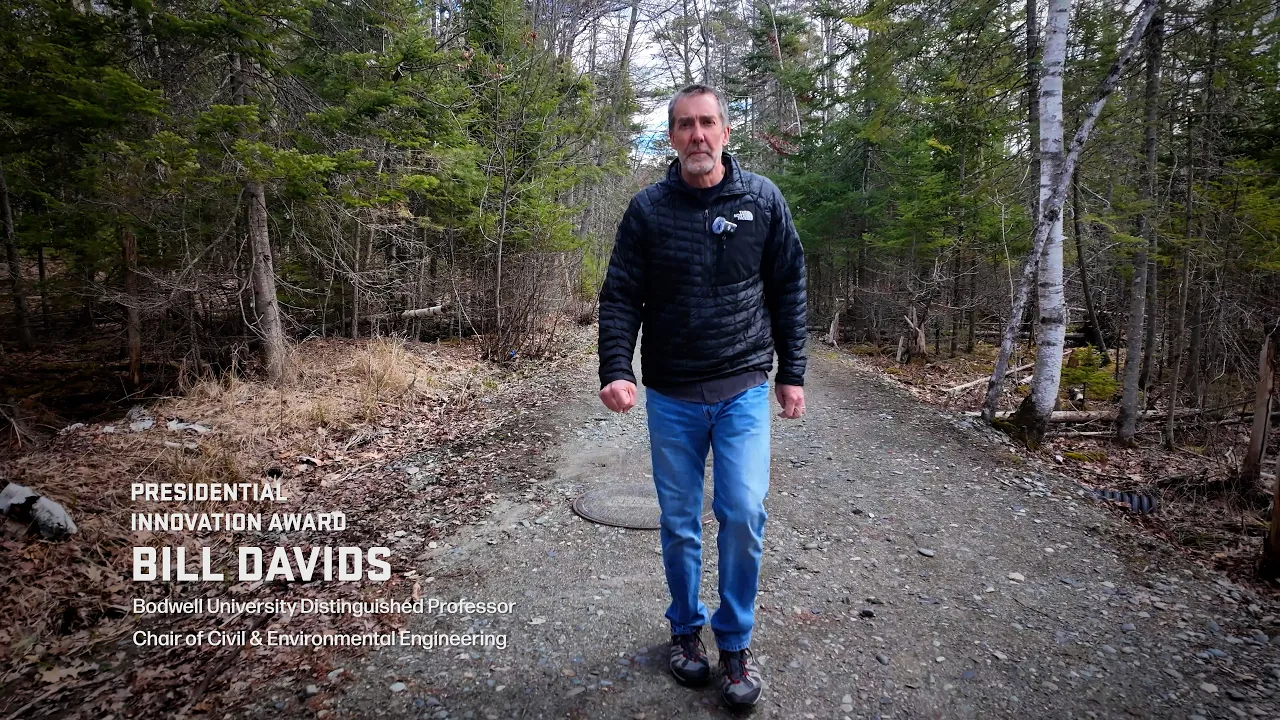
Bill Davids
Bodwell University Distinguished Professor and Chair of Civil & Environmental Engineering
Bill Davids, Bodwell University Distinguished Professor and chair of civil and environmental engineering, is recognized for translating research into technologies with economic and societal impact.
Over nearly three decades at the University of Maine, Davids has focused on engineering research that supports innovation and real-world application. He is a co-inventor of the CT Girder, a fiber-reinforced polymer bridge beam that is significantly lighter than steel and resistant to corrosion. The technology has been used in bridge construction projects in Maine, Rhode Island and Florida.
He has also contributed to the development of the Continuous Forming Machine, a manufacturing technology for fiber-reinforced thermoplastic materials. This work has supported the creation of a startup company that is generating revenue, attracting investment and building a manufacturing facility in Maine.
His research has also contributed to improved methods for evaluating and maintaining bridges, helping extend the service life of infrastructure and reduce the need for repair and replacement.
Through collaboration with students and industry partners, Davids’ work has produced practical outcomes that advance engineering practice and support infrastructure solutions
[background music]
Bill Davids: I came to the University of Maine in 1998 as a faculty member. Although, I should point out, I’m actually an alum, and I grew up in Maine.
I came for several reasons. You know, I really wanted to live in Maine, be close to my family, and my department is just, it’s a wonderful place.
I’ve stayed because I’ve been able to realize a lot of the ambitions I brought with me trying to make a difference with folks.
I’ve worked in a number of different areas. Wood structures and timber engineering, bridge engineering, composites and infrastructure, inflatable structures. I’ve worked really closely with the Maine DOT over the years.
In short, I’m a sort of jack of all trades and master of none. But one thing I want to point out are the students. The real milestone is seeing them complete their degrees and go on into practice.
In fact, if you go in my office, you’ll see there’s a hard copy of the thesis of every M.S. and PhD Student whom I have advised or co-advised. Those are the real milestones. They’re not my milestones. They’re theirs. But I helped them get there. That reminds me why I’m here.
I think there’s no question that UMaine has allowed me to do things I wouldn’t have been able to do elsewhere, or else I would have struggled a lot.
Folks within my department, we’ve collaborated on so many projects, so the whole is greater than the sum of the parts. And of course, UMaine is great in that it really values interdisciplinary collaboration. So I’ve been able to work with a lot of folks from other units in other programs, I’ve learned so much from that as well. And I’ve learned so much from that as well.
The work I’m doing isn’t really any more impactful than that of what so many faculty members on this campus do every day. Folks in the Arts & Humanities are pushing boundaries of their disciplines. People in Extension are working with Maine farmers. Engineers and scientists are working on challenges in the coastal areas. Economists are working with the state to craft better policies.
So all of these things are happening all the time, being done by everybody, that really define what the University of Maine is and its impact.
[music]

Black Bear Award for Extraordinary Impact
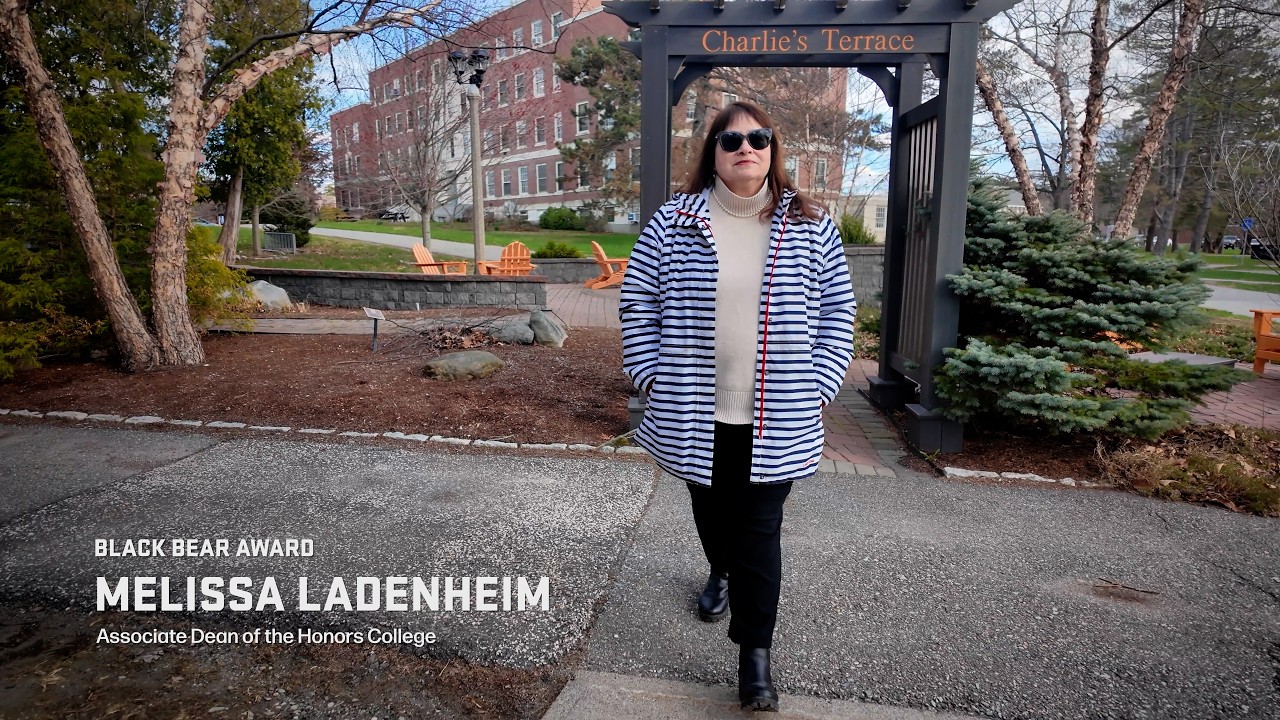
Melissa Ladenheim
Associate Dean of the Honors College
Melissa Ladenheim, associate dean of the Honors College, is recognized for exceeding expectations and making an extraordinary impact through service and leadership.
She coordinates the Maine Day Meal Packout, a campus-wide initiative that provides meals to food-insecure communities across the state. A central part of Maine Day Week of Service, the effort engages approximately 400 to 500 volunteers each year. Since its early years in the 2010s, the initiative will surpass 800,000 meals packed and distributed with the culmination of this year’s event.
The Maine Day Meal Packout is student-driven, with a leadership team playing key roles in fundraising, logistics and partnerships, while Ladenheim oversees and coordinates the initiative. Through that work, students gain experience in leadership, project management and community engagement while contributing to a statewide effort to address food insecurity.
Ladenheim is also involved in the Servant Heart Research Collaborative, which develops educational initiatives addressing social and learning challenges in Sierra Leone, Liberia, Haiti and Uganda. Through this work, she helped create and build the National Education Test Tool, an online platform that prepares students in Sierra Leone for national exams, as well as the Attachment Theory Workshop, a caregiver training program focused on fostering healthy attachments in children who have experienced trauma.
Her work reflects a sustained commitment to service and student development, with impact across campus, throughout Maine, and internationally.
Melissa Ledenheim: I came to the University of Maine in 2005, when I was given the opportunity to teach in the Honors College, and I’m so thankful for that experience because I was able to work with all these fabulous students over the years. Many of whom I’m still in touch with.
The reason I’m such a strong advocate for the University of Maine and the Honors College is it really gives students the best of both worlds. They have all the advantages of a big research institution and the advantages of a small liberal arts college.
I’m a first generation student myself. My grandparents were immigrants to this country. And I was always so proud of the opportunities that I had for my education.
So I’ve gotten to build research collaboratives. The Maine Day Meal Packout created the It’s Personal campaign to provide personal care products to the Black Bear Exchange. Servant Heart Research Collaborative. That work is just tremendous because we are making a difference in the lives of thousands of students in Sierra Leone, in Haiti, in Uganda. And most of this work has involved students.
I think the Honors College is really the place to give students these opportunities, because they’ll realize that even at 18, they can be changemakers in the world that we live in.
I consider myself so lucky to have had the opportunity to go on this journey with so many students, and maybe in some small way the work that we’ve done together will carry on and carry through, and they then will go out and be changemakers in the world themselves.
That’s really important to me. It’s really gratifying to see when it happens. It’s all in the relationships.
And so that’s what the award means to me. That we live in a community who cares about others, and a community who’s willing to do the hard work to make a difference in people’s lives.
[music]
Valedictorians & Co-Salutatorians
Valedictorian and Salutatorian are the highest honors awarded to students by the University of Maine. Each student is recognized for outstanding academic achievements, and for contributions to UMaine or the wider community.

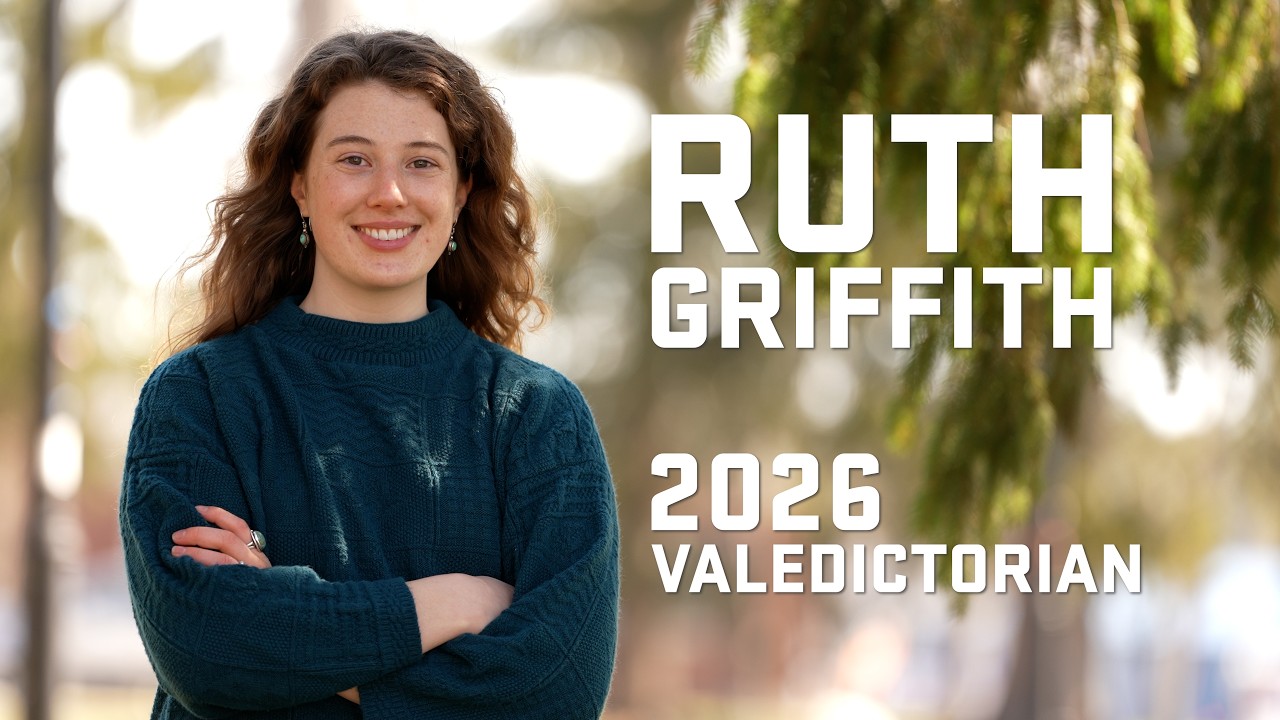
Ruth Griffith
Valedictorian
Outstanding Graduating Student | Honors College
College of Earth, Life, & Health Sciences
Bachelor of Science in Economics with Minors in Mathematics and International Affairs
Having grown up in Parkman, Maine, Ruth Griffith said she has always been intrigued by the disparities between different regions of the state. Piscataquis County, where Parkman is located, has the lowest median household income in Maine. Having seen that reality, Griffith strives to bridge the inequality gap that defines many of Maine’s communities.
At the University of Maine, she has used her knowledge and resources as an undergraduate student to track business cycles in small regions of the state and lead community service initiatives.
Majoring in economics with minors in mathematics and international affairs, Griffith developed a methodology to measure economic expansion and contraction in sub-county regions as part of her Honors thesis. This approach can help show how state policies impact regional economies.
The project was one of many reasons Griffith was named the 2026 UMaine valedictorian.
“I felt like there were a lot of very substantial economic differences across smaller regions of Maine,” said Griffith, who is also the Outstanding Graduating Student in the Honors College. “I was always interested in figuring out why those might happen and learning more about them. This was a way to do that analytically.”
Griffith worked on a farm in high school and enrolled in UMaine’s economics program because of its focus on agriculture. She was later driven to pursue finance and will be moving to New York City after graduation to work for Canadian company TD Bank, with the hopes of one day returning to school for a Master of Business Administration.
In her experience, a job in finance can be difficult for anyone outside of the field to understand. Her idea of modeling isn’t the mainstream tag found on the pages of magazines, and finance isn’t just crunching numbers in a cubicle, it’s her key to solving great economic disparities. It’s the doorway into a career where she can combine her passion for the numbers and data with her values in life: community, action and mindfulness.
Since her sophomore year, she has served as the fundraising chair for Maine Day Meal Packout. This year, she is also the student coordinator and led a team of 12 other students to plan the packout. At the end of April, organizers and volunteers packed approximately 80,000 meals to donate to food pantries across the state.
Griffith also volunteers for organizations that empower and advance opportunities for women. She chairs the Alum Council for the Olympia Snowe Women’s Leadership Institute and is a member of the advisory committee for the Maine Community Foundation’s Maine Women’s Fund.
[background music]
Ruth Griffith: My name is Ruth Griffith. I’m from Parkman, Maine, and I study economics. And I am the 2026 Valedictorian.
Growing up in Parkman, I gained a strong understanding of rural issues, which ultimately influenced my decision to study regional economics.
My research looks at how resilient local economies are. Essentially, how well they respond to shocks. Everyone should care about this research because the more resilient a place is, the better everyone’s livelihoods there will be.
Two of my core values are community and action. At UMaine, I’ve been able to live those values through service projects such as the Maine Day Meal Packout. At the Maine Day Meal Packout, I worked with a team of students and staff on campus where we organized an event to provide meals to hungry Mainers. It’s really exciting that we were able to do this with the Honors College. It will make such a huge difference in the lives of so many Mainers, so it feels really good to give back to our neighbors.
Being a part of clubs on campus has by far been the most impactful part of my time at UMaine. I’ve gained so many wonderful experiences, honed in my leadership skills, and found ways to make tangible impacts beyond the UMaine community.
When I look back at my time at UMaine, I will miss the Maine Day Meal Packout the most. It represents everything that I love about UMaine: community, service, and people coming together to make a tangible impact. For future classes, good luck and make your most of your time at UMaine.
[music]

Isabelle Irani
Co-Salutatorian
Maine College of Engineering and Computing
Bachelor of Science in Biomedical Engineering with a Minor in Business Administration
In 2022, then first-year student Isabelle Irani of Spring, Texas, walked into University of Maine Athletics in the Memorial Gym Complex with a mission: to improve mental health services for student athletes.
A member of the Women’s Swimming and Diving Team who competed in the butterfly and individual medley, Irani founded the UMaine chapter of The Hidden Opponent, a national nonprofit dedicated to athlete mental health advocacy. She also earned support from UMaine Athletics that would eventually lead to the university hiring an in-office therapist for student athletes.
Her successful advocacy is one of many reasons Irani, a biomedical engineering major, earned the title of 2026 UMaine co-salutatorian.
Between early morning swim practice and rigorous engineering coursework, she built a college career defined by discipline, determination and a deep network of support. Alongside excelling in engineering and competing as a Division I swimmer, Irani navigated new challenges and built the confidence to take ownership of her college experience.
Several research and leadership opportunities that shaped her collegiate experience were ones she sought herself. She connected with chemical engineering professor David Neivandt, who then invited her to join the Neivandt Lab. There, she helped develop sustainable lobster shell biomaterials. The material, stronger than both concrete and wood, dissolves in water within two weeks and fully biodegrades in soil in about a month.
“My goal has always been to contribute meaningfully,” Irani said. “I think my mindset changed when I started thinking that way — thinking, how can this be meaningful? How can I show up?”
She credits her growth to the support of mentors, advisors and peers. Neivandt guided her research endeavors, while her athletic and academic advisor Julie Cheville helped her navigate the complex demands of being a student athlete. Her teammates and roommate, Ashley LeClaire, provided daily motivation and friendship, and her girlfriend, Sarah, offered emotional support.
Her family also played a formative role. Her aunt, Jean MacRae, a civil & environmental engineering professor at UMaine, and her uncle, Farahad Dastoor, a biology lecturer and undergraduate coordinator at UMaine, encouraged her curiosity from the start. Their guidance helped Irani discover opportunities and made the university feel like a place she could call home.
Looking ahead, Irani plans to continue her research through a 4+1 master’s program in biomedical engineering at UMaine, working to develop sustainable and effective medical devices that combine innovation with societal impact.
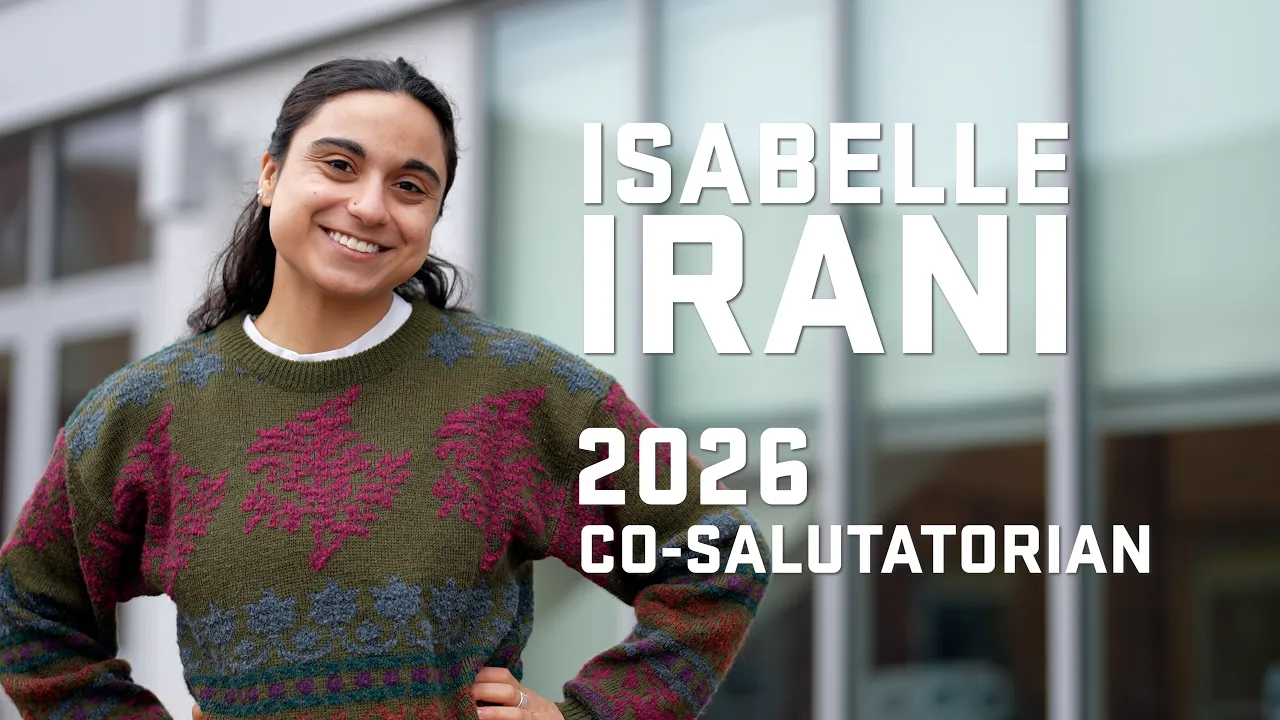
[background music]
Isabelle Irani: Hi everyone, my name is Isabelle Irani. I’m from the Woodlands, Texas. I’m a biomedical engineer and I am your UMaine Class of 2026 Co-Salutatorian.
I’ve always stated that my goal is to contribute meaningfully to everything I do. And that really sprung from kind of going into school and feeling like I’m dreading everything every day. And I kind of switched my mindset and said, what if I go into everything that I have on my schedule and say, how can I contribute meaningfully to this thing and then move on to the next? How can I contribute meaningfully to this? And then the day is over and you’ve done it and you’re doing all of these things.
What really drew me to advocate for mental health resources for student athletes was my own experience and seeing how many people around me were struggling silently. I saw that there was a gap in mental health resources provided for student athletes. So, I took initiative to create a new position here on campus, a student athlete therapist dedicated for the mental well-being of the athletes here. Knowing that I’ve impacted athletes beyond myself is something incredibly meaningful. I’ve always wanted to leave something better than I found it. And knowing that I’ve left a legacy here at UMaine is just super special and super close to my heart.
So, I currently work on a project that’s working on sustainable materials. It is a lobster shell composite material to replace wood and concrete for temporary structures. So that way we can have something that we build, construct, and then it can decompose or dissolve without causing any damage to our earth.
Balancing being a full-time engineer as well as a student athlete is really hard. There’s no secret to success. The secret to success is staying on top of your stuff, being organized, and just having fun. Finding a way to contribute meaningfully to everything that you’re doing every day and just staying happy.
To any student athletes out there, don’t be afraid to ask for help, have fun, and be yourself.
[music]

Andrii Obertas
Co-Salutatorian
Outstanding Graduating Student | College of Liberal Arts and Sciences
Bachelor of Science in Physics
Bachelor of Science in Mathematics
In 2022, Andrii Obertas traveled thousands of miles to get from Lutsk, Ukraine, to the University of Maine. After a long physical and multi-year academic journey, Obertas will cross the stage at Alfond Arena, accept his diploma and graduate as a 2026 UMaine co-salutatorian.
A dual-degree student, pursuing studies in both physics and mathematics, Obertas’ decision to come to Orono came with significant (and life-altering) benefits beyond academics. And he doesn’t have plans to leave the Pine Tree State right away, a place he said is famous for its beautiful nature.
“UMaine provided me with an opportunity to escape a war-torn country,” Obertas said. “It was an opportunity I couldn’t pass up. I am grateful for it. UMaine gave me hope for a better future.”
Obertas noted his gratitude to the Office of International Programs, whose staff went above and beyond to help him adjust during the difficult first few months after his arrival from Ukraine. That gratitude was clearest when he was asked to describe UMaine in one word.
“Hope,” he said. “I am from western Ukraine, so it’s not that bad compared to what some people have to endure, but before I came here, I was stuck in the middle of the Ukraine war with little good to look for in the future.”
An effort he attaches to the charitable and supportive nature of Mainers, Obertas took part in an outreach program led by David Sturm, instructional laboratory and lecture demonstration specialist at UMaine. They traveled to communities and performed physics demonstrations intended to spark curiosity in children who may not have had access to learn about such science otherwise.
While Obertas doesn’t intend to pursue research post graduation, he took advantage of the opportunities available to him.
He spent his first two years working in the thin film lab under Nicholas Bingham, assistant professor of physics, studying artificial spin ice lattices. He also interned under Jack Buttcane, associate professor of mathematics, optimizing Wigner D-polynomials.
After graduation, Obertas intends to pursue a master’s degree in mathematics through the accelerated 4+1 program. After that, the sky is the limit. He plans to take actuarial exams and apply for jobs in that area, but he’s fairly certain that won’t be his final stop. In the end, just like so many of his peers who will be sharing the commencement stage with him, he’s excited to see what’s on the horizon.
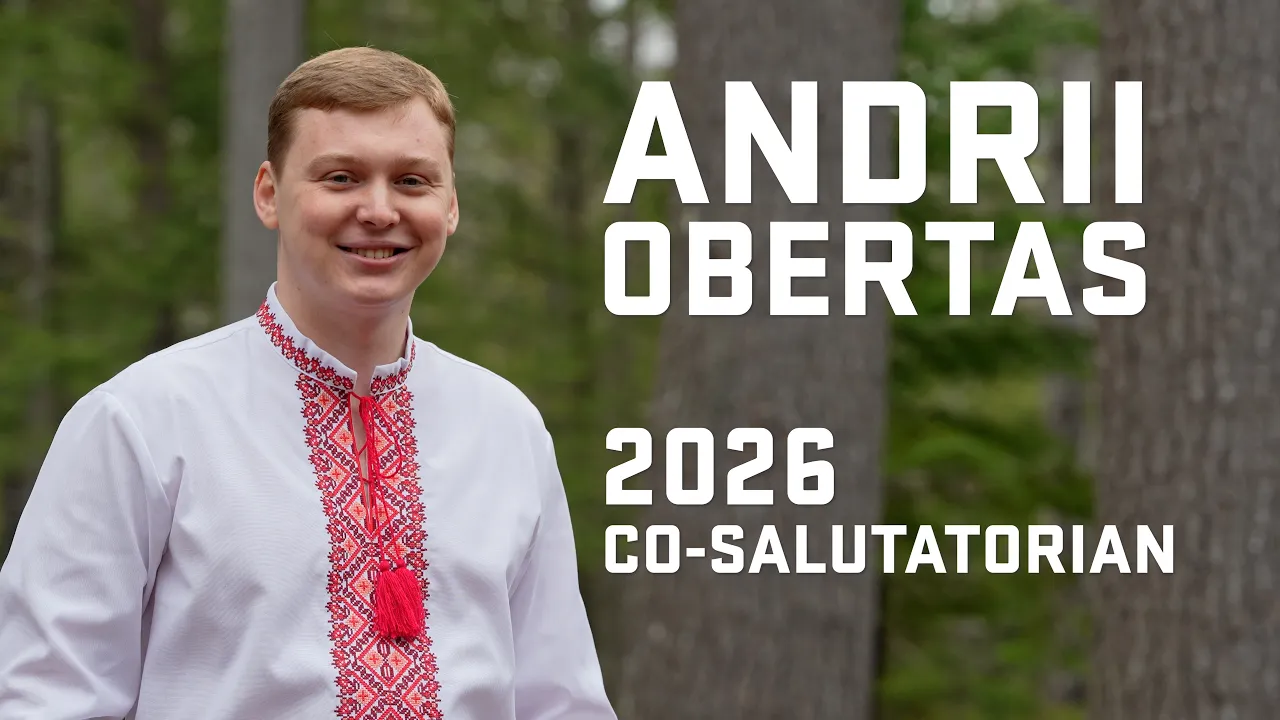
[background music]
Andrii Obertas: Hello, my name is Andrii Obertas. I am from Ukraine. I double major in mathematics and physics and I am a 2026 UMaine Co-Salutatorian.
I chose UMaine because, frankly speaking, it was the only choice I really had. In 2022, I was stuck in the middle of Ukrainian war with not many positive things to look in the future. And when the acceptance letter from Ukraine arrived, it was perhaps the most positive thing I have had in many years. So obviously I came here because UMaine offered me a possibility to have a future.
If someone would ask me why I decided to do mathematics, I would sincerely would not have an answer for that because it feels like I’ve been doing it since I was born. I feel like there is no more profound way of using math than by applying it to physics and trying to find the answers to the most fundamental questions in the universe.
The thing that surprised me the most about the people of Maine, in a good way, is that how charitable and supportive of the local community everybody is. People here genuinely do care about little guy. I’ve been around many places in the world including my own home country of Ukraine and this level of charity and like, goodness of heart, is truly unique.
The things that I will miss the most once I graduate from UMaine is the simplicity of student life, the wonderful community that exists here. All the clubs, all of the events, the hockey games, the wonderful time that I have with my friends and even strangers at times.
I am most grateful for my experience at UMaine for all the opportunities that I could have experienced here that would have not been possible if I were staying back home, and I will remember this for years fondly for the rest of my life.
[music]
Outstanding Graduating Students

Hamidah Aldarwish
College of Education and Human Development
Bachelor of Science in Child Development and Family Relations
Hamidah Aldarwish of Dammam, Saudi Arabia, is the 2026 Outstanding Graduating International Student for the College of Education and Human Development. A child development and family relations major, Aldarwish arrived in Maine in 2019 with her family — her husband, Jafar, and three girls who are now ages 11-15. She took classes at Eastern Maine Community College and through the University of Maine’s Intensive English Institute prior to becoming a full-time student in the College of Education and Human Development in the spring 2022 semester. She has been a Presidential Scholar twice and received Dean’s List honors four times. Aldarwish completed her capstone internship at UMaine’s Children’s Center with a focus on the application of observational and developmental principles in early childhood settings, particularly related to children with diverse developmental needs, including autism spectrum disorder and attention deficit hyperactivity disorder. After graduation, Aldarwish plans to return to Saudi Arabia to work with families and children.

Ella Molly Boxall
Maine College of Engineering and Computing
Bachelor of Science in Civil Engineering with Minors in Sustainability and Mathematics and a Concentration in Water Resources
Ella Boxall of Kennebunkport, Maine, is the Outstanding Graduating Student in the Maine College of Engineering and Computing. Originally from Grand Cayman in the Cayman Islands, Boxall is a civil engineering major with a concentration in water resources and minors in sustainability and mathematics. She has completed internships with GEI Consultants and TRC Companies, conducted research using MATLAB to project sea level rise and king tides in Bar Harbor and served as a learning assistant and grader. Her capstone project focuses on redesigning a gravity-fed water system for a salmon rearing facility in Aroostook County, highlighting creative, low-energy engineering solutions. Outside the classroom, she has embraced Maine’s outdoors through skiing and exploring Acadia National Park. She plans to pursue graduate studies in marine science in the United Kingdom and build a career promoting coastal and environmental resilience.

Dianne Lisa Brindisi
Division of Lifelong Learning
Bachelor of University Studies in Leadership Studies
Dianne Brindisi of Cape Neddick, Maine, is the Outstanding Graduating Student in the Division of Lifelong Learning at the University of Maine. Brindisi will graduate with a Bachelor of University Studies in Leadership Studies. Service has always been central to Brindisi’s life. From supporting families in need and mentoring young leaders to contributing to professional associations that advance women and industry standards, Brindisi believes leadership is inseparable from service. Looking ahead, she is committed to educating the public about the university studies program and sharing her positive experience and welcomes the opportunity to serve as a program ambassador.

Kaitlyn C. Evans
College of Education and Human Development
Bachelor of Science in Secondary Education with a Second Major in Spanish
Kate Evans of Bangor, Maine, is the 2026 Outstanding Graduating Student for the College of Education and Human Development. A single mom of four young children (ages 4-12), who she has homeschooled while working toward her degree, Evans earned a 4.00 GPA while pursuing double majors in secondary education and Spanish. She is a member of Phi Kappa Phi Honor Society and the National Collegiate Hispanic Honor Society. She received the Roger Hill Humanities Scholarship and the College of Liberal Arts and Sciences Outstanding Junior Award. Evans is an active member of her church community, where she often volunteers her time for service and educational programs. In her final semester at UMaine, Evans completed student teaching placements at Hermon High School and Bangor High School. After graduating she plans to stay in the Bangor region and teach Spanish at a local high school.

Chantelle Natalie Flores
College of Liberal Arts and Sciences | Honors College
Bachelor of Arts in English with a Minor in Creative Writing
Bachelor of Arts in Art History with a Minor in Classical Studies
Chantelle Flores of Oakland, Maine, is the Outstanding Graduating Student for the College of Liberal Arts and Sciences. As a dual degree student in English and art history with minors in classical studies and creative writing, as well as a member of the Honors College, she has fully embraced the opportunities that the college offers. She was a McGillicuddy Humanities Center (MHC) Undergraduate Fellow, as well as a Zillman Art Museum Research Curatorial Fellow through the MHC. Chantelle interned at the UMaine Writing Center and served as co-editor-in-chief of Spire magazine. After she graduates, she plans to pursue an internship related to literature or the arts and apply for graduate programs for art history, with the ultimate goal of acquiring a PhD in contemporary art history and becoming a professor.

Zoe Georgina Furber
College of Earth, Life, and Health Sciences
Bachelor of Science in Marine Science with a Second Major in Biology with a Concentration in Marine Biology
Zoe Furber of Vancouver, British Columbia, is the Outstanding Graduating International Student in the College of Earth, Life, and Health Sciences. A double major in marine science and biology with a concentration in marine biology, she has been a member of the UMaine Field Hockey team since 2022 and was appointed captain in 2025. During her time at UMaine, she completed a capstone project comparing ocean temperatures in the Gulf of Maine to heart rate metrics of blue mussels, or Mytilus edulis. Her research and studies as a student expanded her perspective and understanding of sustainability and corporate strategy, while helping her develop leadership, teamwork and time management skills. These experiences prepared her for a career in environmental, social and governance (ESG) and sustainability. Furber plans to complete a Master of Science in Global Strategy and Sustainability at the University of Edinburgh, where she will play field hockey for an additional year.

Sarah Elizabeth Johnson
Maine Business School
Bachelor of Science in Business Administration in Accounting with a Second Major in Business Information Systems and Security Management
Sarah Johnson of Clifton, Maine, is the Outstanding Graduating Student for the Maine Business School. A double major in accounting and business information systems and security management and member of the Honors College, Johnson has completed multiple internships with both the Maine Business School and BerryDunn, an accounting and consulting services firm. She has also worked as an undergraduate assistant for UMaine’s Office of Institutional Research and Assessment. Following graduation, she will launch her career at BerryDunn as a tax specialist.

Jasper Makowski
College of Earth, Life, and Health Sciences | Honors College
Bachelor of Science in Microbiology
Jasper Makowski of Dover-Foxcroft, Maine, is the Outstanding Graduating Student in the College of Earth, Life, and Health Sciences. He is majoring in microbiology and is a member of the Honors College. He was able to expand his skillset in the lab and his knowledge of healthcare environments by securing internships and part-time work with two medical facilities and UMaine’s Maginnis Lab. Working closely with associate professor of microbiology Melissa Maginnis, who was not only his advisor and lab director but also a positive influence and mentor in his life, he researched signaling mechanisms in viruses and learned about a range of diseases. Makowski is a student organizer for the Maine Day Meal Packout, an experience that fortified his belief that change can spark from one person’s passion. Outside of academics, he retreats to the Maine outdoors and enjoys a variety of activities, from backpacking to fly fishing. After he graduates, he is pursuing a medical degree with plans to return to rural Maine as a primary care provider.

Samuel Tremblay
Maine Business School
Bachelor of Science in Business Administration in Management
Samuel Tremblay of Quebec City, is the Outstanding Graduating International Student for the Maine Business School. A business administration student majoring in management, Tremblay is a tutor, mentor, Maine Business School ambassador and president of the UMaine chapter of the Beta Gamma Sigma honor society. Fueled by a passion for sports, he is a kicker for the UMaine Football Team, where he was a finalist for the Fred Mitchell Award, and is the representative for the Student-Athlete Advisory Committee. He played on Canada’s Junior National Team at the International Federation of American Football’s World Junior Championship and served as a captain. After receiving his bachelor’s degree in May, he plans to stay at UMaine and pursue a master’s degree while continuing to play football.

Karun Manoj Varghese
Maine College of Engineering and Computing | Honors College
Bachelor of Science in Computer Engineering with a Minor in Robotics
Karun Varghese of Dubai, United Arab Emirates, is the Outstanding Graduating International Student in the Maine College of Engineering and Computing and the Honors College. While attending UMaine, Varghese, a computer engineering major with a robotics minor, assumed research roles in the Computer Vision and Autonomous Robotics Lab, the High Altitude Ballooning Lab and the Advanced Structures and Composites Center, where he built practical skills beyond those he learned in the classroom. Outside of academics, he was heavily involved in campus life, participating in the Black Bear Robotics Club, the South Asian Association of Maine and Model United Nations. Through Model UN, he traveled internationally to Taiwan, the Philippines and Peru — growing his worldview and reinforcing his desire to pursue robotics at the highest level of study. After graduation, he will pursue graduate studies at Carnegie Mellon University’s Robotics Institute.
Advice for Future Black Bears
We asked our outstanding graduates to share advice for future Black Bears.
[background music]
[Text: We asked our outstanding graduates to share advice to future Black Bears.This is what they said …]
Sarah Johnson: My advice to incoming first years is to say yes to new experiences, even if they seem scary.
Ruth Griffith: Take action on the things you care about.
Jasper Makowski: Stack small wins every day. Find people that build you up and have fun along the way.
Andrii Obertas: Hold on to what you’ve learned and never stop learning what you do not yet know.
Zoe Furber: It goes by really fast, so make sure to enjoy every moment.
Hamidah Aldarwish: Be curious and ask for help when you need it. Take every opportunity to learn and grow.
Ella Boxall: Your time at college is what you make of it. So enjoy it and take every opportunity you can.
Karun Varghese: These four years will go by really quick. So take your time, enjoy yourself, and savor every moment.
Samuel Tremblay: Have fun, enjoy college, and make memories.
Chantelle Flores: Take every opportunity that comes your way. Even if you’re unsure or even if you’re not quite sure yet what you want to explore. Take those opportunities because they might end up being the most meaningful parts of your college experience.
[Text: Congratulations Class of 2026!]
[music]
Doctoral Degree Candidates
Read about our doctoral degree candidates and their dissertations here.
Ceremony Music
Program to Be Selected From
Overture for Brass
by Fred Frank
Irish Tune from County Derry
by Percy Grainger
set by J. Kreines
The UMaine Medley
arr. Daniel Williams ’91, ’94G
The University of Maine Band by Joseph McCusker, ’17
O! Our Dear Alma Mater by Emma and William Chapman
For Maine! by Charles Bartlett, ’14
Napoli Celebration
by Harold Waters
Prelude and Caprice
by Frank Cofield
Shenendoah
Traditional American Folk Song
arr. Jeff Funk
Amazing Grace
arr. Jari Villanueva
Battle Hymn of the Republic
by Willima Steefe and Julia Ward
arr. Peter Wilhousky
Fanfare for the Common Man
by Aaron Copland
Pomp and Circumstance
by Edward Elgar
arr. William S. Bartolotta
Stein Song
by Lincoln Colcord and EA Fenstad
arr. Lester Brockton
Musicians
University of Maine Ceremonial Brass Ensemble
Conductor
Dr. Philip B. Edelman
Trumpet
Tristan Gammon
Ashton Kinney
Katelyn Myers
Jeffrey Nowack
Liz Rolph
Lars Spooner
Horn
Braden Craig
Hannah Ferrell
Isabelle Puccio
Daniel Rumery
Trombone
Collin Beirne
Phoebe Honeywell
Mei Li Johnson
Connor Maurice
Benjamin Weaver
Euphonium
Jennifer Morin
Tuba
Heath Kennedy
Amede Olise
Percussion
Kai Harden
Antonio Price
Jay Trecartin
University of Maine Black Bear Men’s Chorus
Conductor
Daniel Williams
Accompanist
Sky Kust
Tenor I
Zachary Croy
Zachary Fisher
Roger Feeley
Dylan McFarland
John Thompson
Ben Wetzel
Tenor II
Jesse Bouchard
Nathan Brame
Andrew Brown
Luis Cordero
Tom White
Bass I
Shaun Dowd
Jim Green
Johnny Morehouse
Dillon Perry
Vaughn Simmons
Bass II
George Deans
Mark Lena
David Renedo
Kurt Schaller
Andrew Weeks
Wyatt Williams
After the Ceremony
Join the University of Maine Alumni Association at their Alumni Welcome Center just outside Alfond Arena as you exit Commencement. They have gifts for the grads and a great spot for photos with family and friends!
Volunteers
University of Maine Commencement Committee co-chairs Kevin Coughlin and William Biberstein thank the many volunteers, including undergraduate ceremonies coordinator Mallory Morehouse and graduate ceremony coordinator Kathleen Harding-Heber who dedicated countless hours to the success of our university’s ceremonies.
Commencement Photography
PLEASE NOTE: In order to commemorate this milestone occasion, professional photographers will photograph each graduate receiving a diploma. To avoid congestion and to maintain decorum in the ceremony, we ask that family members and other guests refrain from approaching the stage to take pictures. Please remain seated until the end of the ceremony. We ask you to respect the importance of commencement to the University of Maine community and to those individuals being honored on this occasion.