Biomedical Engineering (B.S.)

About

The University of Maine’s Biomedical Engineering Program prepares students to thrive in the dynamic and impactful field of biomedical engineering. This discipline focuses on the intersection of biology, medicine, and engineering, equipping students with the skills to create innovative solutions that benefit society. Biomedical engineers are at the forefront of designing artificial organs, developing advanced cancer detection methods, creating sensors for biological agents, and engineering materials for drug delivery.

UMaine’s program emphasizes rigorous undergraduate engineering instruction in areas like biological systems analysis, instrumentation, and the manipulation of biological processes. The curriculum combines core training in engineering, mathematics, and science with elective courses in humanities, social sciences, and specialized biomedical topics. Students gain hands-on experience through opportunities to participate in cutting-edge research, addressing challenges like cancer detection, tissue-implant compatibility, bio-inspired materials, and computational diagnostics.
Isabelle Puccio:

Mass and Maine, I would say they’re sisters but not twins. Maine is like the nicer sister and Massachusetts, she’s a little bit more sassy. Maine feels like a hug, honestly. It feels like a warm hug. Everyone loves each other. There’s that big sense of community. We’re all just one big state of Maine.

Hello, my name is Isabelle Puccio, I’m a senior, crazy, Biomedical Engineering major in the Honors College. And this is my life in the pines.

We are walking by Cloke Plaza, heading towards Ferland. There she is, my house. If you look up there, I’m a Biomedical Engineer, so I live on the third floor. We do a lot of research here. A lot of our core classes are here.

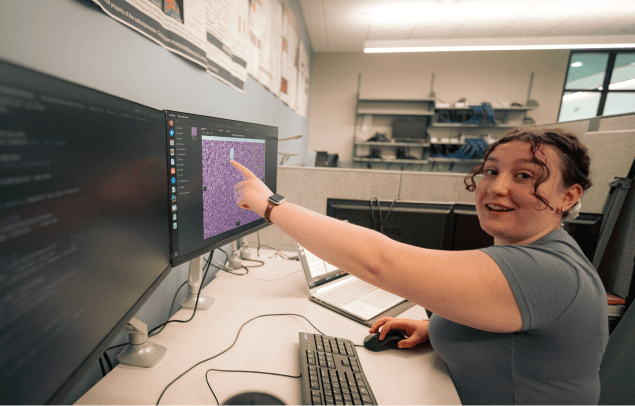
You peek right over here. We’re in the CompuMaine lab, which is where I work. It’s really nice to work in a state-of-the-art building. I’m able to come in here later to study. So I don’t just have to like do my classes here. I still come and do like homework. I’ll take a whiteboard for like a health exam and go absolutely crazy. It’s one of the best parts of my week, I will not lie.

So I research in the CompuMaine lab. And if you were to ask me in high school, like what research you want to do, this would not have been it. During our freshman year courses, all of the lab instructors come in and introduce themselves. And Dr. Khalil introduced himself and his research. And I was really interested, but I didn’t think I was capable. And I didn’t really step up until my second year, where I felt that I had the skills to really get involved. And then I had an opportunity to pursue a summer fellowship. And I got really interested in the research I do here.

I specifically look at H&E digital pathology slides. So that’s kind of like when you go in to get a biopsy, what the pathologists will get from you. I get to see those slides and work with them every day, which is really cool.

So I’m an out-of-state student. I’m actually from Massachusetts. I was really nervous about finding my group, finding my like UMaine family, but that happened really quick, really easily. I have a lot of friends in the band. I have a lot of friends in my major. The band is big, but my section’s always been smaller. So we’re like a tight-knit community and it’s the best thing ever.

I’ve been doing marching band, I want to say 10 years now, which is a really long time. That’s like more than half my life, which is crazy. I knew I wanted to do it in college. So when I saw like what a huge program we have here, I was like, might as well. I’ve been a section leader for the past three years. And it’s been like the greatest privilege in the history of ever. I have the best section.

I feel like my favorite part of music and band is that everyone is important. Like if you’re even on like the second part or the third part, the song does not sound the same without you. And that’s kind of another way that I feel about life. Like every person is equally important. Like, yeah, you might be third-kazoo, but that song will never be the same without the third-kazoo.

So I didn’t really get to do symphonic band until my second year. I was really nervous when I first auditioned, because I’m a self-taught French horn player until I got to school here when I started taking lessons. So I auditioned for the symphonic band, not thinking I was gonna get in. And then I got put on the third horn. Been playing in the group for three years now.

I just love to perform honestly, and I love the athletic aspect of it. My good friend Sarah is a big part of dance here and we both study biomed together. And she’s like, “I love dance. I know you danced like 30,000 years ago. You should come try it.” So on a whim, I went to Dance Club last semester and I’ve been in love with it ever since. I’m actually taking some dance classes right now. And it’s been great to get back into that motion.

I don’t think I would have gotten this experience anywhere else. Like other schools I was looking at maybe had more labs with more opportunities, but I feel like as an undergrad, I wouldn’t have gotten as much of an enriching experience because there have been too many people.

I would say Maine is kind of like a great melting pot of personalities and people. You’ll find that everyone is really welcoming and really joyful. There’s a lot of just like community joy and like camaraderie, like everyone in Maine roots for the University of Maine, which is really awesome.

Never forget that perhaps in your own life, you’re your own third horn and you just make everything just a little bit better.
You all deserve to see the lovely poetry of our director, Mr. White.

The warm Maine sun is starting to rise, melting the frost before your eyes. Soon the seniors will march to graduate. Come get a muffin before eight.

That’s his poetry. That’s just one of them. We get like three to four every game day.

Program Highlights

  • Lorem ipsum dolor sit amet, consectetur adipiscing elit. Nunc pharetra orci sit amet arcu mattis pretium.
  • Quisque rhoncus arcu nec massa mollis malesuada. Integer urna est, tempus at interdum sit amet, tempor nec diam.
  • Pellentesque molestie dignissim justo, facilisis efficitur sem pharetra in. Vestibulum nec erat leo. Vestibulum nec tincidunt lectus, at fringilla felis. Pellentesque elementum nec augue.
  • Quisque commodo posuere augue, et euismod nibh. Fusce finibus augue ac libero varius laoreet.
  • Nulla ligula risus, accumsan vel tellus vel, volutpat condimentum magna. Nunc tristique turpis at laoreet dapibus. Curabitur tempor porttitor libero id congue.
  • Sed consectetur risus quis lacinia sodales.

Requirements

A minimum of 45 credits in engineering topics is required for graduation. For transfer students, judicious use of Technical Electives should be employed to meet the minimum number of engineering topic credits.

The course sequence BEN 477BEN 479  and BEN 493 satisfies the University of Maine General Education requirements for ethics.  Transfer students who do not complete the sequence of courses should make sure that they satisfy the ethics requirement through their choice of Human Values and Social Context electives.

The Human Values & Social Context Electives (18 credits) must be selected to meet the University of Maine General Education requirements. These should be selected from a list of approved courses to satisfy each of the five sub-categories: western cultural tradition, social context and institutions, cultural diversity and international perspectives, population and the environment, and artistic and creative expression. Some courses cover more than one sub-category. It is recommended that students consider completing their elective requirements during extra sessions such as summer, winter or May terms. Doing so provides scheduling flexibility for the addition of minors or COOP activities.

The Technical Electives (12 credits) should be upper level (300 level or higher) engineering, mathematics or science courses.

Program Learning Outcomes

  • Identify, formulate and solve complex engineering problems by applying principles of engineering, science, and mathematics
  • Apply engineering design to produce solutions that meet specific needs with consideration of public health, safety, and welfare, as well as global, cultural, social, environmental, and economic factors
  • Communicate effectively with a range of audiences
  • Recognize ethical and professional responsibilities in engineering situation and make informed judgments, which must consider the impact of engineering solutions in a global, economic, environmental, and societal contexts
  • Function effectively on a team whose members together provide leadership, create a collaborative and inclusive environment, establish goals, plan tasks, and meet objectives
  • Develop and conduct appropriate experimentation, analyze and interpret data, and use engineering judgment to draw conclusions

Careers

Graduates of UMaine’s Biomedical Engineering Program are equipped for employment in clinical, diagnostic, and therapeutic industries or for pursuing advanced degrees. Additional pathways, including minors in Pre-Medical Studies or Engineering Leadership and Management, and a five-year BS-MBA option, provide flexible opportunities tailored to student interests. With biomedical engineering’s rapid growth, UMaine graduates are well-positioned to make meaningful contributions to healthcare innovation and society.

Biomedical Engineering Students holding a tube with tweezers

At a Glance

Maine College of Engineering & Computing

Department of Chemical & Biomedical Engineering

Accreditation

Engineering Accreditation Commission (EAC) of ABET


Degree Level

Undergraduate Major

Degree Earned

Bachelor of Science in Biomedical Engineering

Mode of Study

In-Person

time to Complete Degree

130 Credits

Maine College of Engineering & Computing

Chemical & Biomedical

Accreditation

Engineering Accreditation Commission (EAC) of ABET


Degree Level

Undergraduate Major

Degree Earned

Bachelor of Science in Biomedical Engineering

Mode of Study

In-Person

time to Complete Degree

130 Credits

Join the HonorS College

Open to students in all majors

Featured Courses

XXX 101

A really, really, really Long course title goes here

Lorem ipsum dolor sit amet, consectetur adipiscing elit. Ut placerat quam in neque ornare faucibus. Integer porttitor ligula dui. Nam feugiat magna nibh. Ut id velit eu velit vehicula pharetra ut eget justo. Proin dignissim non mauris a condimentum. Vivamus semper sem sodales, elementum mi eget, pulvinar ipsum. Proin lacinia condimentum pulvinar. Praesent elit risus, aliquet at blandit a, tempor vehicula enim. Phasellus euismod sem eu lorem vulputate dignissim. Fusce commodo tempus ex, non varius.

XXX 101

A really, really, really Long course title goes here

Lorem ipsum dolor sit amet, consectetur adipiscing elit. Ut placerat quam in neque ornare faucibus. Integer porttitor ligula dui. Nam feugiat magna nibh. Ut id velit eu velit vehicula pharetra ut eget justo. Proin dignissim non mauris a condimentum. Vivamus semper sem sodales, elementum mi eget, pulvinar ipsum. Proin lacinia condimentum pulvinar. Praesent elit risus, aliquet at blandit a, tempor vehicula enim. Phasellus euismod sem eu lorem vulputate dignissim. Fusce commodo tempus ex, non varius.

XXX 101

Research Learning Experience

A really, really, really Long course title goes here

Lorem ipsum dolor sit amet, consectetur adipiscing elit. Ut placerat quam in neque ornare faucibus. Integer porttitor ligula dui. Nam feugiat magna nibh. Ut id velit eu velit vehicula pharetra ut eget justo. Proin dignissim non mauris a condimentum. Vivamus semper sem sodales, elementum mi eget, pulvinar ipsum. Proin lacinia condimentum pulvinar. Praesent elit risus, aliquet at blandit a, tempor.

Learn More about RLE Courses

Scholarships

Many Biomedical Engineering undergraduates enjoy some degree of scholarship support. Students should inquire at the Office of Student Financial Aid to learn about opportunities. Additionally, the following scholarships are offered by the department on a competitive basis:

  • Eileen M. Byrnes Scholarship
  • S.T. Han Memorial Scholarship

Accreditation

The Biomedical Engineering program is accredited by the Engineering Accreditation Commission (EAC) of ABET, under the commission’s General Criteria and Program Criteria for Biomedical Engineering. This program leads to a Bachelor of Science degree in Biomedical Engineering.

ABET Graphic - Accreditation of the Major

Contact

Department of Chemical & Biomedical Engineering

Peter Van Walsum

Jenness Hall, Room 117

mcec.umaine.edu/depts/chembio/

P

207.581.2277

Admissions

Undergraduate

Estabrooke Hall, Room 115

go.umaine.edu/

P

207.581.1561

F

207.581.1213

International

Chadbourne Hall, Room 122

go.umaine.edu/international-undergraduate-admissions/

P

207.581.3437

F

207.581.2920