
William Brenneman: A Graduate Degree Built Around Community

Article by Sonja Heyck-Merlin
William Brenneman came to the University of Maine’s master’s program in anthropology and environmental policy with a clear purpose: working with communities to develop solutions to sustainability problems.
Brenneman traces his motivation to growing up near the ocean in Cape Elizabeth, Maine. The natural beauty and working waterfront instilled a personal sense of responsibility to the environment and the people dependent on it.
His focus took shape as an undergraduate at Lawrence University in Wisconsin. He gravitated towards food-related community projects — composting food scraps from the dining hall for the school garden; helping a children’s museum assess their programming at a new exhibit celebrating food; and studying how family cooking classes can bolster food security.
Aware of his interests, Brenneman’s incoming UMaine advisor, Christine Beitl, forwarded him a job posting from Susanne Lee, team leader of Food Rescue Maine (FRM) housed within the Mitchell Center. FRM’s goal is to end food loss and waste in Maine. FRM’s mission goes beyond diverting wasted food: the group follows a triple bottom line strategy, aiming for solutions that deliver economic, social, and environmental benefits, including saving money, reducing food insecurity, and mitigating pollution for Maine communities. Support for the Mitchell Center’s student-engaged work to build sustainable solutions is generously provided by grants from the World Wildlife Fund, the Maine Beer Company, and the Sumner Scholarship Endowment Foundation.
Brenneman accepted a position with FRM, and the summer before classes began, he was already touring ecomaine’s waste disposal and recycling facility in Portland and familiarizing himself with Maine’s food systems.
“The Mitchell Center has been a part of my graduate education since before I even got to Orono,” Brenneman said.
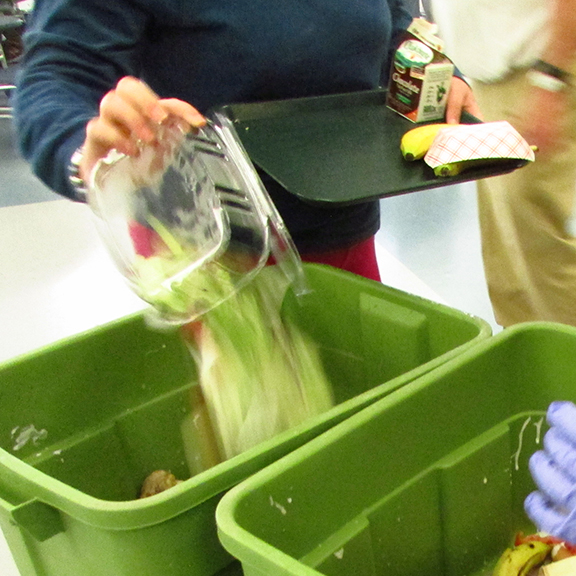
Brenneman helped launch the second Maine School Cafeteria Wasted Food Study at four schools. Maine schools collectively function as the state’s largest food-service operation and are one of the largest food waste generating sectors. Through these pilot programs with Maine schools, FRM has shown that reducing wasted food can save schools money while helping the state meet its solid waste reduction goals.
Of the four schools participating in the second pilot, he spent the majority of his time at Easton Elementary School in Aroostook County. He became a fixture in the school cafeteria over the next two years as he helped the staff and students create systems for diverting wasted food, eliminating plastic materials like single-use silverware and foil condiment packages, and setting up stations to share food items that would typically end up in a trash can.
These pilot programs culminated in the production of the “Maine School Cafeteria No More Wasted Food DIY Toolkit.” with Brenneman as the lead author. The toolkit is a comprehensive step-by-step guide for Maine schools seeking to reduce wasted food. The Maine Department of Education Child Nutrition Program, one of FRM’s longtime partners, shared the guide with all Maine school nutrition directors, and Brenneman gave toolkit presentations at the 2026 New England Farm to Institution Summit, the Maine School Nutrition Association conference, and at the Mitchell Center’s Sustainability Talk series.
Shortly after the guide was published, the Maine legislature passed LD 1065, a law stating that by 2031 any institution that wastes more than 100 pounds of food a week must redirect it out of the waste stream by donation, composting, or anaerobic digestion. Brenneman hopes the toolkit will make it easier for schools to implement food waste reduction strategies that will soon be required.
For Brenneman, it was proof that community-level collaboration can reach all the way to the statehouse.
“The Mitchell Center really allowed me to feel like I belonged there in a way that wasn’t just a two-year pit stop, but that I was actually invested in these long-term projects that the state, the Mitchell Center, and the university have going on,” Brenneman said.

The FRM project wasn’t the only place Brenneman put his beliefs in community engagement into practice. He applied the same approach to his work with Mitchell Center faculty fellow Cindy Isenhour on a pilot project with coastal Maine restaurants to trial reusable take-out containers as a way to reduce plastic marine pollution. Brenneman served as the coordinator for South Portland, first leading community outreach during the survey portion of the project and then acting as the liaison between the pilot restaurants, partners in South Portland, and the rest of the UMaine team.
He also had a chance to share his knowledge with undergraduate students. He served as a poster judge at the Maine Sustainability & Water Conference, where he reviewed dozens of student posters from institutions across Maine. “The experience opened my eyes to the wealth of strong academic institutions here in Maine all contributing to solving pressing sustainability challenges facing our state,” he said.
For two semesters, he co-taught the one-credit Seminar in Sustainability Solutions course with Mitchell Center director David Hart. Students in this class attend the Mitchell Center’s weekly Sustainability Talk series and explore how the speakers are transforming their knowledge into action — like how Brenneman took his knowledge of food systems and developed them into a replicable system for reducing wasted food in Maine schools.
He reflected that the class challenged students’ assumptions. Many arrived thinking academic research and community engagement couldn’t co-exist, but their experiences with the Mitchell Center, Brenneman said, helped prove otherwise.

Before his graduation in May 2026, Brenneman visited Easton Elementary School to say farewell. He was greeted with hugs from the lunch staff, and together they shared a school lunch. It reinforced the value of taking time to build relationships and find common ground. This methodical approach, he believes, creates durable programs that are bigger than any one person or project.
Brenneman is now ready to put all these lessons to work in downtown Minneapolis where he is serving in city hall; his work focused on decarbonization and climate action. “I was inspired to find a job in public service thanks in part to my Mitchell Center projects and many of the speakers I got to learn from during the course I taught,” he said.
He’s already thinking beyond Minneapolis and isn’t ruling out a return to teaching. He envisions himself eventually earning a doctorate and returning to Maine to lead the kind of community-engaged research that shaped his own graduate experience with another generation of changemakers.