
Molly Shea: From a love of nature to green energy evaluations
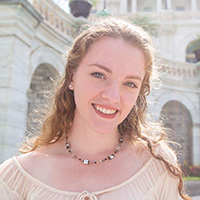
Molly Shea’s journey at the University of Maine led her somewhere she never anticipated. Shea always knew she cared about the environment and wanted to be involved with academic research. But during her years at UMaine, she also developed a surprising passion for economics, found an important mentor, and entered a burgeoning field of study about PFAS — per- and polyfluoroalkyl substances — also known as forever chemicals.
Now that she has completed her master’s degree at UMaine, Shea is using everything she learned to tackle the complex analytical questions behind pressing environmental issues and policy decisions.
Coming to UMaine for nature
Shea grew up in southern New Hampshire, where she fell in love with hiking, kayaking, and “all things outdoors,” she said. UMaine fit all of her criteria as she searched for the right undergraduate program: opportunities for outdoor recreation, an ecology and environmental sciences (EES) major, and a close-knit community.
“I think UMaine has a really unique community that not all places have where there’s a lot of support, and there is a kind of warmth that other universities don’t necessarily have,” Shea said.
A few semesters in, Shea found a surprising passion: economics. Shea never expected to pursue this field; while in high school, she took a challenging economics class and didn’t think she was particularly adept at the subject. Then she took microeconomics as one of her core requirements and realized that the subject was second nature to her.
The professor pulled Shea and a few other students aside at the end of the class and, based on their exceptional performance, encouraged them to continue pursuing economics in their academic careers.
Gaining real-world research experience
As her interests were shifting, Shea began applying for research assistant positions to gain real-world experience and contribute to the UMaine community. As a sophomore, she worked with Sonja Birthisel, then a postdoctoral research associate in EES, studying sustainable farming techniques, specifically whether processes like tarping for weed control could leach plastics into the soil. Some of Birthisel’s weed control research was supported by a grant from the Mitchell Center.
“It was a really good introductory experience into what academic research looks like,” Shea said.
Shea conducted both field work and lab work for the project. She enjoyed the process of taking and testing soil samples, but, between her love of the environment and her growing interest in economics, she realized that her true passion was policy.
When Shea took a class with Caroline Noblet, associate professor of economics and Mitchell Center faculty fellow, about the economic valuation of natural resources, she realized she had found her niche. Noblet posted a research assistantship position that Shea applied for. Once hired, Shea started working with Noblet, who has since become an invaluable mentor. Shea’s position focused on what was then a fairly new field of research: PFAS.
As the first student researcher on Noblet’s interdisciplinary team, Shea assisted in the development and distribution of one of Maine’s first comprehensive public PFAS surveys. The survey queried Mainers about their attitudes, perceptions, and knowledge regarding PFAS. Noblet was also curious about the impact of PFAS on rural communities, particularly farming areas.
“We learned a lot. It was really the beginning stages of PFAS knowledge so anything we could get was really important,” Shea said. “I think the biggest thing that we learned is that there is an education gap, suggesting that people want to know more than they currently know. So there is a need for further education in the state regarding PFAS.”
Being a student researcher also provided Shea opportunities to venture outside of her comfort zone by presenting at conferences and events, including at the Maine Sustainability & Water Conference and the 2023 UMaine Student Symposium.
“I think those experiences really helped me get over my stage fright and learn how to communicate in professional environments and communicate results effectively,” Shea said. “If I wasn’t involved in this research, I wouldn’t have gotten those experiences.”
Going on to graduate school
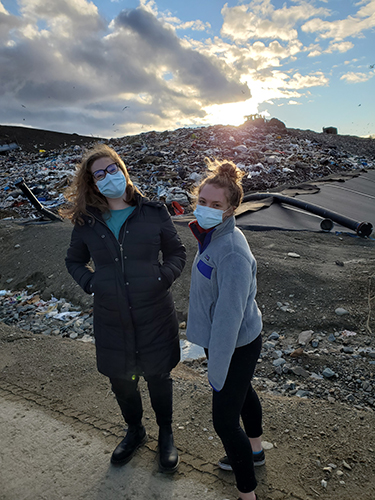
During her junior year, Shea decided to pursue a master’s degree and continue her PFAS research with Noblet. She enrolled in the Accelerated Graduate Program to study the economics of natural resource management. Additionally, she trained under One Health and the Environment, a National Science Foundation (NSF) Research Traineeship (NRT) that focused on intersections among human, animal, plant, and environmental health.
Now that social scientists had gained insights into how the general public was reacting to the PFAS crisis, they began to refine their research. Shea spent the majority of her master’s program surveying licensed hunters and anglers in Maine to understand how they may be impacted by PFAS, particularly in light of the new standards set by the Maine Department of Inland Fisheries and Wildlife about eating fish or wild game contaminated by PFAS.
Noblet said, “Molly consistently took the initiative. She understood that each new research challenge afforded her the opportunity to expand her knowledge and learn new skills.”
After graduating with her master’s degree in economics, Shea accepted a job as an associate consultant at Opinion Dynamics which was recently purchased by E Source. The company evaluates clean energy initiatives, primarily for utility companies. One client, a utility on Long Island, New York, used the firm’s report to help them design heat pump technology programs. More recently, Shea evaluated energy efficiency programs to see how effective their rebates are in motivating consumers to transition from gas to electric vehicles.
Similar to her interdisciplinary graduate work, many people work together to generate these comprehensive reports. As the social scientist on the team, Shea is grateful for the skills related to survey design and analysis that she acquired while working with Noblet.
“There’s usually a lot of chefs in the kitchen, from engineers to data managers. Everything about my time at UMaine and the Mitchell Center has translated very well to what I’m doing here,” Shea said.