
Academic Program Actions
Creations, Suspensions and Eliminations
Definition of Terms:
“Academic Program” is defined as a prescribed course of study (i.e., course or other academic requirements) that a student must complete within a specific subject matter area. This definition includes academic programs of study identified by a specific degree title, documented on a transcript, diploma, and/or described in an undergraduate or graduate catalog. Thus, all undergraduate majors, graduate degree programs, post-master’s advanced certificates of study, concentrations, minors, associate degrees, and credit-bearing certificates meeting one of these criteria are considered programs of study.
“Intent to Plan” (ITP) refers to the initial notification document that signals to campus and System leadership the desire to develop a full program proposal.
“Program Proposal” refers to the full proposal developed by units following the approval of an ITP by campus and System leadership. The proposal criteria is extensive, requiring proposers to include substantial evidence and justification for the new academic program being considered. The development and submission of a proposal to System leadership must be completed within one calendar year.
“Department” is equivalent to a “School” within a degree-granting college.
The “Undergraduate Program Curriculum Committee” is a committee of the Provost that reviews new and modified program or course offerings to ensure compliance with relevant university policies and union contracts.
Action Types
Proposals of New Majors, Graduate Degree Programs and Certificates of Advanced Study
The creation of a new major, graduate degree program, or certificate of advanced study follows a two-step process at the campus level:
Step 1: Intent to Plan
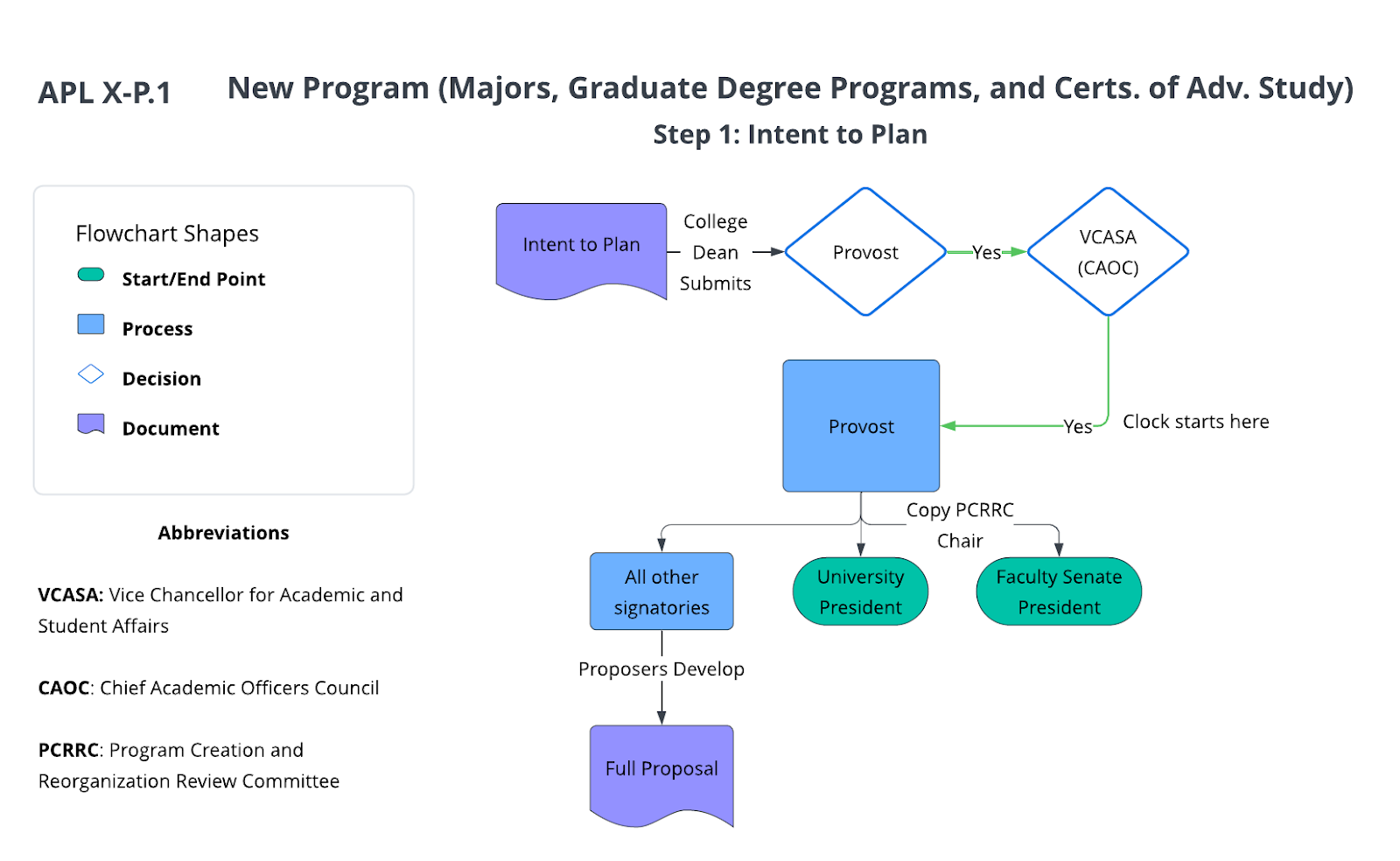
An Intent to Plan (ITP) document is developed by the department in which the new program will be housed and in consultation with the college dean. ITPs must include the following information as specified in APL X-P.1:
An Intent to Plan (ITP) will be submitted to the University Provost with a written description and rationale for a new program in 500 words or less. The ITP must briefly address the following areas:
- general objective of the proposal and how it supports the mission of the university
- evidence of need supported by market analysis
- involvement of universities with similar programming
- extent of support presently available and/or new costs required
- timeline
The college dean submits the ITP to the Provost for review and approval. If the Provost approves, the ITP is forwarded along with a letter of support to the Vice Chancellor for Academic and Student Affairs (VCASA), who presents it to the Chief Academic Officers Council (CAOC) for review and comment. If the VCASA approves, the ITP is returned to the Provost to notify the University President, Faculty Senate President and Program Creation Reorganization and Review Committee Chair(s), and all other signatories of the ITP, including the college dean and proposers. The proposers then begin the process of developing a full proposal.
If at any point the ITP is disapproved, it is returned to the college by the Provost. If relevant, the college may choose to revise and resubmit the ITP following the college’s internal processes.
Step 2: Program Proposal
A full program proposal must, at minimum, address the following areas as specified in APL X-P.1:
- program objectives and content;
- program need (to include the detailed findings of the market analysis conducted in consultation with campus or University of Maine System (UMS) institutional researchers or other relevant programmatic information);
- differentiation from similar existing UMS programs or how programs will complement each other;
- availability of resources and finances for sustainable program support;
- outline of the future program evaluation process;
- accommodations for diverse accessibility needs under Americans with Disabilities Act (ADA);
- documentation of the university’s approval process, including letters of support from the university president and provost.
- Pro Forma statement (maintained by the VCASA office)
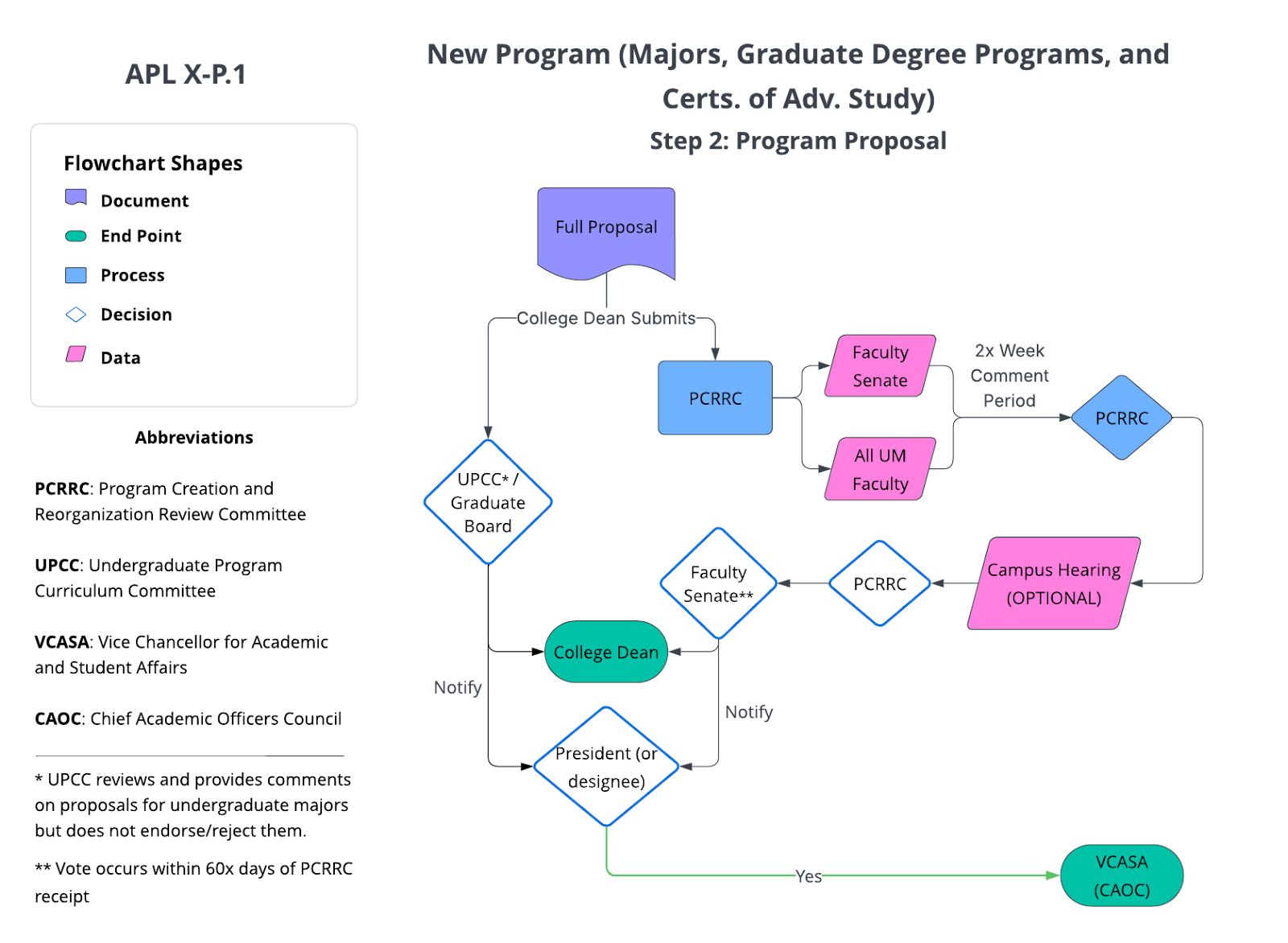
Following the development of the full proposal, the college dean submits the proposal to 1) the Faculty Senate’s Program Creation and Reorganization Review Committee (PCRRC) and 2) either the Undergraduate Program Curriculum Committee (UPCC) (if an undergraduate major) or the Graduate Board (if a graduate program or a certificate of advanced study). Note that the UPCC does not formally approve or reject proposals for new undergraduate majors.
PCRRC review processes are explained in detail in the standing committee’s policy manual. After receipt of the full proposal, the PCRRC forwards it to 1) the Faculty Senate and 2) all University of Maine faculty. Each entity is given 2x weeks to submit comments to the committee. Depending on the volume and content of written comments, the committee may or may not elect to hold a campus hearing. Using the comments it receives from the public comment period and the campus hearing, the PCRRC may request revisions from the proposers or it may issue a recommendation to the faculty senate to endorse or reject the full proposal. The period from PCRRC receipt of the proposal to the Faculty Senate decision must not exceed 60 days.
UPCC and the Graduate Board review proposals and provide feedback at their regularly scheduled meetings.
If PCRRC or the Graduate Board determine that substantive changes to a program suspension proposal are necessary, the proposers must prepare and resubmit a revised version—with track changes—to all reviewing groups within a reasonable time frame. As soon as revisions are requested, the proposers should notify all reviewing groups that a revised proposal will be submitted. Guidance on what constitutes a “reasonable time frame” may be obtained from the Provost’s Office following receipt of the pending request.
Following approval by the Faculty Senate and Graduate Board (if relevant), notification of approval along with a copy of the (revised) proposal is sent to the college dean and the President (or designee). If the President (or designee) approves of the proposal, it is forwarded to the VCASA. After review of the proposal by the CAOC at the next regularly scheduled meeting, the VCASA may choose to take one of the following actions as described in the APL:
- forward the proposal with a recommendation for approval to the Chancellor;
- refer the discussion of the program proposal to the President’s Council;
- seek external review from disciplinary experts;
- return the proposal to the originating university with specific critiques and suggestions for revision; or
- return the proposal to the initiating university with specific written rationale for its rejection.
If at any point the proposal is disapproved, it is returned to the college by the disapproving body with specific written rationale for its rejection.
Note: The university must submit the full proposal to the CAOC within 12 months of ITP approval by the VCASA.
Proposals of New Majors, Graduate Degree Programs and Certificates of Advanced Study
The campus-level process for the creation of a new concentration, minor, or undergraduate certificate (CMC) is as follows:
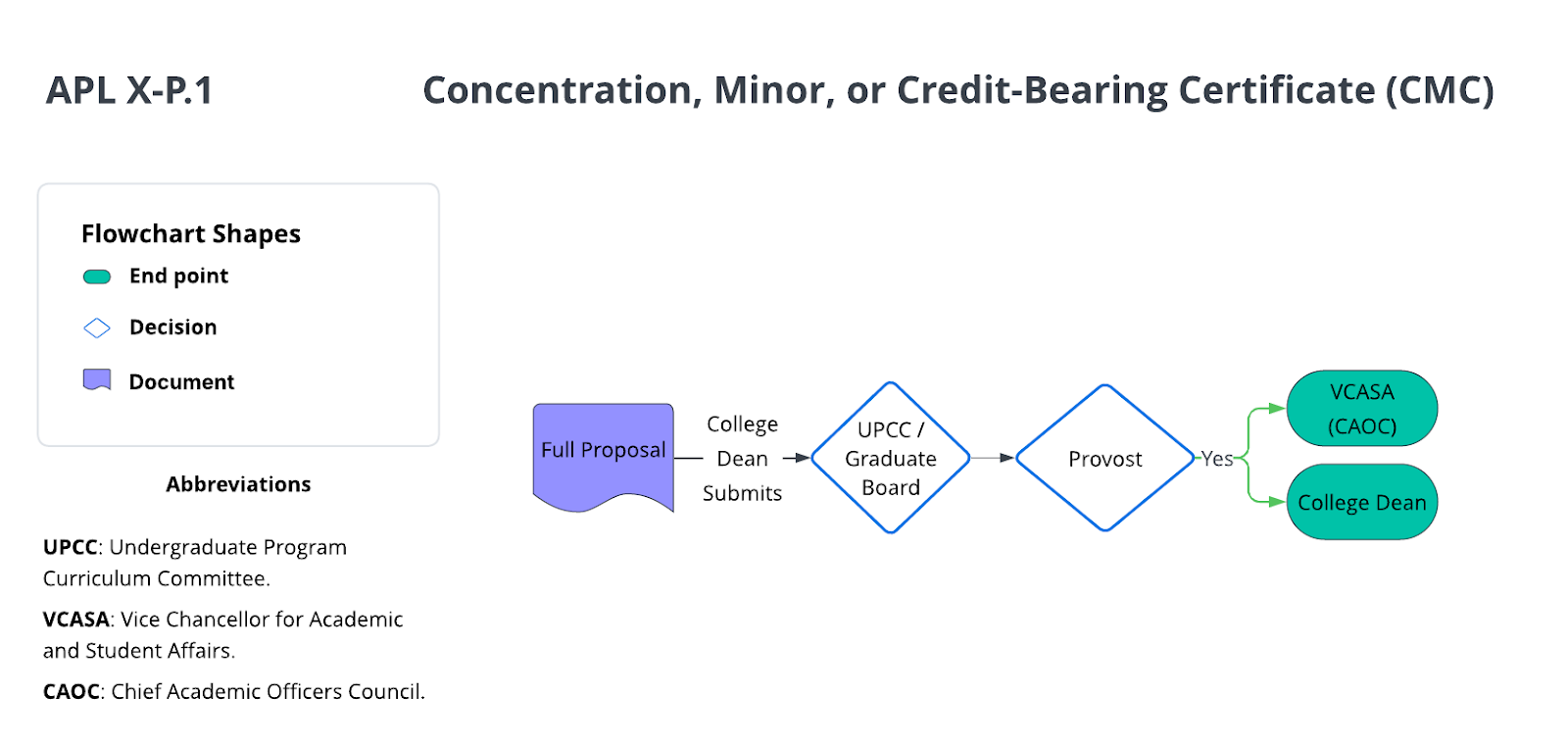
Note that proposals for CMCs do not require an Intent to Plan (ITP). Proposals must address the following areas in accordance with APL X-P.1:
- CMC objectives and content;
- availability of resources and finances for sustainable CMC support;
- accommodations for diverse accessibility needs under ADA;
- documentation of the university’s approval process, including letters of support from the university president and provost.
After a proposal has been developed, the college dean submits the proposal to either 1) the Undergraduate Program Curriculum Committee (UPCC) (in the case of Undergraduate CMCs) or 2) the Graduate Board (in the case of graduate concentrations).
The UPCC or Graduate Board, according to internal review processes, may choose to take one of the following actions: 1) endorse the proposal as written, 2) endorse the proposal with stipulations, or 3) return the proposal to the college dean with specific rationale for its rejection.
If approved, the UPCC/Graduate Board provides notice along with a copy of the proposal to the Provost. If the Provost approves, the proposal is forwarded to the college dean and the Vice Chancellor for Academic and Student Affairs (VCASA) for discussion at the next regularly scheduled Chief Academic Officers Council (CAOC) meeting. After review of the proposal by the CAOC, the VCASA may choose to take one of the following actions as described in the APL:
- approve as written;
- approve with stipulations;
- return the proposal to the originating university with specific critiques and suggestions for revision; or
- return the proposal to the initiating university with a specific rationale for its rejection
If at any point the proposal is disapproved, it is returned to the college by the disapproving body with specific written rationale for its rejection.
Note: Since approval is not required by the Board of Trustees/Chancellor for CMCs, the Program Creation and Reorganization Review Committee (PCRRC) of the Faculty Senate also does not require these types of proposals to undergo committee review and Senate approval.
Academic Program Suspensions
APL X-P.4 explains that the Program Suspension Procedure may commence as a result of any of the following:
- the program review process,
- the initiative of the campus offering the program, or
- the initiative of the Chancellor.
When considering a program suspension, please contact the Office of the Provost directly before taking any of the steps outlined below.
The suspension of an academic program (including new majors, graduate degree programs, certificates of advanced study, minors, concentrations, and credit-bearing certificates) follows a two-step process at the campus level.
Step 1: Intent to Develop a Suspension Proposal
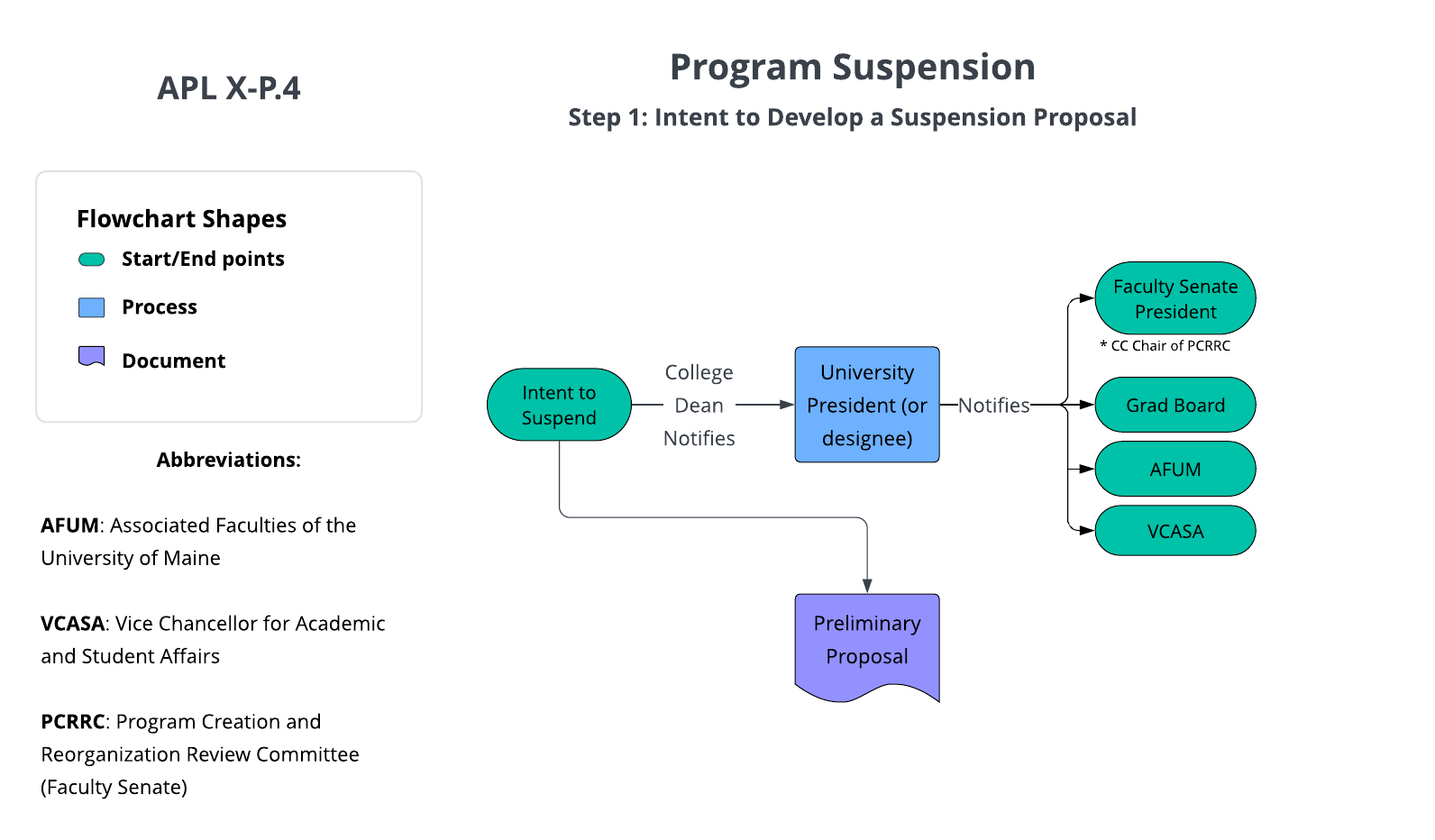
Step 1 of the Procedure is notification of the intent to develop a suspension proposal by the college dean to the President and Provost. The President or designee must then notify the Faculty Senate President and Chair(s) of the Program Creation and Reorganization Review Committee (PCRRC), the Associated Faculties of the University of Maine System (AFUM), the graduate board (if a graduate program), and the Vice Chancellor for Academic and Student Affairs (VCASA). The notification of the intent to suspend a program does not require attaching a formal document as does an “Intent to Plan.”
The proposers must then develop a formal, preliminary proposal.
Step 2: Develop a Program Suspension Proposal
Preliminary Program Suspension Proposals should, at minimum, address the following areas as specified in APL X-P.4:
- A five-year summary of program enrollments (number of majors and number of graduates) and number of faculty equivalents (FTEs) associated with the program.
- The specific rationale for the suspension of the program.
- The relationship of the program suspension to the institutional mission and to other programs at the institution. Where faculty positions are involved, UMS will follow the AFUM agreement and will consult with the appropriate faculty governance body.
- A plan for the assignment of faculty during the suspension period.
- The impact of the program suspension on students, including plans for assisting students to complete an appropriate degree program.
- A timetable for the program suspension, with date for consideration of the program for reinstatement or elimination.
Campus input as outlined below shall be included in the complete Program Suspension Proposal:
- The input obtained from meeting and discussion with the appropriate faculty committees and with the Associated Faculties of the University of Maine System prior to completion of the proposal.
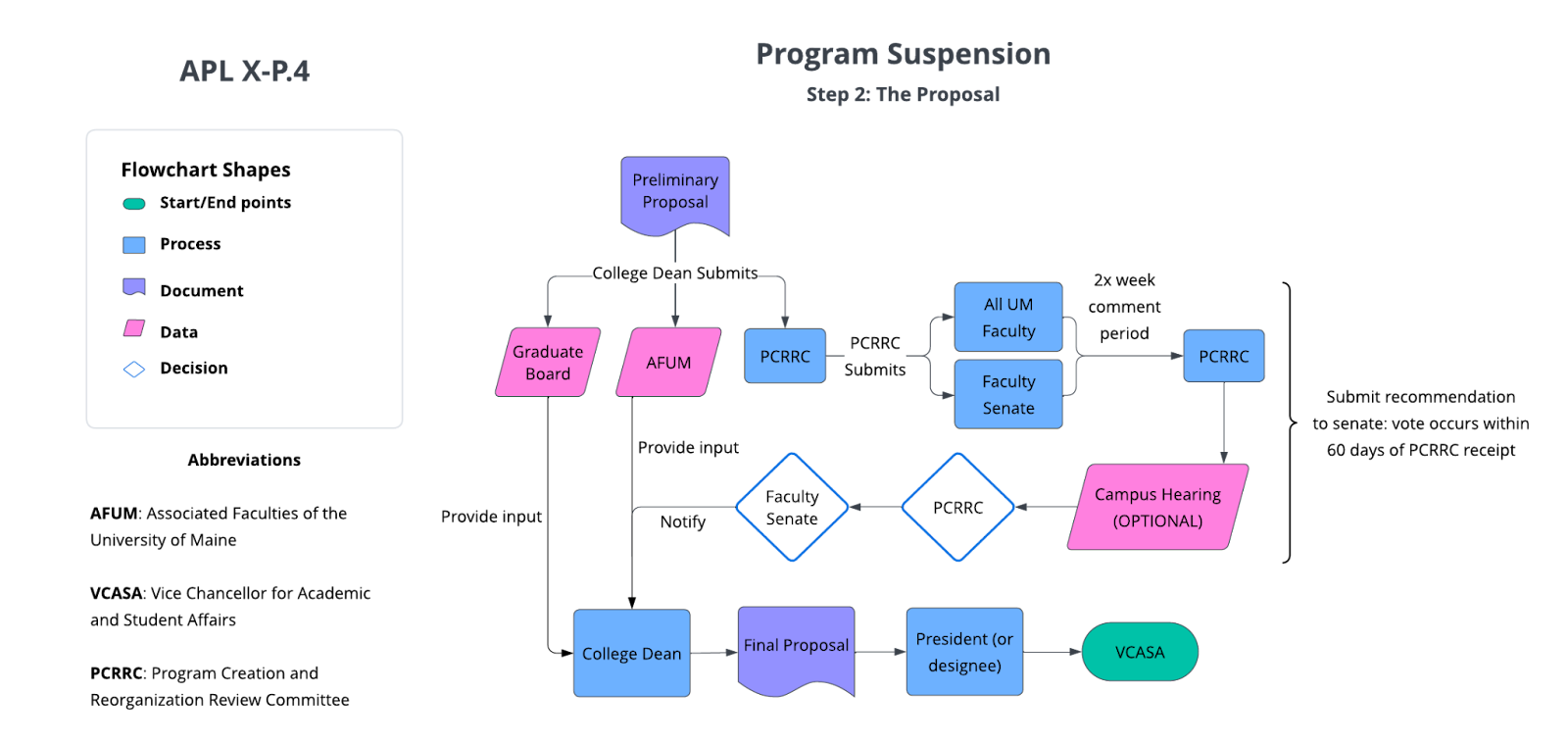
Following the development of the preliminary Program Suspension Proposal, it is submitted by the college dean to 1) the Faculty Senate’s Program Creation and Reorganization Review Committee (PCRRC), 2) the Associated Faculties of the University of Maine (AFUM), and 3) the Graduate Board (if a graduate program).
PCRRC review processes are explained in detail in the standing committee’s policy manual. After receipt of the full proposal, the PCRRC forwards the proposal to 1) the Faculty Senate and 2) all University of Maine faculty. Each entity is given 2x weeks to submit comments to the committee. Depending on the volume and content of written comments, the committee may or may not elect to hold a campus hearing. Using the comments it receives from the public comment period and the campus hearing, the PCRRC may request revisions from the proposers or it may issue a recommendation to the faculty senate to endorse or reject the preliminary proposal. The period from PCRRC receipt of the preliminary proposal to the Faculty Senate decision on that proposal must not exceed 60 days.
AFUM and the Graduate Board review proposals and provide feedback at their regularly scheduled meetings.
If PCRRC, AFUM, or the Graduate Board determine that substantive changes to a Program Suspension Proposal are necessary, the proposers must prepare and resubmit a revised version—with track changes—to all reviewing groups within a reasonable time frame. As soon as revisions are requested, the proposers should notify all reviewing groups that a revised proposal will be submitted. Guidance on what constitutes a “reasonable time frame” may be obtained from the Provost’s Office following receipt of the pending request.
The PCRRC, AFUM, and the Graduate Board (if relevant) will forward their feedback along with any decisions on the preliminary proposal to the college dean. The dean will distribute these documents to the proposers who must incorporate input into the final Program Suspension Proposal. The college dean then forwards the final proposal to the President (or designee) who forwards it to the VCASA for review by the Presidents and Chief Academic Officers of all other System campuses.
Academic Program Eliminations
APL X-P.5 explains that the Program Elimination Procedure may commence as a result of any of the following:
- the program review process,
- the initiative of the campus offering the program, or
- the recommendation of the Chancellor based on enrollments and the centrality of the program to the campus mission.
When considering a program elimination, please contact the Office of the Provost directly before taking any of the steps outlined below.
The elimination of an academic program (including new majors, graduate degree programs, certificates of advanced study, minors, concentrations, and credit-bearing certificates) follows a two-step process at the campus level.
Step 1: Intent to Develop a Program Elimination Proposal
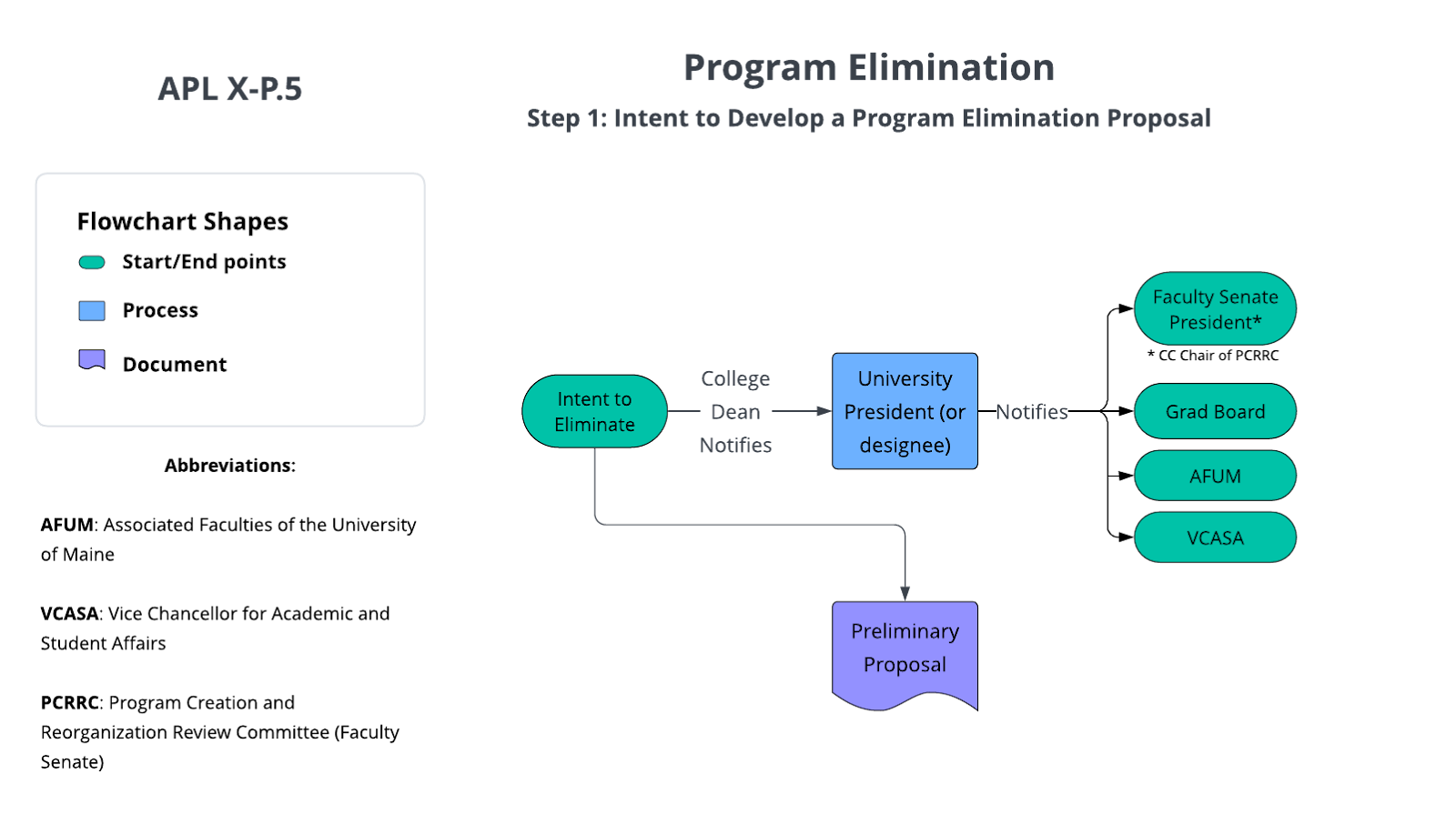
Step 1 of the Procedure is notification of the intent to develop an elimination proposal by the college dean to the President and Provost. The President (or designee) must then notify the Faculty Senate President and Chair of the Program Creation and Reorganization Review Committee (PCRRC), the Associated Faculties of the University of Maine System (AFUM), the Graduate Board (if a graduate program), and the Vice Chancellor for Academic and Student Affairs (VCASA). The notification of the intent to eliminate a program does not require attaching a formal written document as does an “Intent to Plan.”
The proposers must then develop a preliminary Program Elimination Proposal.
Step 2: Develop a Program Elimination Proposal
Preliminary Program Elimination Proposals must, at minimum, address the following areas as specified in APL X-P.5:
- A five-year summary of program enrollments (number of majors and number of graduates), course section enrollments, number of full-time faculty equivalents associated with the program, and budgets.
- The specific rationale for the elimination of the program including an indication of the campus process used to reach the recommendation.
- The relationship of the program elimination to the campus mission and to other programs on campus.
- A plan for the retrenchment or reassignment of faculty.
- The impact of the program elimination on students.
- A timetable for the program elimination.
Campus input as outlined below shall be included in the complete Program Elimination Proposal:
- The input obtained from meeting and discussion with the Associated Faculties of the University of Maine System prior to completion of the proposal.
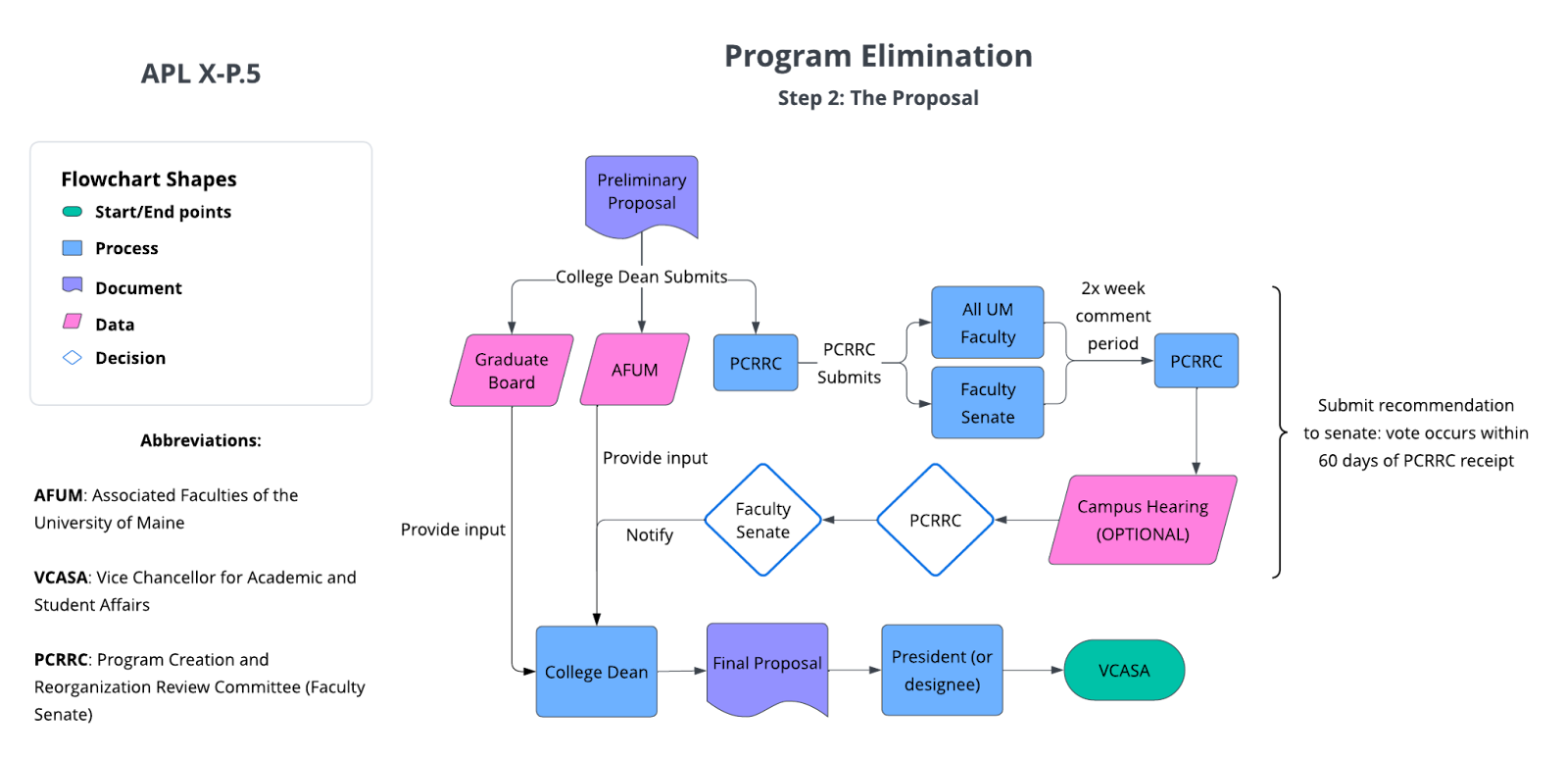
Following the development of the preliminary Program Elimination Proposal, it is submitted by the college dean to 1) the Faculty Senate’s PCRRC, 2) AFUM, and 3) the Graduate Board (if a graduate program).
PCRRC review processes are explained in detail in the standing committee’s policy manual. After receipt of the preliminary proposal, the PCRRC forwards the proposal to 1) the Faculty Senate and 2) all University of Maine faculty. Each entity is given 2x weeks to submit comments to the committee. Depending on the volume and content of written comments, the committee may or may not elect to hold a campus hearing. Using the comments it receives from the public comment period and the campus hearing, the PCRRC may request revisions from the proposers or it may issue a recommendation to the faculty senate to endorse or reject the preliminary proposal. The period from PCRRC receipt of the preliminary proposal to the Faculty Senate decision on that proposal must not exceed 60 days.
AFUM and the Graduate Board review proposals and provide feedback at their regularly scheduled meetings.
If PCRRC, AFUM, or the Graduate Board determine that substantive changes to a Program Elimination Proposal are necessary, the proposers must prepare and resubmit a revised version—with track changes—to all reviewing groups within a reasonable time frame. As soon as revisions are requested, the proposers should notify all reviewing groups that a revised proposal will be submitted. Guidance on what constitutes a “reasonable time frame” may be obtained from the Provost’s Office following receipt of the pending request.
The PCRRC, AFUM, and the Graduate Board (if relevant) will forward their feedback along with any decisions on the preliminary proposal to the college dean. The dean will distribute these documents to the proposers who must incorporate all input into the final Program Elimination Proposal. The college dean then forwards the final proposal to the President/Provost who forwards it to the VCASA for review by the Presidents and Chief Academic Officers of all other System campuses.