
The Wild Blueberry Research Team
2025 Award for Outstanding Contribution Toward the Development of a Solution by a Research Team
The UMaine Wild Blueberry Research Team has ramped up its climate change research over the past year, tackling critical questions about the crop’s future.
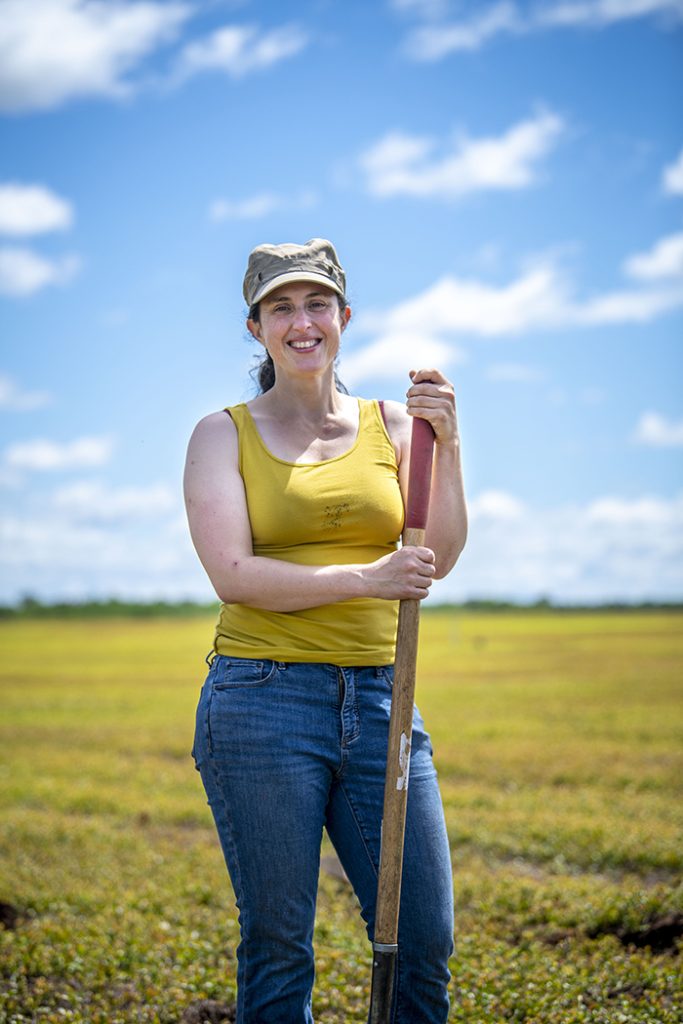
The goal of the research, funded by the United States Department of Agriculture’s National Institute of Food and Agriculture, is to address the many challenges facing Maine’s wild blueberry growers. Led by Rachel Schattman, an associate professor of sustainable agriculture and Mitchell Center faculty fellow, the team aims to build agricultural resilience in a changing climate while protecting natural resources.
This research primarily takes place at the Wyman’s Wild Blueberry Research and Innovation Center, created in 2022 at UMaine through a gift from Wyman’s, a wild blueberry grower and processor based in Milbridge, Maine. Here, Schattman and her team designed and installed a wild blueberry ecosystem that mimics the growing conditions of Maine’s wild blueberry barrens.
The experimental system is now used in the four-year USDA trial designed to understand how wild blueberries might respond to different climate scenarios that are predicted outcomes of a changing climate.
It’s a complex project involving not only the wild blueberry industry but students of plant physiology, entomology, mycology, climatology, economics, and crop modeling. Managing this interdisciplinary scope requires both scientific expertise and skillful coordination. Schattman emphasizes collaboration and communication in managing this diverse team of students, researchers, and external partners.
“Rachel’s commitment to problem-solving—whether related to staffing, equipment, methodology, or field logistics—has ensured that the center produces high-quality, applied science focused on both filling knowledge gaps and operationalizing findings for growers,” an award nominator said.
The quality of Schattman’s research program also relies on her support for each student’s educational experience and individual interests. For undergraduates, it’s often one of their first training opportunities in field science. During the growing season, they’re responsible for counting flowers, buds, and pollinators. They also help look for plant diseases and assist with watering, weeding, and harvesting. Doctoral students take on more responsibility and have greater creative autonomy. One is currently studying how different climate scenarios impact the fungi, called mycorrhiza, that may support the crop. Another is examining how the plants physically respond to the experimental treatments.
Lots of Google Sheets and regular communication, Schattman explained, are central to keeping everyone organized. She schedules quarterly meetings to keep the team updated on different parts of the project, essential given how the various components are interconnected.
Because Schattman and her team are only two years into the four-year trial, she’s cautious about drawing premature conclusions, especially since 2025’s drought may influence the results for that year. Some of the team’s data, however, has already been put to practical use. Working with Jonathon Malacarne, a principal investigator on this research, the team conducted an economic analysis of different irrigation systems for wild blueberries that led to the development of an online calculator. The tool allows growers considering irrigation investments to set up different scenarios and compare costs of various systems against potential yield increases, especially in dry years. Malacarne is also an assistant professor at the UMaine School of Economics and Maine’s sole agricultural economist.
This is just one example of the team’s ability to translate findings into accessible, actionable guidance, and Schattman looks forward to turning future results into practical solutions for Maine wild blueberry growers.
“I just am in awe and so appreciative of the people that I work with, both at the university and at Wyman’s and in the industry at large. It makes for a really great experience, which I hope is meaningful to the state,” Schattman said.