
Sam Roy, Maine Geological Survey
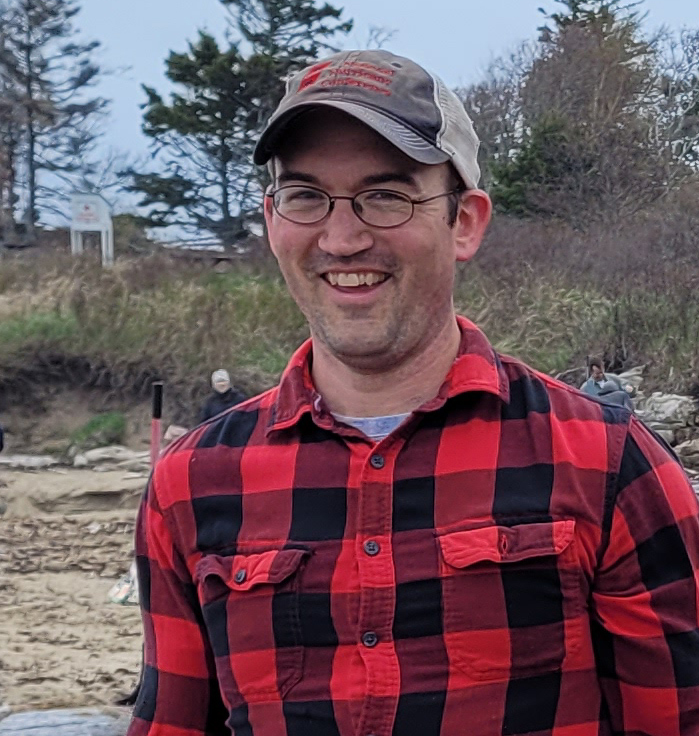
2025 Award for Outstanding Contribution by an External Partner to Sustainability Research
No matter the project, Sam Roy leans into the network he built at the Mitchell Center and to the conviction that science should serve the public. Roy is a marine geologist with the Maine Geological Survey (MGS) and serves as a Mitchell Center faculty fellow. He received his bachelor’s, master’s, and doctoral degrees from UMaine, and then completed a postdoc at the Mitchell Center where he worked on the Safe Beaches & Shellfish project and the Future of Dams project.
Roy is currently one year into a five-year project to update the maps of Maine’s coastal bluffs which constitute about 45% of the coast and are susceptible to erosion caused by waves, wind, and storms. It’s a massive multi-agency project involving Maine’s departments of Environmental Protection, Marine Resources, and Inland Fisheries and Wildlife.
As geologists, Roy’s team brings a specific expertise to the mapping, looking at physical evidence like erosion rates, the clay content of a bluff, and how groundwater influences the bluff. To understand the broader environmental forces acting on these coastal features, Roy collaborates with engineers at UMaine to better understand factors that influence bluff stability.
“They’re studying different factors like wave energy, wave power, and wave direction.The engineers are helping us understand the broader environment,” Roy said.
Technical engineering data, collected by a current doctoral student at UMaine, is also used in the Living Shorelines Decision Support Tool, an important resource Roy is helping to update. The tool provides a color-coded map that shows how suitable different sections of Maine’s coastline are for nature-based solutions. Nature-based solutions use vegetation, natural materials, and green infrastructure to protect the coastline from erosion rather than hard structures like seawalls.
Roy also draws on relationships with his UMaine colleagues at River Flow Advisory Commission (RFAC) meetings where he’s served as the facilitator for the last five years. Established after major floods in the 1980s, the commission is composed of representatives from eight major river basin management operations, state and federal agencies, and UMaine. The group serves to improve the exchange of information about Maine river flooding.
Sean Smith, an associate professor in the UMaine School of Earth & Climate Sciences, director of the Darling Marine Center, and Mitchell Center faculty fellow, is Roy’s friend and respected colleague who also serves on the RFAC. Roy appreciates the expertise in Maine hydrology Smith brings to these meetings. Roy learned some tricks from Smith in his approach as facilitator.
“Like Smith, I took a more technical angle, understanding the science and trying to bring together more groups who are impacted by flooding. The group is bigger now, and I think it’s more engaged than it has been in the past,” Roy said.
In another collaboration with UMaine, this time with Maine Sea Grant faculty Taylor Spencer and Jessica Jansujwicz, Roy hopes to engage the public with coastal science. One idea is to create an annual bluff day event in the spring. He’s also hoping to develop a tool where people who are active along Maine’s coast can report changes to Maine’s bluffs.
Roy is also committed to developing the next generation of interdisciplinary scientists, often bringing UMaine students under his wing as interns. He’s currently working with the undergraduate advisor in the School of Earth and Climate Sciences to establish a pipeline of students who might be interested in government science work.
Whatever the project, Roy continues to rely on his Mitchell Center colleagues. About these relationships Roy said, “There’s a deeper meaning there. And I think it has to do with how we’re all interested in applying science. It’s not just about pumping out papers, it’s more about making a difference in the world. That’s definitely been a benefit for keeping my connections with Mitchell Center folks,” said Roy.