
Caroline Noblet’s Most Important Research Tool? Talking With People
Article by Sonja Heyck-Merlin
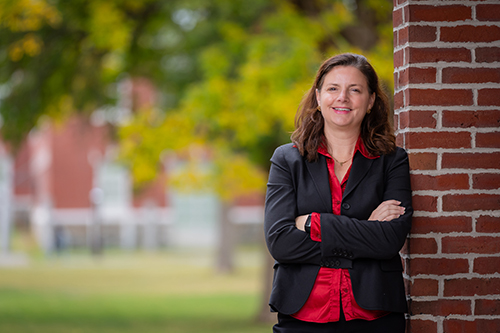
“When I engage in research, when I collect information from people, I’m establishing a relationship with them,” said Caroline Noblet. Noblet is a University of Maine associate professor of economics studying why people make the choices they do and what factors and contexts influence those choices.
Noblet, who is also a Mitchell Center faculty fellow, will be giving the keynote address at the upcoming 2026 Sustainability & Water Conference where she will discuss her work tackling complicated topics, like how Mainers think about PFAS contamination or destructive coastal storms, that require, in Noblet’s experience, genuine connections between scientists and Maine communities.
Noblet’s research, focused on sustainability-related behavioral economics, doesn’t take place in a vacuum. For her, relationships are at the heart of understanding how Mainers think about and respond to issues impacting their families and communities.
This perspective is what sent Noblet and her team knocking on strangers’ doors to gauge coastal Mainers’ views on offshore wind development. The survey was part of a broader project to understand coastal residents’ thoughts on community resilience. Noblet’s team was curious what coastal Mainers thought about community benefit agreements. These are commitments made by wind developers to provide communities with tangible benefits, like jobs, funding, or services, to offset disruptions the development may cause.
Relationships are also the reason Noblet supported a graduate student researcher setting up a table at 4 a.m. at the 75th annual Old Town Hunter’s Breakfast, purported to be the longest continuously running hunter’s breakfast east of the Mississippi. The breakfast provided the perfect setting to survey hunters face-to-face, part of a broader survey in partnership with the Maine Department of Inland Fisheries & Wildlife to understand how Maine hunters are thinking about PFAS contamination in wild game.
Relationship building, however, is also important well before any funding has been awarded or a survey is delivered. Sometimes, according to Noblet, it takes careful listening to learn about the problems Mainers are facing and the impact on their lives. These conversations often spur Noblet’s long-term research agenda.
After the catastrophic coastal storms and flooding in 2023 and 2024, Maine Coast Heritage Trust (MCHT), one of Noblet’s long-standing nonprofit collaborators, expanded engagement with communities on coastal resiliency and flood mitigation strategies. Research shows that salt marshes serve as natural buffers against flooding, absorbing storm surge, wave energy, and heavy rainfall, and this information resonated with community members. MCHT reached out to Noblet’s team and colleagues from other institutions, and a shared research project about decisions that landowners are making about marshland on their properties evolved.
Noblet has also focused on issues related to aquaculture, which emerged from direct engagement with the industry and communities. When Noblet and a colleague were attending an aquaculture industry conference there was a robust conversation about the different ways the aquaculture industry communicates about their products and how they’re marketed. Some people wondered why there are no organic standards for aquaculture products. Others were grappling with how the industry could shift the narrative in light of some negative press decades prior.
Nobelt recalled that there were a lot of ideas and opinions discussed that day. Because she was there, listening and observing, she saw a research opportunity that could benefit those in the room and received funding to test how seafood consumers respond to different names and labels.
Over the years, Noblet has learned that no matter what she’s researching, when she’s engaging with communities, she needs to meet Mainers where they are.
“Things that I might think are the most important problem might not be the problem that someone else thinks is the most important. The way that I talk about a problem may not resonate with someone else,” Noblet said.
This was the case when Noblet was a team member contributing to the 2024 Maine climate action plan at the request of the Governor’s Office of Policy Innovation and the Future. The team was tasked with ascertaining why some Mainers are less likely to engage with climate and energy planning. What they discovered was that it’s not that some people aren’t concerned about climate change or sustainable energy, but that there are often barriers in the way like their personal financial situations or health.
Nobet and her team realized they needed to adapt communication strategies by presenting climate and energy actions in terms that resonated with peoples’ daily experiences. Those experiences are now reflected in the state’s action plan. For example, instead of talking about abstract renewable energy concepts, the report emphasizes energy conservation as something that could reduce financial burdens for families. Similarly, it highlights practical infrastructure improvements like culverts that prevent road flooding after heavy rainfall events, something everyone can relate to and support.
Noblet’s research topics may shift — from offshore wind, PFAS, aquaculture labels, to climate and energy planning — but her approach to community engagement never wavers. It’s what sends her team to strangers’ doorsteps, a hunter’s breakfast, and to other Maine communities.
“You could do all the science in the world, but if it doesn’t connect with people, it just becomes a report that sits on a shelf,” said Noblet.