
Brianne Suldovsky — Bridging Complex Science and Public Understanding
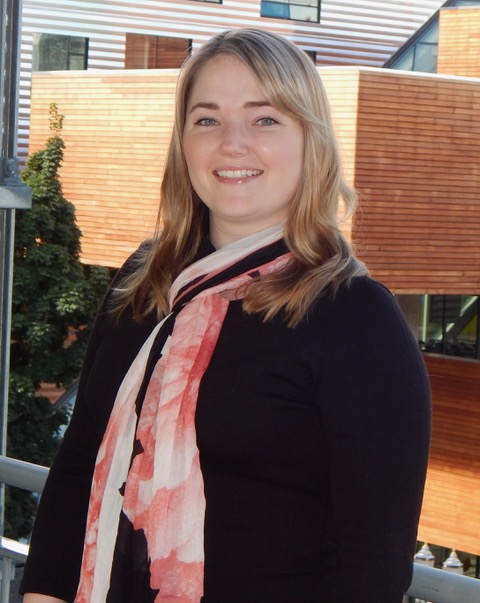
Article by Sonja Heyck-Merlin
Brianne Suldovsky wasn’t sure what she wanted to do as she neared the completion of her master’s degree in communication at Washington State University. Her future, however, crystallized when her advisor introduced her to Laura Lindenfeld, who offered Suldovsky a paid doctoral research position at UMaine.
At the time of their meeting in 2012, Lindenfeld, a former UMaine professor of journalism and communication, was working on the Sustainability Solutions Initiative (SSI). This $20 million National Science Foundation (NSF) grant laid the foundation for the creation of the Mitchell Center for Sustainability Solutions in 2014.
It was SSI’s sustainability and interdisciplinary focus— and the chance to further study how peoples’ beliefs shape their scientific engagement—that compelled Suldovsky to move all the way across the United States.
“SSI provided me with the experience of working on a diverse team. I also really wanted to do applied work and cared that higher education research actually helps society and communities,” Suldovsky said.
Following the SSI project, Suldovsky joined the Mitchell Center’s Safe Beaches and Shellfish Project. The goal of this NSF project was to improve strategies for managing coastal water quality impairment. Suldovsky’s team focused on the communication between project stakeholders who represented a diverse array of perspectives and knowledge — scientists, shellfish harvesters, municipalities, advocacy groups, and the public.
Working collaboratively was challenging, sometimes even frustrating, but the lessons Suldovsky learned were invaluable.
Suldovsky, now an associate professor of communication at Portland State University (PSU) in Portland, Oregon clearly remembers her confusion when an ecologist on the Safe Beaches and Shellfish team talked about “surveying frogs.” To Suldovsky, a social scientist, “survey” had a different meaning. It took her a few minutes to realize that the ecologist wasn’t talking about interviewing frogs; they were talking about counting them.
“I realized that you can’t always assume that everyone is on the same page. You can’t assume that we’re thinking about the problem the same way or that we have the same goals when working together,” Suldovsky said.
Another lesson that Suldovsky learned during her time with the Mitchell Center is that interdisciplinary work requires humility and empathy. She explained that as scientists become more specialized, they can lose empathy for people who don’t share their knowledge base.
“Nothing breaks down communication and engagement faster than a lack of empathy or a feeling that the expert you’re talking to thinks that they’re smarter than you and better than you.” — Brianne Suldowsky
Suldovsky explained that the SSI and Safe Beaches and Shellfish Projects taught her to respect complex problems as truly complex and to be comfortable with the reality that single grants projects won’t solve everything. She developed realistic expectations, understanding that, she said, “We are not going to suddenly make the coast bacteria free in the course of three years.”
Suldovsky continued studying communication after graduating with her doctorate, completing a one-year University of Pennsylvania Annenberg Public Policy Center postdoctoral fellowship in the Science of Science Communication. By the time she finished the fellowship, she had decided she wanted to continue her career in research and teaching. She credits her time at the Mitchell Center for helping her land her dream job as a professor at PSU where she divides her time between the two.
“In my interviews with PSU, I was able to demonstrate that I could do applied solutions-focused research with people in other disciplines. Not a lot of graduate students have the chance to say that or to demonstrate that they have those skills,” she said.
Eight years into the position, Suldovsky occasionally still marvels that she gets paid to examine the role communication plays in sustainability-related topics ranging from youth climate anxiety to peoples’ opinions of genetically modified organisms.
She’s also happy in the classroom, teaching classes like Communicating Environmental Controversies and Research Methods in Communication, where she helps students grasp the complexities of environmental problems and see the value different perspectives offer to the solutions.
Suldovsky often reflects on her relationship with the Mitchell Center and its role in her evolution and success as a researcher and teacher.
“The Mitchell Center really is one of the best interdisciplinary sustainability centers. I owe my current research program to the Mitchell Center. Without it, I would not have my communication and collaboration skills. I have really heartfelt gratitude for my time there and everything that they offered,” Suldovsky said.