
Research
We engineer more function into materials by controlling interfaces, working with biological processes, and designing manufacturing methods that reduce the need for continuous inputs.
Across our research, we ask how materials can perform sophisticated functions with less energy, fewer recurring inputs, and manufacturing approaches suited to a resource-constrained future. The work below shows how we are pursuing that question across biological materials, engineered interfaces, and scalable sensing systems.
Explore our research
Growing function directly on familiar materials
We use fungal growth as a fabrication process, cultivating thin interwoven layers that add liquid-barrier function to paper, textiles, and wood.
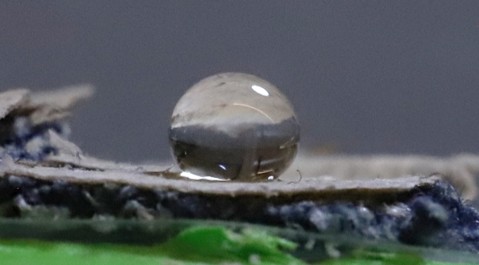
Most coatings are fabricated first and then applied to a surface. We take a different approach: using biological growth itself to fabricate functional structure directly on a material.
By growing fungal hyphae together with cellulose-derived material, we can form thin, interwoven coatings on lignocellulosic substrates. These grown layers resist water, oil, and grease without requiring continuous energy or repeated chemical treatment.
Selected publication:
Zier et al., “Growing sustainable barrier coatings from edible fungal mycelia,” Langmuir (2025)
Fungal mycelium grown with cellulose nanofibrils produced water-, oil-, and grease-resistant coatings across paper, denim, felt, and wood.
From grown coatings to predictive design
We are working toward design rules that connect how a fungal network grows to the structure and performance of the coating it creates.
Building high-value function from abundant cellulose
We turn abundant cellulose into thin functional layers using coating methods designed to work with paper manufacturing rather than specialty fabrication.
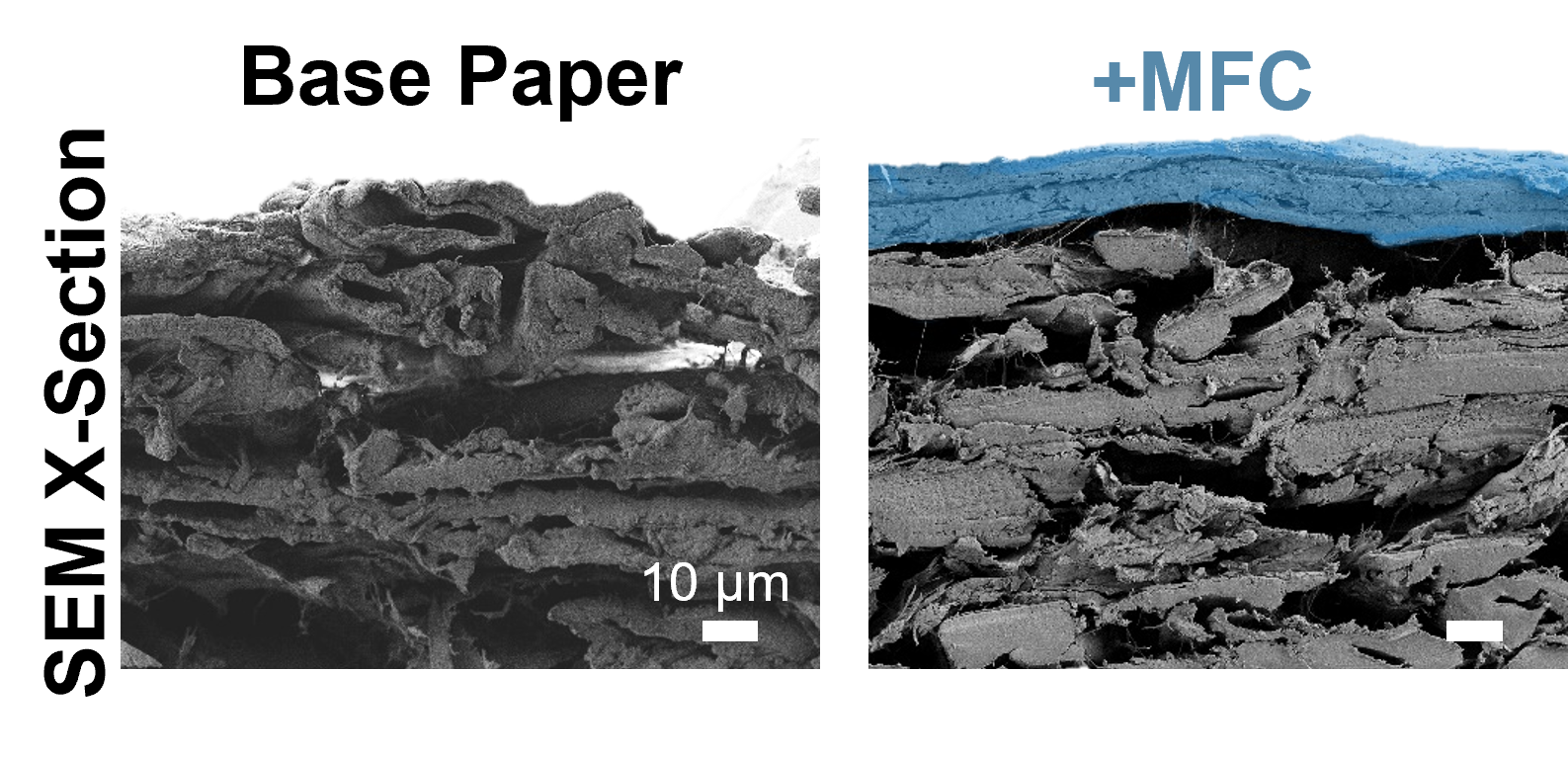
Microfibrillated cellulose (MFC) can form dense, high-performance barrier layers, but their low-solids suspensions make them difficult to apply efficiently using conventional coating approaches. We ask whether the coating process itself can be redesigned around the properties of the material.
Using vacuum assistance, we can deposit and consolidate MFC onto paper in a single coating step, creating a functional layer directly on an abundant, familiar substrate. The result shows how coating processes can be designed around the unusual properties of cellulose fibril suspensions rather than requiring specialty fabrication.
Selected publication:
Vacuum-assisted coating enabled MFC to be deposited onto paper in a single step, creating functional barrier layers from low-solids cellulose suspensions.
From barrier layers to integrated functionality
We are working to control how coating conditions, deposited mass, consolidation, and layer architecture determine performance at manufacturing-relevant speeds—and how cellulose layers can become platforms for additional or biologically grown functions.
Making antifouling behavior part of the interface
We design interfaces whose physical structure continuously manages biological adhesion and fouling, so the material itself performs work that would otherwise require repeated treatment.
Biological fouling begins at an interface. Proteins arrive, organize, and change the surface that cells and microorganisms subsequently encounter. Rather than treating fouling only after it occurs, we ask how the interface itself can be engineered to change that sequence.
One approach is to incorporate a stable liquid layer into a solid material. This creates a mobile boundary between the underlying material and the surrounding biological environment, changing how proteins and microorganisms interact with the surface.
Our work examines how the amount, composition, and organization of these interfacial liquids affect adhesion—and why different organisms can respond differently to apparently similar materials. These mechanistic insights guide the design of passive surfaces that maintain function without continuous external input.
Selected publications
From persistent interfaces to self-renewing materials
We are working to understand how interfacial liquids are lost, redistributed, and replenished over time—and how those processes can be designed into materials that restore their own surface function.
Moving sensing intelligence into material geometry
We encode sensing and fluid-handling function into structures that can be made at scale, read with simple tools, cleaned, and reused.

Many sensing systems concentrate complexity in electronics, instrumentation, and specialized fabrication. We ask what happens when some of that measurement function is instead encoded directly into inexpensive material geometry.
Our replicated diffraction structures transform changes in fluids into spatial, temporal, and spectroscopic optical information that can be captured with simple imaging. Because the patterned material can be manufactured over large areas, the same principle can support measurements across space and time rather than at a single instrumented point.
We apply the same manufacturing philosophy to fluid handling. Mass-manufactured channel networks can generate microdroplets without specialized microfabrication and can be cleaned and reused, extending scalable design from optical sensing into fluidic systems.
Selected publications:
Together, these systems explore how optical and fluidic function can be built into inexpensive, manufacturable structures rather than added through increasingly complex instrumentation.
From individual sensors to distributed measurement
We are working toward sensing systems inexpensive and scalable enough to measure environmental processes across large areas and over long periods, including field settings where conventional instrumentation is difficult to deploy.
The questions connecting our work.
Across these systems, we are interested in a common challenge: how much useful function can be built into materials themselves—through interfaces, biological growth, and manufacturable structure—rather than supplied continuously from outside? These ideas are leading us toward new questions about growable functionality, biological manufacturing, and materials that can be produced locally from abundant resources.