
FIRST News
10/29/25:
FIRST/UMaine builds sensors that can withstand the next generation of nuclear reactors
Following two years of testing and development, University of Maine scientists and engineers created a microelectronic sensor that can withstand both the in-core radiation levels and the extreme temperatures that exist within these advanced nuclear reactors. The nanotechnology-based microchip at the heart of this sensor system not only survives the harshest reactor environments, it also provides operational data in real-time. This can help nuclear power plant engineers and operators identify technical issues faster and reduce maintenance costs. For the full article, click here.
9/16/25:
FIRST’s Thomas Schwartz featured on WABI
FIRST Associate member, Dr. Thomas Schwartz, was featured in a WABI news story. Click here for the video. UMaine News also published an article, featuring Schwartz’s work on lowering prescription drug costs.
07/30/25:
FIRST’s PFAS Research in the News
FIRST’s PFAS Research in the News: A low-cost, rapid-testing tool is in development at UMaine’s Frontier Institute for Research in Sensor Technologies (FIRST) laboratory.
FIRST Faculty & Staff Publish New Article
Dr. Mauricio Pereira da Cunha, along with staff members Luke Doucette and Morton Greenslit, recently published an article entitled “Langasite Surface Acoustic Wave Sensors for High Temperature nuclear Reactor Monitoring Applications” in the Advanced Sensors and Instrumentation newsletter.
UMaine’s Pereira Da Cunha named IEEE Fellow
Mauricio Pereira Da Cunha, professor of electrical and computer engineering at the University of Maine, has been named an IEEE Fellow, one of the highest distinctions awarded by the Institute of Electrical and Electronics Engineers (IEEE). The honor recognizes his contributions to the commercialization of harsh-environment microwave acoustics materials, sensors and systems.
IEEE Fellow status is conferred on less than 0.1% of voting members annually, honoring individuals with extraordinary achievements that significantly impact their fields. Pereira Da Cunha’s groundbreaking work in microwave acoustic sensing technology has advanced many applications in energy, environmental monitoring, and biomedical engineering, earning him global recognition.
“Dr. Pereira Da Cunha’s achievements highlight the transformative power of research and innovation,” said Giovanna Guidoboni, dean of the Maine College of Engineering and Computing. “His contributions not only advance global science and technology but also strengthen Maine’s computing and technology economy, creating opportunities for our students and workforce.”
UMaine researchers creating semiconductor curriculum for high schoolers
The National Science Foundation awarded $1.2 million to a University of Maine-led team of researchers to create a comprehensive semiconductor curriculum for high school students.
Spearheaded by principal investigator Prabuddha Chakraborty and co-principal investigator Rosemary Smith from UMaine’s Department of Electrical and Computer Engineering, the team will devise lessons and coursework about developing semiconductors that will feature state-of-the-art technologies such as artificial intelligence, interactive game modules and hands-on learning. Read More Here.
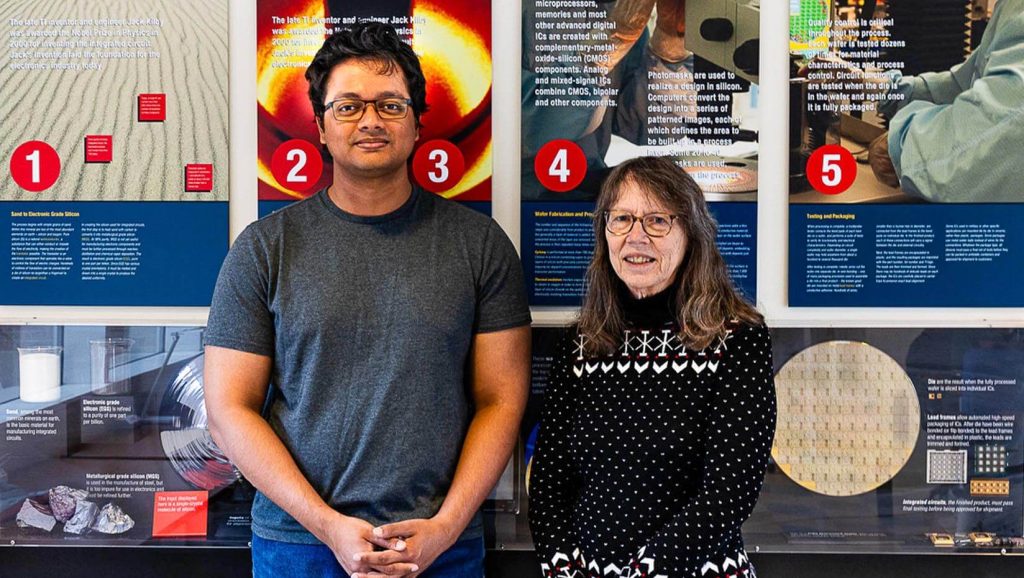
The National Science Foundation awarded $1.2 million to a University of Maine-led team of researchers to create a comprehensive semiconductor curriculum for high school students.
Spearheaded by principal investigator Prabuddha Chakraborty and co-principal investigator Rosemary Smith from UMaine’s Department of Electrical and Computer Engineering, the team will devise lessons and coursework about developing semiconductors that will feature state-of-the-art technologies such as artificial intelligence, interactive game modules and hands-on learning. Read More Here.