
Maine Integrated Forest System Model (MIFSM)
A Decision-Support Tool for Balancing Carbon, Timber, and other Forest Ecosystem Services
What is MIFSM?
The Maine Integrated Forest System Model (MIFSM) is a decision-support tool developed by researchers at the University of Maine to evaluate how different forest management strategies affect timber supply, forest carbon sequestration, and other ecosystem services across large forested landscapes.
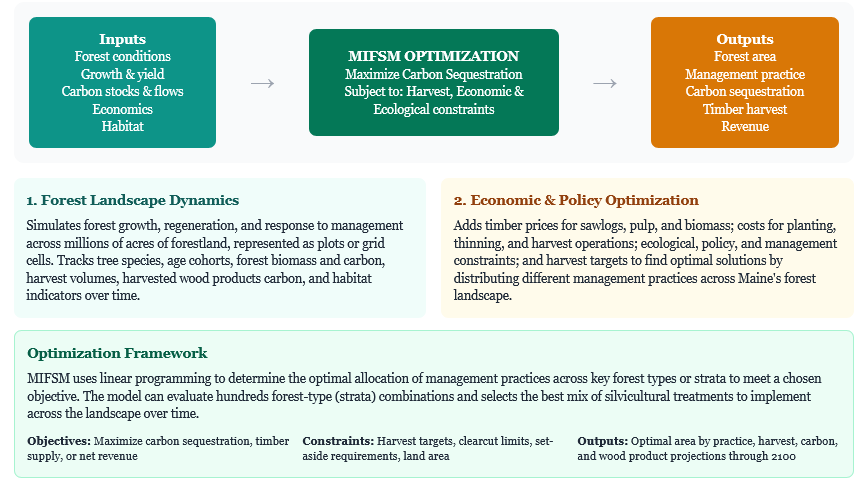
MIFSM links a forest landscape growth model with economic data and management constraints to show how combinations of silvicultural practices applied across millions of acres will shape Maine’s forests over time.
MIFSM Helps Answer Questions Such As:
- Can Maine’s forests store more carbon while still sustainably supplying timber & wood products?
- How do different silvicultural prescriptions affect long-term forest carbon, habitat, and revenue?
- What mix of management approaches yields the best balance of ecological and economic outcomes in Maine’s commercial forests?
Why Was MIFSM Developed?
Maine’s forests offset 90%+ of the state’s greenhouse gas emissions annually. As Maine aims for carbon neutrality by 2045, forest-based natural climate solutions are increasingly important. However, achieving more carbon sequestration without reducing timber supply is challenging.
MIFSM was built to answer landscape-scale forestry questions by combining ecological metrics with economic feasibility, moving beyond stand-level analysis to regional decision-making relevant to commercial forest landowners and state-level policymaking.
How MIFSM Works: Optimization-Based Decision Support
Want to Know More?
Model application published in Forest Policy and Economics available here.
Project report available here.
Modeled silvicultural practices and forest types available here.
FCCL model estimates available for download in this Excel spreadsheet and presented in Tableau.