Interested in joining the lab?

Thanks for your interest in joining the group!  If you are a prospective student, please scroll down for more information on specific opportunities.  We mainly work on optical and chemical oceanography, with flavors of engineering and biological oceanography.  If you are interested in organismal biology or aquaculture systems, you will find it useful to connect with other faculty in UMaine’s School of Marine Sciences.

Who we are

Our lab’s goal is for all members of the group to be recognized, welcomed, and supported as scientists and as human beings. We are physically situated in rural Maine, a place with its own history and traditions, which we strive to recognize in all their forms. This recognition spans from honoring the indigenous groups in whose traditional lands we work, to conversing honestly with each other about issues of social acceptance, belonging, and the challenges of change in our cultures.

Prospective undergraduate students

Interested in a capstone or honors project for academic credit?  There are lots of potential ideas!  Check out the poster linked at right (sign in with your UMaine email credentials to view) and email Dr. Estapa to connect. The Estapa lab is based at the Darling Marine Center, so most lab- and field-based projects will require a period in residence at the DMC. Literature reviews in any area of oceanography are also possible.
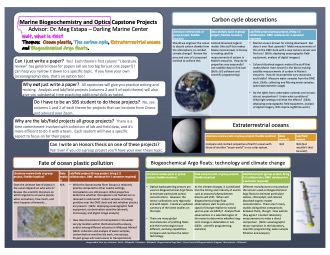
Link to Capstone Ideas
Capstone and honors thesis opportunities (click poster, log in with UMaine ID)

In general, full-time, paid summer internships require residency at or within commuting distance of the Darling Marine Center. They usually depend on grant funding and will be posted below in January/February if available.  If you are a UMaine student, please check out the Center for Undergraduate Research (CUGR) for opportunities to secure your own funding.

We typically hire 1-2 part-time undergraduate research assistants during academic semesters for Semester-by-the-Sea students in residence at the DMC. Please watch your email in the first week of the semester for opportunities.

Prospective graduate students

  • Gain experience. Getting 1-3 years of science-related work experience after your bachelor’s degree will help you identify and articulate your specific goals for graduate school.
  • Identify research areas of interest. Look around this website — are your interests a good match for the active projects? 
  • Consider funding options. If grant support is not available, you will need to explore options for securing your own funding.  Pay close attention to deadlines, application procedures, and eligibility criteria.
  • Contact me! Send an email outlining your interests and funding options before applying to the program.  In your email, include a concise description of
    • Your own interests and prior experiences
    • How your interests and prior experiences are related to my active projects
    • Your plan to seek funding if grant support is not currently available
  • Attach a copy of your CV or resume, which should truthfully reflect your interests and prior experiences discussed in your email. If you are encouraged to apply, your references will need to confirm key details given in your CV.
  • I receive many general inquiries about graduate study, and may not be able to respond if you have not addressed the above steps. I am only interested in mentoring human graduate students, so I will not respond to inquiries that appear to be AI-generated.
  • Most support for graduate students in UMaine’s School of Marine Sciences comes from research grants awarded to individual faculty.  If there is an open opportunity in my lab, it will be listed below.
  • I generally only accept students into my lab for graduate study if external grant funding is available for at least two years, or a graduate fellowship has been awarded.

We are recruiting a new PhD graduate research assistant to work on a funded, 3-year NSF project starting January 1, 2027. This project aims to develop conventional computer vision tools alongside an interpretable AI framework to predict the chemical composition of sinking “marine snow” from underwater imaging data, testing the fundamental assumption that visual elements like shape and transparency are conservative indicators of composition.

The key activities of this assistantship will include:

  1. Marine snow sample imaging and laboratory geochemical analysis (carbon, biominerals, microplastics) from six major oceanographic field campaigns.
  2. Developing computer vision tools to to generate a database of visual particle properties and associated composition information.
  3. With collaborators in UMaine’s Computer Engineering department, comparing and interpreting AI-generated assemblage-based predictions against traditional methods.

The ideal candidate will have a background in computer vision techniques and/or chemical oceanography and a keen interest in both areas. They will also have well-developed laboratory and computer programming skills, and will be able to start the degree program in January 2027 (including obtaining any necessary visa approvals). This assistantship is based at UMaine’s Darling Marine Center in Midcoast Maine.

Interested? Please read the section above “How to inquire about graduate study” carefully and then get in touch!

Prospective postdoctoral researchers: Please email!