Why join the Teaching Observation Partnership?

Having someone observe your class can make you feel vulnerable. But what we hear time and again is that this program is worth it. It’s not about being evaluated—it’s about connecting with colleagues, seeing new possibilities, and focusing on the aspects of teaching you care about most. You decide what you want feedback on and how you want to grow as an instructor.

Spring Focus: Active Learning Classrooms

Build Confidence & Gain Inspiration for teaching in Active Learning Classrooms

Orientation & Overview, 9:00am – 12:00pm | January, 16th 2026
Four Semester Meetings, last Friday of the month, 1:00pm – 2:00pm | Starts January 30th

Observe. Reflect. Connect.
With the growing demand for these innovative spaces, we have developed a new program to support the most effective use of Active Learning Classrooms (ALCs) for you and your students. The program will help you build confidence in using ALCs as well as discover new instructional approaches and engagement strategies. Faculty learn from observing different styles of teaching in ALCs, and discussing their own approaches and innovations. A minimum of six participants is required.


This is an in-person program. (Accommodations for remote faculty can be arranged.)
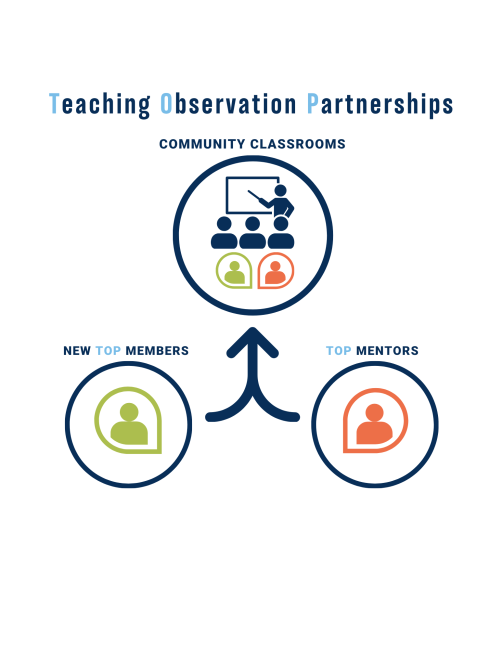
An schematic showing a circle representing new TOP members merging with another circle representing mentors.  Both join together to observe an instructor in a Community Classroom.

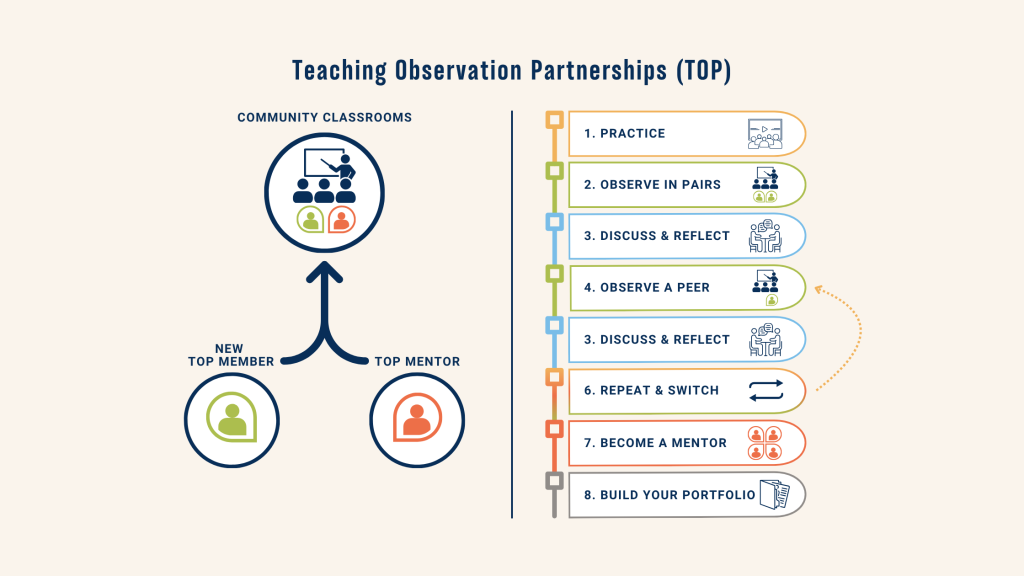
The program is scaffolded to build your comfort with formative observations.

Learn together
You’ll begin by observing recorded classrooms together as a group, sharing your observations, and learning the process.You’ll begin by observing recorded classrooms together as a group, sharing your observations, and learning the process.
Shift to a mentor
Your first “real” observation of a classroom will be with an experienced TOP mentor* and reflecting on the experience together.
✔ Choose what you want feedback on
You’ll use our Dimensions of Teaching tool to identify what you want to grow or gain insight on related to student engagement in your classroom and/or your use of high impact practices.
✔ Engage in peer observations
You’ll complete 2-3 peer-to-peer class observations as both an observer and observee (based on scheduling), exchanging formative feedback with your observation partner. Over the semester, we will try to partner you with different peers. 
✔ Connect in community
We meet bi-weekly to debrief observations, share ideas, surface challenges, and support each other’s growth.
✔ Receive a $300 stipend
Participants who complete the program receive a stipend in recognition of the time invested.

Fall Semester

TOP Fall Focus
(Topic changes annually.)

spring semester

TOP in Active Learning Classrooms
(Topic repeats annually.)

Additional time is required for observations and associated meetings.  
Space is limited to keep the group small and supportive.
Acceptance is first-come, first-served.

What are observation mentors?
Observation mentors are faculty who have completed our observation-based learning communities (TOP, Teaching in ALCs). They help grow capacity for formative course observations.

Why become a mentor?
Most faculty new to observations need to be oriented to the process and protocols through a low-stakes practice opportunity. Mentoring also keeps you involved in observations, reflection and your own educational development!

What will be asked of you?
Mentoring happens in our Community Classrooms (see below), which represent diverse disciplines, classroom styles, and pedagogies.
You will:
– Partner with a new observee currently enrolled in an observation-based learning community
– Observe a class together.
– Discuss the observation process to help prepare them for future observations. (There are no required meetings with the instructional faculty being observed.) 

The details:
Before the semester starts, you will receive a Google calendar invite with all Community Classrooms.
– Add your name to any classes you’re available to observe with a mentee.
– Coordinate with your mentee to schedule an observation and follow-up discussion.
– You can mentor multiple observers if you choose. Based on scheduling, you may not be asked to mentor at all.

What are Community Classrooms?
Even though many of us spend much of our professional lives thinking about and engaging in teaching, it is actually not common to observe others teach. Observing and being observed as instructors is one of the most powerful ways to improve your teaching mindset and skills. Community Classrooms (CCs) are classrooms where faculty open their doors to support our Teaching Observation Partnership (TOP) programs.

Why Participate?
Because class observations are not commonplace, many faculty feel uncertain about the process, leading to lower quality feedback and reduced learning. Community Classrooms help address this by providing a low-stakes environment for new observers to learn along side a mentor.


Your Role in a Community Classroom
As a Community Classroom instructor, you agree to:

– Allow observers to observe one of your classes, at times in pairs, likely during the first month of the semester.
– Reply to emails from interested faculty with logistics (days and times you are available to be observed) and relevant course documents (e.g., syllabus, assignments).
You will never be observed without your permission.

How much time will it require?
Because all you are being asked to do is open your doors to an observation, the time required is that involved in the emailing and coordination –less than 15 minutes!

Important Note: We aim to select a small subset of classrooms that offer diverse experiences for observers. Decisions are based on availability of times, days, and features and have NO reflection on teaching quality.

– Anyone open to growing their teaching practice through observation and feedback who will be teaching a course (online or in-person)
– Instructors looking to grow their community and expand their teaching repertoire
– Those who enjoy trying new strategies—or want to rekindle that curiosity

Questions? Want to talk it through before committing?
Contact: karen.pelletreau@maine.edu