
forest Conservation Easement Monitoring
The University of Maine has been an essential technical partner to the New England Forestry Foundation (NEFF) in stewarding its large-scale conservation easements in Maine. UMaine faculty collaborated with NEFF to create a three-level inspection process. Originally, UMaine’s School of Forest Resources and the Maine Image Analysis Lab provided satellite imagery analyses for the program.
Following a collaborative reassessment, the process was refined. Today, the Wheatland Geospatial Lab conducts the first two tiers of the annual monitoring process. Level One consists of a manual scan of recent public aerial imagery. For Level Two, Wheatland lab personnel fly a UMaine Cessna equipped with a specialized near-infrared camera to take high-resolution aerial photos of identified areas of interest. The imagery is then georectified and analyzed in a GIS to flag disturbances for potential on-the-ground (Level Three) inspections by NEFF staff. This partnership provides the crucial remote analyses needed to monitor vast forestlands efficiently.


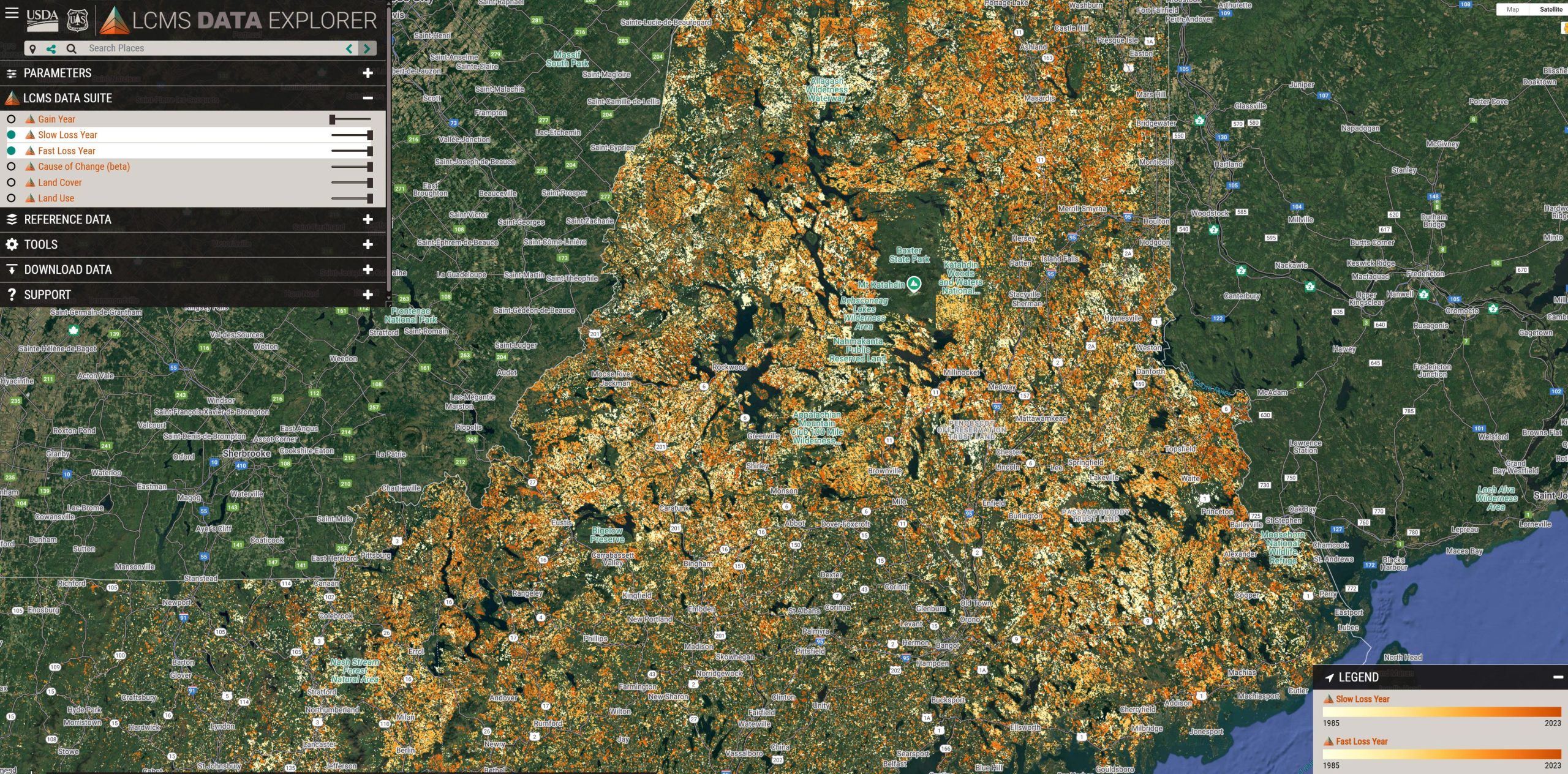
Improving Existing Forest Disturbance Detection Techniques Using Satellite Imagery
The project aims to build a regionally calibratable tool for mapping forest disturbances using Landsat and Sentinel-2 satellite imagery in Google Earth Engine. Disturbance detection is based on time-series analysis to identify change event year and classify disturbance types such as harvest, fire, windthrow, insect outbreaks, and land use change (e.g., forest to agriculture or urban). The workflow integrates medoid composite generation, stratified sampling, LandTrendr segmentation, and machine learning classification, with a focus on temporal consistency, agent attribution, and regional forest dynamics. The approach balances accuracy and scalability, supporting both scientific understanding and practical monitoring applications.