
Falling for the Fish: How Melissa Flye Learned That Conservation Needs More Than Data
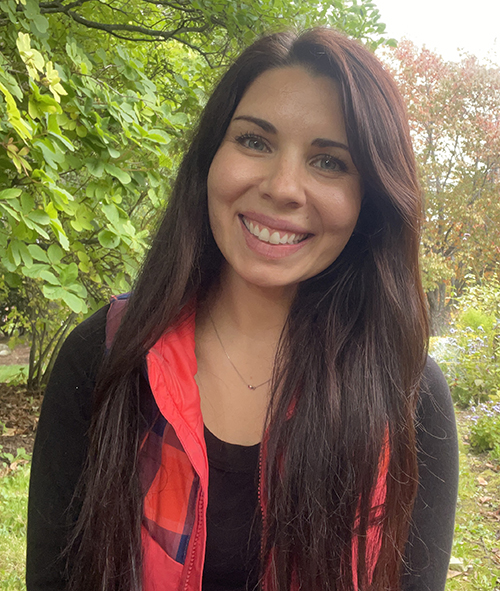
Melissa Flye discovered her love of all creatures great and small early in life, spending hours on her family farm in central Maine flipping over rocks to examine and count what she found underneath. She was the kind of child apt to surprise her family with the small frog or slug tucked in her hand.
Flye still loves being in the field collecting scientific data, especially if it’s related to fish and aquatic organisms. But after 15 years of professional scientific inquiry, it’s become clear that when it comes to wildlife conservation, numbers alone don’t change public opinion or shape policy.
“Along the way, I started to notice that many recommendations weren’t seamlessly executed in real life because there are a lot of other factors that complicate the decision-making process,” Flye said.
That realization, however, wouldn’t fully take shape until after her bachelor’s degree and five years working in the field.
Flye graduated from the University of Maine with a bachelor’s degree in wildlife ecology in 2013. As an undergraduate student, she studied fish living in impounded versus natural bodies of water and spent summers in the Maine backcountry counting snowshoe hare pellets to estimate the animals’ population density.
After graduating, she worked as a field technician with the Maine Department of Marine Resources counting juvenile wild Atlantic salmon to get an estimate of their spawning success. Then she took a position with an environmental consulting firm that was monitoring adult Atlantic salmon passage at hydroelectric facilities along the Penobscot and Union Rivers. That’s when she first experienced the awe of wild Atlantic salmon.
She joked that at the time in life when her peers were meeting their life partners, she fell for the fish. “People are like, ‘Oh, it was love at first sight. I met my soulmate.’ I’m like, ‘Oh, it was love at first sight. I met Atlantic salmon,’” Flye said.
Atlantic salmon were federally listed as endangered under the Endangered Species Act (ESA) in 2000. As Flye continued her consulting work, she began to notice a disconnect between the science and the success of restoration efforts on the ground.
She hoped that a policy-related job with the Maine Department of Environmental Protection would show her how science can better be used to inform wildlife conservation and policy.
Instead, it revealed a gap in her knowledge: how much human perspectives, not just scientific data, shape whether conservation efforts actually succeed.
Master’s: The Gap Flye Needed to Fill

It was then that she discovered a master’s position at UMaine in Carly Sponarski’s Human Dimensions of Wildlife Lab. “Carly was looking at the human and social elements that determine the way we manage and conserve wildlife, and I thought, ‘That’s it. That’s the gap I need help filling, so I can do better conservation work in whatever capacity I end up in,” said Flye.
At the time, Sponarski was a Center faculty fellow and assistant professor in the UMaine Department of Wildlife, Fisheries, and Conservation Biology. She was working on a 2018 Center-funded seed grant titled Getting Over the Dam. The Atlantic salmon population in Maine remains critically low despite extensive hatchery supplementation and habitat improvement efforts over the past four decades.
Getting Over the Dam explored how well organizations communicate and coordinate with one another and how that coordination can shape decisions about dam operations, fish passage, and habitat restoration for endangered species like Atlantic salmon under the Endangered Species Act.
Flye’s master’s research focused on the collaborative governance structure for Atlantic salmon which includes multiple partners: National Oceanic and Atmospheric Administration (NOAA), U.S. Fish and Wildlife Service, the Maine Department of Marine Resources, and the Penobscot Nation. The group created a collaborative governance structure in 2011, but by 2017, when Flye stepped into the project, participants were expressing increasing frustration because the structure wasn’t working as intended.
She said, “Management decisions were happening but weren’t necessarily going through this collaborative framework.”
Flye’s research ultimately helped lead to the implementation of a new governance structure: the collaborative management strategy (CMS). It was designed to facilitate communication between the many groups working to protect the Atlantic salmon by systematically incorporating the unique structures underlying each one.
“So many considerations get left out of our management decisions because legal and jurisdictional boundaries are difficult to navigate. Scientists and managers have jobs to do and the immense work it takes to coordinate across groups is not always recognized or rewarded within employment structures. That’s why it is so encouraging to see such a diverse group of management groups engage in this type of reflective process,” Flye said.
Doctorate and Post-doc: Same Question, Different Species
Excited to continue working with Atlantic salmon, Flye enrolled in a doctoral program in ecology and environmental sciences at UMaine. Sponarski again served as her advisor along with Joseph Zydlewski, unit leader of the U.S. Geological Survey’s Maine Cooperative Fish and Wildlife Research Unit and a professor in the Department of Wildlife, Fisheries, and Conservation Biology. He is also a Center faculty fellow.
The COVID-19 pandemic stymied her plans to continue her salmon research, and Flye pivoted to a NOAA-funded project designed to better understand human-marine mammal interactions. Though the species were new to Flye, the underlying question wasn’t: How do you help people work more effectively toward a shared conservation goal?
This time, the conflict wasn’t between government agencies, but between humans and marine mammals. Marine mammals managed by NOAA (whales, dolphins, porpoises, and most seals and sea lions) have been protected since the 1970s, and some populations have grown substantially, leading to conflicts with humans.
For example, in Maine, harbor seal mothers commonly leave pups alone on beaches as they forage offshore. Some people think they need help, resulting in crowding, handling, or other dangers which may reduce the pups chance of survival. There are also documented cases of people getting too close to seal pups for photo opportunities and letting off-lease dogs approach the seals.
Flye discovered that NOAA dedicates a significant amount of time responding to these types of conflicts; some employees reported that they were spending over 50% of their work time on human-marine mammal interactions.
Flye’s doctoral and subsequent postdoctoral research serve to help NOAA understand the scope and scale of these interactions with the goal of designing processes that allow for more proactive mitigation. Her work leverages the vast experience of federal scientists and managers to identify specific challenges — as opposed to anecdotal ones — and compare those patterns and experiences across different regions of the U.S. Flye hopes the information will allow NOAA to leverage and share resources across regions, identify regional and national opportunities and needs, and to target their outreach and education more intentionally.
Her work continues to show the complexity of human-wildlife relationships and has further demonstrated to Flye that understanding the perspectives of different partners who play a role in conservation— managers, biologists, social scientists, industry, citizens — is essential to developing effective and sustainable solutions.
For Flye, this type of research, which began during her time working with Sponarski at the Center, has now become the standard. “I didn’t fully appreciate that interdisciplinary research isn’t the norm for everyone, but I know that I have learned so much from the opportunities I have had to work with diverse partners,” she said.
“It’s also essential that the people who are going to use the information, the people that are going to be impacted by it, are part of how you go about getting information. If you’re going to do that research, you’re going to take information from people. It’s so important that they get something back out of it.”