
Sucking Insects That Affect Vegetable Plants

Pest Management Fact Sheet #5039
James F. Dill, Pest Management Specialist
Clay A. Kirby, Insect Diagnostician
For information about UMaine Extension programs and resources, visit extension.umaine.edu.
Find more of our publications and books at extension.umaine.edu/publications/.
Introduction
The mouthparts of sucking insects are specialized for piercing and sucking. These pests damage plants by inserting their mouthparts into plant tissue and removing the juices. Heavily infested plants become yellow, wilted, deformed or stunted, and may eventually die. Some sucking insects inject toxic materials into the plant while feeding, and some transmit disease organisms. Some prime examples of piercing-sucking insect pests of vegetables are:
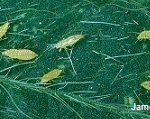
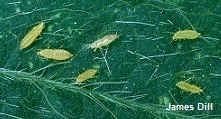
Aphids: Aphids are small, soft-bodied insects. They range in color from black to green to yellow. Their numbers can greatly increase over a relatively short time period. They may cover the entire surface of a leaf or stem. They can be vectors of plant viruses. Encourage natural predators, such as ladybird beetles or lacewing larvae, to reduce their numbers. Lacewing eggs can be purchased from seed companies. The lacewing eggs soon hatch and provide good aphid control. Aphids can be washed off from plants with a garden hose. Chemical options for controlling aphids include insecticidal soap, horticultural oil, neem oil, or malathion.
Leafhoppers: Leafhoppers are small, green, wedge-shaped insects that attack many garden, forage and fruit crops. They suck out plant juices causing yellowing, leaf-curling and stunting. They also transmit several disease organisms, especially those associated with bacterial yellows. Use pyrethrins or carbaryl (Sevin®) as a control.
Stink bugs: Stink bugs comprise a family (Pentatomidae) of ‘true bugs’ in the order Hemiptera that feed on the fruit of a wide range of plants including beets, beans, pears, squash, tomatoes and corn, causing the fruit to become shriveled and deformed. The most common species attacking home gardens are the green stink bug and the brown stink bug. Hand-picking may lower numbers sufficiently for damage control. To control, use pyrethrins or carbaryl (Sevin®).
Tarnished plant bugs: Tarnished plant bugs (family Miridae) feed on the leaves of many plants, causing them to curl, reducing growth, and transmitting diseases. These bugs also deform apples and cause corky, deformed strawberries. To control, use pyrethrins or malathion.
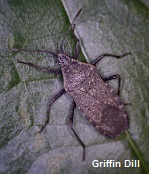
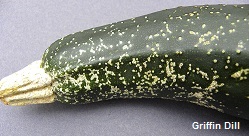
Squash bugs: Mature squash bugs (family Coreidae) are about an inch long and are gray-black in color. While still immature, they are strikingly colored with white and black. Squash bugs suck juice from the leaves and stems of squash, pumpkins, melons and related plants, and thus spread disease. Hand-picking may be effective. Leaving boards or shingles out overnight between the rows of cucurbits is a way to “harvest” squash bugs. The bugs tend to use the boards and shingles for cover. They can easily be gathered from under such items and disposed of early in the morning. Eggs can be scraped off the foliage with one’s thumbnail. Insecticide options include insecticidal soap or carbaryl (Sevin®).
Thrips: Thrips are minute insects that feed on pollen and tender plant tissues. They typically hide in the cracks and crevices of leaf buds, junctures, and flowers. They rasp the tissue and suck up the exuding sap. Leaves take on a silvery appearance after the thrips have fed on them, and plants become stunted and deformed. Thrips are usually a pest of seedling plants but may attack plants in any stage, especially gladioli, onions and blueberries. Neem oil, horticultural oil, spinosad and pyrethrins are options for thrips management.
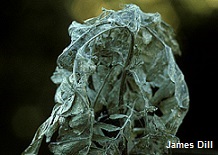
Spider mites: Spider mites are not insects, but are closely related to ticks. They suck out juices from leaves and stems, causing plants to become deformed or have a bronze or yellow appearance. Hot and dry weather favors their development and survival. Heavy infestations can cause leaf and flower bud-drop and death of the plant. Use insecticidal soap or neem oil to control spider mites.
Management
A hand vac can be used for small-sized pests. Control of sucking insects with insecticides is often difficult because of their capacity to reproduce rapidly. Also, they may quickly develop resistance to the chemicals when only materials with the same mode of action are used repeatedly. Often a blast of water from a garden hose will knock the pests off the plants, and very rarely do they find their way back to them again before falling victim to the elements or to natural predators.
Observe the waiting periods listed on the labels for insecticides (number of days from application to harvest).
If possible, protect bees by spraying only in late afternoon or evening, and by not spraying plants when flowers are present.
-
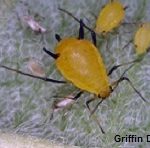
- Aphids (Oleander or Milkweed Aphid – Aphis nerii)
-
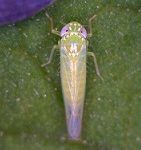
- Leafhopper
-
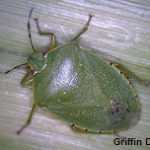
- Stink Bug
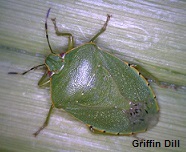
-
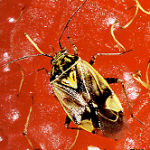
- Tarnished Plant Bug
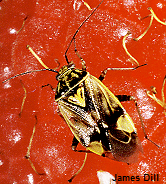
-
- Thrips
-
- Spider Mite Webbing
-
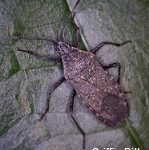
- Adult Squash Bug
-
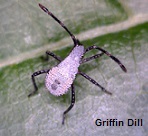
- Squash Bug Nymph
-
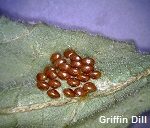
- Squash Bug Eggs

-
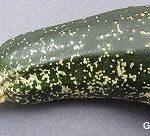
- Squash Bug Damage
When Using Pesticides
ALWAYS FOLLOW LABEL DIRECTIONS!
Pest Management Unit
Cooperative Extension Diagnostic and Research Laboratory
17 Godfrey Drive, Orono, ME 04473-1295
1.800.287.0279 (in Maine)
Information in this publication is provided purely for educational purposes. No responsibility is assumed for any problems associated with the use of products or services mentioned. No endorsement of products or companies is intended, nor is criticism of unnamed products or companies implied.
© 2016 | Reviewed: 2020, 2023
Call 800.287.0274 (in Maine), or 207.581.3188, for information on publications and program offerings from University of Maine Cooperative Extension, or visit extension.umaine.edu.
In complying with the letter and spirit of applicable laws and pursuing its own goals of diversity, the University of Maine System does not discriminate on the grounds of race, color, religion, sex, sexual orientation, transgender status, gender, gender identity or expression, ethnicity, national origin, citizenship status, familial status, ancestry, age, disability physical or mental, genetic information, or veterans or military status in employment, education, and all other programs and activities. The University provides reasonable accommodations to qualified individuals with disabilities upon request. The following person has been designated to handle inquiries regarding non-discrimination policies: Director of Equal Opportunity, 101 Boudreau Hall, University of Maine, Orono, ME 04469-5754, 207.581.1226, TTY 711 (Maine Relay System).