
Maine Home Garden News — July 2012
- July is the month to . . .
- Mosquitoes!
- Are You Berry Smart?
- Morris Farm Master Gardener Volunteers Strive for Continuous Harvest
By Kate Garland, Horticulture Professional, University of Maine Cooperative Extension, Penobscot County, katherine.garland@maine.edu.
- Seek local gardens to tour as a way to pick up news gardening ideas and tips. Visit public gardens or parks in your area. Garden clubs and groups often arrange tours of some of their best gardens.
- Pay attention to what is happening in your yard and garden. Look for and note any changes, growth, damage, stress, death, fruit formation or flowering. On damaged plants, look for the culprits. Some of this inspection might need to take place on your hands and knees.
- If slugs are in your gardens, consider using control such as iron phosphate. For more information, see Bulletin #5036, Slugs.
- Enjoy your flowering lilies. If you have lilies, you may have lily leaf beetle. For more information, see Bulletin #2450, Lily Leaf Beetle.
- Donate fresh fruits and vegetables to Maine Harvest for Hunger. Learn how you can help – it’s not just for gardeners who have a lot of zucchini! Consider Harvest for Hunger if you are a business or organization looking for a service project.
- Enjoy a bountiful crop of beans. Learn how to freeze green beans. While you’re at it, be sure to gather supplies and learn about preserving all of your upcoming harvests.
- Learn about insect repellents. Remember insect repellents are registered pesticides!
- Visit your local farmers market and visit a nearby farm on Open Farm Day, Sunday July 22nd. Watch farm activities and demonstrations from milking to felting; pet farm animals, pick berries, tour a barn or go on a hay ride.
- Set up drip irrigation in your home garden. Water plays a big role in how much you harvest every year.
- Learn about common diseases and insect pests on fruit trees.
- Scout for Colorado potato beetles. They are a serious pest of potatoes and they also like tomatoes and eggplant. Destroying their bright yellow egg masses as soon as you see them can greatly reduce their damage.
- Re-seed empty spots in your garden with peas, lettuce, radishes, chard, spinach, beet greens and other short-season crops. You could also sow a cover crop.
By Donna Coffin, Extension Professor, University of Maine Cooperative Extension, Piscataquis County, donna.coffin@maine.edu.
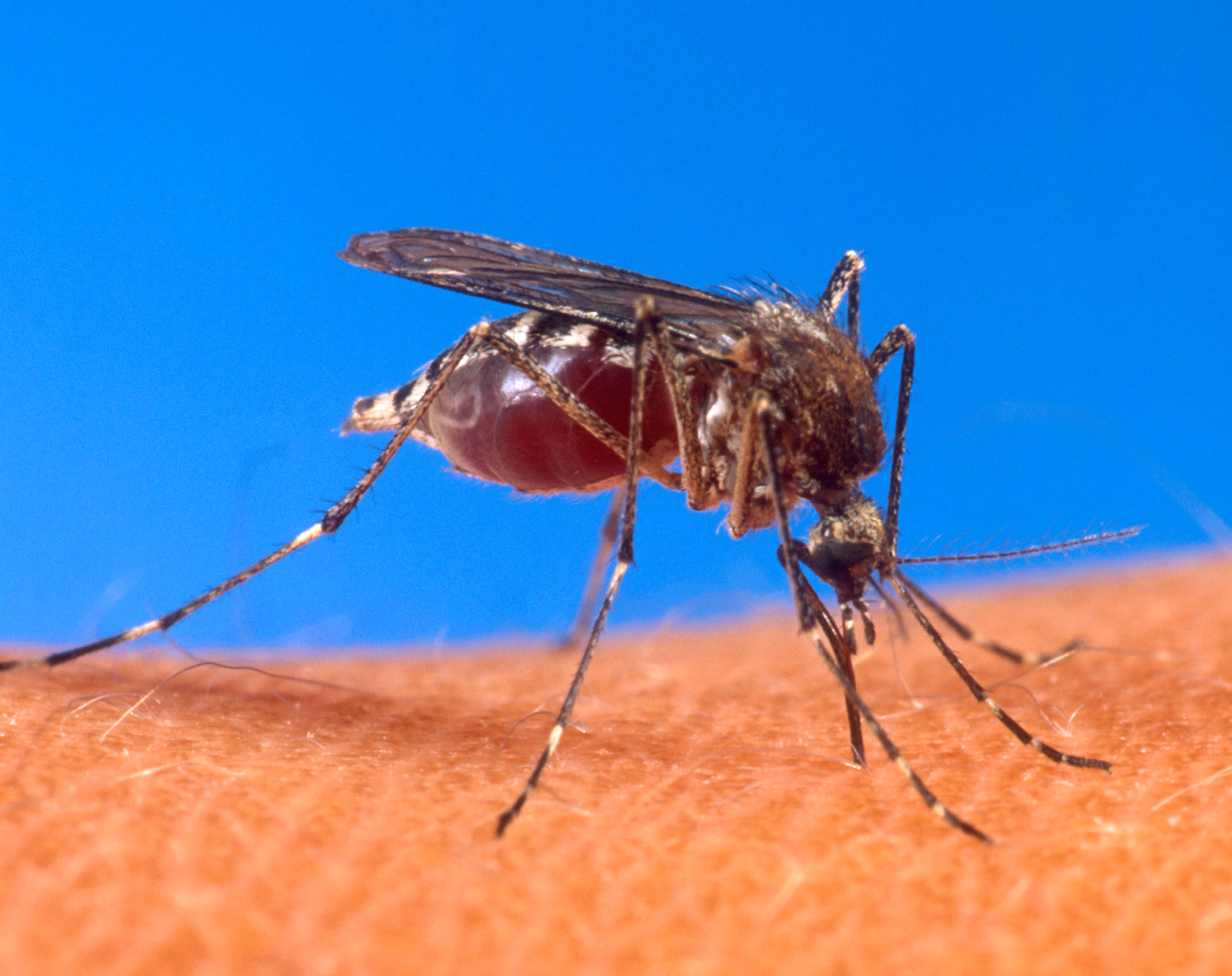 Mosquitoes are one of the most common complaints from people who enjoy gardening during the spring and summer months. It’s only female mosquitoes that feed on blood to obtain the required protein needed to produce and lay eggs. In this biting process the females can act as vectors of parasites and disease organisms, such as malaria, yellow fever, and various forms of viral encephalitis such as Eastern Equine Encephalitis (EEE) and West Nile Virus (WNV).
In Maine, most of the nuisance biting mosquitoes can be broadly placed in three groups based on their breeding sites or where they are likely to cause the greatest problem: urban, woodland or salt marsh. All mosquitoes pass through four developmental stages: egg, larva, pupa, and adult. Eggs are laid either in or near water or in moist depressions that will fill with water during the spring or in flood times. All larvae and pupae require water to develop to adults. Mosquitoes are usually the most active in the evening or on overcast days.
Control Methods
The following are various controls that can be undertaken to reduce the presence of mosquitoes, either by elimination of breeding places or destruction of the adults or larvae. Alone, these methods won’t eliminate your mosquito problem. However, using an integrated approach of combining several of these methods, you should see some results in reduction of mosquito annoyance.
- Eliminate Breeding Sites – sources of stagnant water, (e.g. unused pools, old tires, tin cans along with other similar discarded containers, rain gutters, and birdbaths). Also, be sure to check and refresh water weekly in small children’s wading pools, birdbaths, and animal water dishes and tubs to eliminate larvae. Keep dumpsters and trash receptacles covered to prevent water accumulation.
- Eliminate Adult Resting Sites – Cut back or remove dense brush and similar vegetation from around houses and camps. Keep grassy areas mowed short. Promote natural breezes to discourage mosquito occurrence.
- Encourage Natural Predators – Although limited in their effectiveness, predators such as dragonflies, bats, birds, frogs, and mosquito eating fish naturally control the numbers of mosquitoes, especially in and around small farm and garden ponds or pools.
- Water management – Every community should consider water management as a very important component of their mosquito reduction program. Roadside ditches and culverts should be cleared to avoid water stagnation.
- Use of burning wicks containing pyrethrum or citronella candles may provide some relief in limited areas, provided that there is no wind. Although expensive, commercial traps that use carbon dioxide and octenol as attractants can be effective in reducing mosquito annoyance when used with other management tools. However, proper placement of commercial traps is critical.
- Homeowners and camp owners can alleviate the mosquito nuisance indoors by installing and maintaining tight fitting window and door screens and keeping outside lighting to a minimum. Specific materials for screen treatment containing insecticides, such as permethrin, may add to the effectiveness of screens.
- Beware of novelty approaches to mosquito control, including such things as “bug zappers,” various sound devices, and scented geraniums (“mosquito plants”). While there may be certain psychological benefits to the use of such things, they are usually expensive and there is little scientific evidence to support the claims of those who market such products. There is no sure-fire solution to the problems as some would assert.
Personal Protection
The use of protective clothing and insect repellants are two tactics that can provide some personal protection against adult mosquitoes.
- Protective clothing include veils or mosquito netting worn around the head, or even the entire body as a suit, high boots, long sleeved shirts, long pants, gloves, etc. As with many biting flies, it is best to avoid the use of colognes and perfumes while in the field as these may enhance biting fly activity!
- Insect repellents are chemicals that can be applied to the skin or clothing that will repel mosquitoes and to a lesser extent black flies and ticks. A number of products are available, and come as pressurized sprays, creams, sticks and liquid formulations that are usually spread on exposed parts of the body. The two repellents that have demonstrated a higher degree of efficacy in the peer-reviewed, scientific literature are DEET and Picaridin. Studies indicate that oil of lemon eucalyptus, a plant-based repellent, also provides protection similar to low concentrations of DEET. Usually a few drops of repellent applied to the neck, face, hands, and arms or sprayed onto thin clothing items such as stockings can repel mosquitoes for periods of 2 hours or more. Since repellents can irritate the eyes or the lips, care should be taken in their application. Be sure to read the instructions to make sure the repellent won’t harm clothing or especially plastic items. Do not over use repellents. Be especially careful with DEET on young children. For more information regarding the use of repellents visit www.cdc.gov/ncidod/dvbid/westnile/index.htm.
- Clothing treatments with permethrin (a toxicant) products have a long lasting period of effectiveness but cannot be applied directly to the skin; once dried on clothing however, there is little or no transfer of chemical compounds.
UMaine Extension Fact Sheets:
By David Handley, Vegetable & Small Fruit Specialist, UMaine Extension, Highmoor Farm, david.handley@maine.edu.
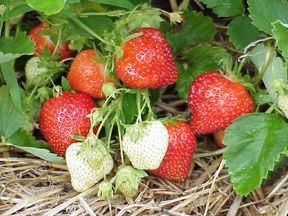 Sure, you’ve been growing all those great berries for years, but how much do you really know about small fruit? Here’s a little quiz for all of you horticultural trivia fans and berry know-it-alls that provides some interesting facts and insights about our favorite little fruits. A score of 10 or better earns you the rank of Golden Strawberry.
Small Fruit Trivia Quiz
- Which three fruit are considered the only true native American fruit?
- Strawberry
- Raspberry
- Concord Grape
- Blueberry
- Cranberry
- What small fruit variety is considered to be the first commercially bred and named horticultural variety in the United States?
- Concord Grape
- Hovey Strawberry
- Elizabeth Blueberry
- Early Black Cranberry
- “Doubtless God could have made a better berry, but doubtless God never did.” This famous quote is attributed to William Butler, a 17th Century writer, referred to what fruit?
- Strawberry
- Raspberry
- Grape
- Blueberry
- Botanically speaking, a berry refers to a very specific type of fruiting structure. Which one of the following are “true” berries?
- Strawberry
- Raspberry
- Blueberry
- Grape
- The Concord grape formed the basis of an entire juice and jelly making industry in America, yet the man who developed it earned no money and received little recognition for his efforts. Who was he?
- Luther Burbank
- Thomas Jefferson
- Ephraim Bull
- Ralph Waldo Emerson
- What Native New Englander and famous fruit breeder has had a strawberry, blueberry, and blackberry variety named in his honor?
- Elwyn Meader
- George Darrow
- Thomas Latham
- Arthur Howard
- Which small fruit can not be grown in Maine as a result of state law barring its culture and importation?
- Juneberry
- Black currant
- Loganberry
- Hempfruit
- What berry(ies) did President Reagan publicly cite as an example of frivolous government spending?
- Strawberry
- Raspberry
- Blueberry
- Cranberry
- What fruit, originally called “Chinese Gooseberry,” was renamed to improve its consumer appeal?
- Kiwifruit
- Jostaberry
- Star Fruit
- Jujube
- What fruit, in its botanical and anatomical or structural sense, most closely resembles a strawberry?
- Raspberry
- Fig
- Lemon
- Pineapple
- Which berry is said to have been the favored fruit of Greek Gods? Hint: the Latin or species name of this fruit refers to this honor.
- Strawberry
- Raspberry
- Blueberry
- Grape
- What is the official fruit of the state of Maine?
- Apple
- Cranberry
- Blueberry
- Strawberry
Answers
- c, d, e. (cultivated strawberries and raspberries are mixed with European types)
- b. Charles Mason Hovey (1810- 1887) of Massachusetts, was one of the first and most prolific strawberry breeders in the U.S.
- a. Dr. Butler’s quote was made famous by Izaak Walton in his book The Complete Angler (1655), a treatise on fishing.
- c, d. Botanically, strawberries and raspberries are considered “aggregates”, not berries.
- c. Ephraim Wales Bull (1805-1895) developed the grape from wild seedlings in Concord Massachusetts, but it was Thomas Welsh, who began experimenting with the juice of this grape in 1869, that would, with his son, develop large and successful company based on the fruit. Bull died near penniless. His epitaph reads “He sowed, others reaped”.
- b. George Darrow (1889-1983) was a native of Vermont, but spent most of his professional career at the USDA Fruit Laboratory in Beltsville, MD. He wrote over 200 publications on small fruit and developed such important varieties as the Blakemore strawberry, which was an industry standard for over 20 years.
- b. Black currants are illegal to grow in Maine because they are an alternate host for white pine blister rust, an important and devastating disease of white pine. Maine is sometimes called the “Pine Tree State”.
- c, d. In his 1986 State of the Union Address, President Reagan was hoping to win support for a line item veto in the federal budget by citing what he called wasteful research programs on such things as blueberries and cranberries. Ironically, a blueberry flavored jelly bean was later developed especially for his second inauguration and has become one of the most popular flavors.
- a. The original name was thought to be unappealing by fruit growers in New Zealand hoping to develop a world-wide market for the fruit, and thus changed the name to honor their country’s famous native flightless bird, the kiwi.
- d. Both pineapples and strawberries are aggregates, with each “fruit” having numerous small, true fruit called achenes.
- b. The red raspberry is classified as Rubus idaeus with the species name idaeus referring to Mount Ida where, it is said, the Greek gods would go to harvest this fruit.
- c. Actually, it’s the Wild Blueberry.
Morris Farm Master Gardener Volunteers Strive for Continuous Harvest
By Paul Fenton, Master Gardener Volunteer, UMaine Extension, Knox, Lincoln, Waldo Counties.
In 2007, I took the Master Gardener Volunteer program for Knox, Lincoln, and Waldo Counties. I really enjoyed the classes and the positive attitude of everyone I met. I’d found a home and volunteered to do several different things. While all of the projects I tried were wonderful, the Morris Farm in Wiscasset really hit a home run for me. It had a great atmosphere and a well established group of Master Gardeners who’d maintained a large garden for many years.
In 2008, after winter planning meetings, I planted a circular-shaped demonstration garden with vegetables that were uniquely Italian. We grew cardoons, arugula, radicchio, fennel, Cavolo Nero kale, and fava beans. The colors, textures, and flavors in the garden were truly beautiful.
The next year, two of us decided to run a carrot trial. We selected 10 varieties and tried to measure whether they would meet the specifications they were bred to produce in the farm’s notorious heavy clay. Planting was late because of wet weather, thinning was difficult, and at harvest the carrots did not meet the specs. Our conclusion? Carrots would never be a cash crop for Morris Farm!
In 2010, we decided to grow more vegetables for Plant-A-Row for the Hungry (now Maine Harvest for Hunger). To get past the clay and quack grass, we decided to add two very large raised beds, 30 feet long and 4 feet wide. We grew 20 different varieties of vegetables and made careful notes about their performance. We found that raised beds were ready to plant earlier in the spring, but very quick to dry, needing extra watering and coordination of volunteers to keep them at peak performance. We were rewarded with a harvest of over 1,300 pounds of food, which we donated predominantly to the Bath Soup Kitchen. We also had a very well-attended tomato tasting event to raise money for the Morris Farm Trust. At the end of the season, we wrote a detailed summary of our results and decided to expand the number of raised beds for the next season’s focus on Maine Harvest for Hunger.
In 2011, we added two 24’ x 4’ raised beds and a “Three Sisters” demonstration garden with corn, squash, and pole beans. Despite losing most of our squash to insects, our tomatoes to late blight, and a record infestation of Colorado potato beetles, we exceeded our harvest from the year before. We also learned a great deal about how to increase our soil productivity, spending one of our group work days applying chicken manure to the gardens.
This season, we’ve completed our raised bed journey by adding one 36’ x 4’ and two 12’ x 4’ beds. This left us with the original circle garden and the Three Sisters garden as the only ones with native clay, which has been greatly improved with organic matter and a 2:1 mix of blood meal and kelp meal for general fertility. We’ve also been fine-tuning our bio-intensive planting schedule, where there’s never a space left unplanted. When we harvest a vegetable, another one goes in. Within this succession, we do our best to rotate crop families.
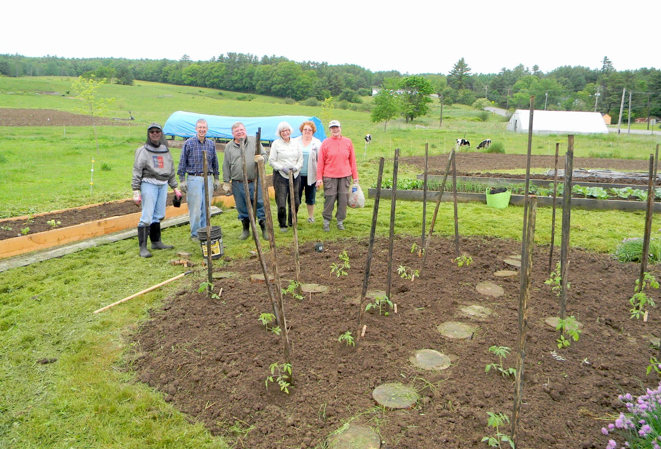
The garden at Morris Farm has been a learning experience for all nine of us. We’ve tried to use our successes (and mistakes) to manage tasks, improve our soil, and increase our yield for Maine Harvest for Hunger. If you’d like to meet us and see our gardens, please visit on July 22nd for Open Farm Day!
University of Maine Cooperative Extension’s Maine Home Garden News is designed to equip home gardeners with practical, timely information.
Let us know if you would like to be notified when new issues are posted. To receive e-mail notifications fill out our online form.
Contact Colleen Hoyt at colleen.hoyt@maine.edu or 1-800-287-1471 (in Maine).
Visit our Archives to see past issues.
Maine Home Garden News was created in response to a continued increase in requests for information on gardening and includes timely and seasonal tips, as well as research-based articles on all aspects of gardening. Articles are written by UMaine Extension specialists, educators, and horticulture professionals, as well as Master Gardener Volunteers from around Maine, with Professor Richard Brzozowski serving as editor.
Information in this publication is provided purely for educational purposes. No responsibility is assumed for any problems associated with the use of products or services mentioned. No endorsement of products or companies is intended, nor is criticism of unnamed products or companies implied.
© 2012
Published and distributed in furtherance of Acts of Congress of May 8 and June 30, 1914, by the University of Maine Cooperative Extension, the Land Grant University of the state of Maine and the U.S. Department of Agriculture cooperating. Cooperative Extension and other agencies of the U.S.D.A. provide equal opportunities in programs and employment.
Call 800-287-0274 or TDD 800-287-8957 (in Maine), or 207-581-3188, for information on publications and program offerings from University of Maine Cooperative Extension, or visit extension.umaine.edu.