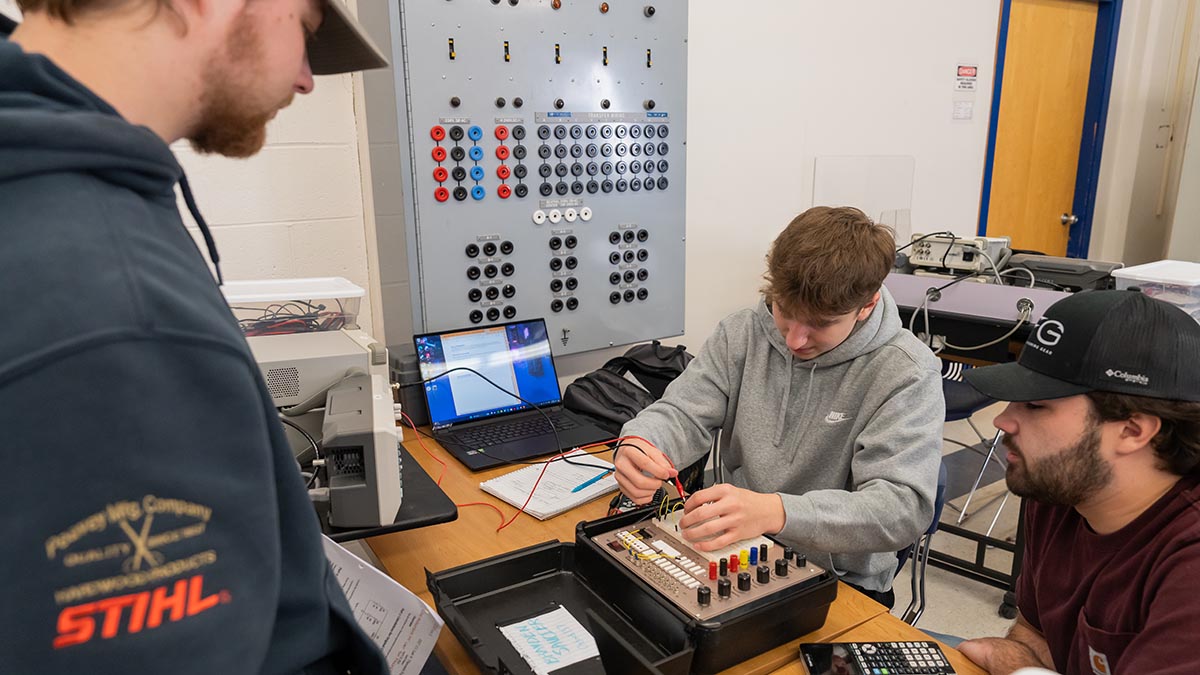
The University of Maine has received a grant from the U.S. National Science Foundation to give rural Maine teachers hands-on experience conducting research in artificial intelligence, quantum computing and microelectronics, which they will use to bring emerging science and technology into their own classrooms.
The three-year project, which began Sept. 1, will provide 18 K-12 STEM teachers with research experiences alongside UMaine scientists and support them in turning what they learn into lessons for their students. The project is supported through NSF’s Robert Noyce Teacher Scholarship Program.
Nuri Emanetoglu, professor of Electrical and Computer Engineering, is principal investigator. Susan McKay, professor emerita of Physics and Astronomy and a founder of the Maine Center for Research in STEM Education, or RiSE Center, is co-principal investigator.
The project combines UMaine’s expertise in emerging technologies with RiSE’s expertise in STEM education and teacher professional learning. Researchers will provide teachers with firsthand experience in advanced scientific research, while RiSE education specialists will help them translate those experiences into learning opportunities appropriate for their students.
“There are two parts to it,” Emanetoglu said. “One is exposing the teachers to the research projects and the state of the art in these fields. The second is translating that into an educational experience for their students.”
Each year, six teachers will be selected for the program. The first cohort will spend four weeks on UMaine’s campus in summer 2027 conducting research with Electrical and Computer Engineering and with Physics faculty and working with RiSE education research specialists. They will have an additional three weeks to continue their research and develop classroom materials.
“One of the really exciting parts is bringing together faculty who do research in these new, fast-moving fields while also tapping into the expertise of the RiSE Center at the University of Maine,” McKay said.
Teachers will work directly with UMaine researchers on projects involving AI, robotics, sensors, microelectronics and other advanced technologies. Depending on their research group, they could test AI models used to help robots recognize and grasp objects, study how microelectronic devices perform in extreme environments or work with microscopic devices used for scientific and biomedical applications.
The teachers will then draw from those experiences to develop learning opportunities appropriate for their students. A teacher could, for example, bring data collected through their research into the classroom and have students analyze it and determine what conclusions they can draw.
“They can really be part of an exciting research enterprise,” McKay said. “The beauty of having teachers design these kinds of learning experiences is that they know their students. They know what the students will know and what they’ll get excited about.”
Teachers will work in cohorts of six, allowing them to exchange ideas and provide feedback to one another. They will also test their lessons with fellow participants, their research group and RiSE team members before using the materials in their own classrooms. RiSE will continue supporting teachers throughout the school year as they refine their lessons and introduce new approaches in their classrooms.
The project focuses on teachers in rural, high-need Maine school districts, where students may have fewer opportunities to interact with scientists and engineers working in rapidly developing fields.
Emanetoglu said exposing students to areas such as AI, quantum computing and microelectronics can introduce them to new educational and career possibilities while helping prepare the workforce needed in strategically important areas of science and technology.
McKay said those opportunities could have implications beyond individual students and classrooms by contributing to Maine’s future economy.
“This is where innovation is going to come from in our economy,” McKay said. “There’s no reason why these sites of innovation can’t be in rural areas with good connections all over the world.”
Maine already has a long history in semiconductor manufacturing, Emanetoglu said, including semiconductor facilities in South Portland. Emerging fields such as AI, cybersecurity and robotics also can create opportunities that do not require proximity to a large manufacturing center.
“As long as you have a good internet connection, you could run that business anywhere in the state,” Emanetoglu said. “You could be doing that in Portland. You could be doing that in Fort Kent.”
The project brings together researchers from UMaine’s Department of Electrical and Computer Engineering, Department of Physics and Astronomy, Frontier Institute for Research in Sensor Technologies and RiSE Center.
The program is also designed so its impact can extend beyond the initial 18 teachers. Participants will have opportunities to attend conferences and share the research and instructional materials they develop with other educators. Returning teachers will also share their experiences with subsequent cohorts.
“This is a real opportunity for them to emerge as leaders in the STEM teaching field,” McKay said. “That’s exciting because it helps sustain the work that they’ve started.”
The project complements other UMaine efforts to strengthen STEM teacher leadership, particularly in rural communities. McKay said these types of professional development opportunities can also help retain strong teachers.
For Emanetoglu, long-term success would mean seeing the impact move from UMaine laboratories into Maine classrooms and, eventually, the state’s workforce.
“From the students’ perspective, it’s being exposed to these high-tech, high-impact areas and new career opportunities,” Emanetoglu said. “Hopefully, we’ll get some of them to come to UMaine or another institution where they can further study these areas.”
Contact: David Nordman, david.nordman@maine.edu