
Building a Sustainable Portland, One Bucket at a Time
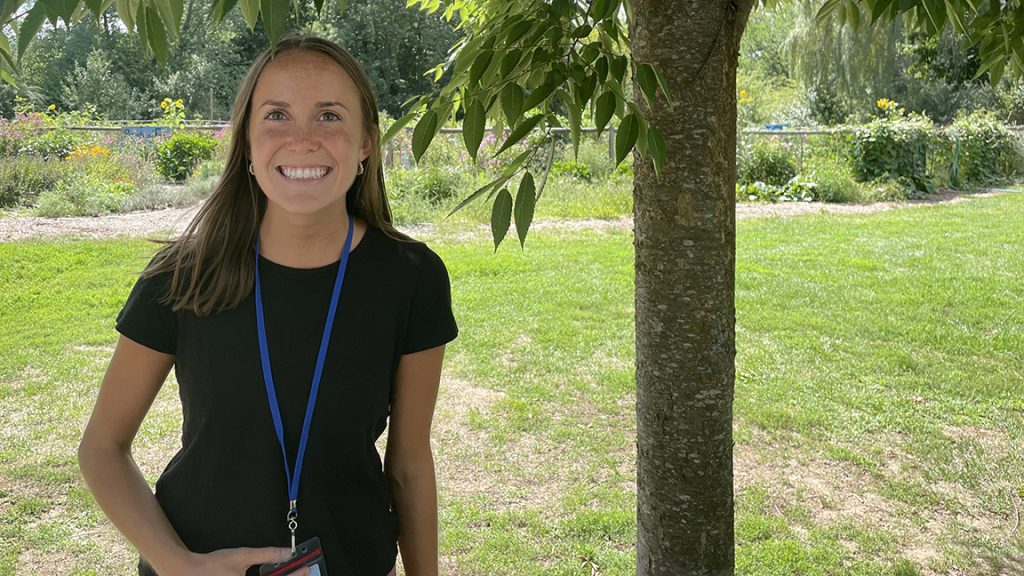
It’s not uncommon to see a resident of Portland, Maine hauling their compost bucket in one hand with a toddler in the other to one of 10 drop-off sites. Katie Tims, a sustainability associate with Portland’s Sustainability Office said, “We are trying to put them in every neighborhood.” Already the municipal composting program collects approximately 13 tons of food scraps per month.
And after Halloween, the city invites people to chuck their slumpin’ pumpkins onto the Payson Park Little League parking lot, an event dubbed Pumpkin-Cycle. Participants can then hang out and enjoy some food from the participating food truck.
If you’d asked University of Maine freshman Tims what she would be doing after finishing her bachelor’s degree, she probably would have said she wanted to be a doctor. The thought wouldn’t have occurred to her that she might one day be brainstorming and implementing sustainability solutions for the City of Portland.
But during her sophomore year, as part of the Honors College, she took a class on sustainable food systems, and it changed her academic trajectory. She still majored in biology with a pre-med concentration but added a sustainable food systems minor.
Then Tims saw an internship opportunity with Susanne Lee focused on wasted food research. Lee is a Mitchell Center faculty fellow and member of the center’s Materials Management Research Group (MMRG). Tims saw the internship as a chance to use her theoretical knowledge from her food systems classes — like how food and culture are intertwined and how history impacts food accessibility— and translate it into action.
Lee’s initiative eventually became known as Food Rescue Maine (FRM), but the project was still in its infancy when Tims signed on. Tims’ to-do list included researching existing solutions to wasted food, identifying key players in the food system, and conducting interviews with stakeholders to understand how they dealt with wasted food issues.
Six solutions emerged from this foundational research, which continues to guide FRM’s efforts to reduce wasted food in Maine.
Tims said, “The internship was exactly what I was looking for. I learned how to tackle problems that are both economically and environmentally challenging. I also learned that we can actually solve real-world problems by looking at them with a triple bottom line lens,” Tims said. By the end of the internship, she knew she no longer wanted to be a doctor.
The triple bottom line is made up of the “three P’s”: profit, people, and the planet. Ideally, sustainability solutions deliver a financial return but also positively impact society and the environment. It’s a framework that Tims continues to use at the Sustainability Office.
Portland’s ambitious One Climate Future climate action and adaptation plan also guides Tims’ work. The plan is the city’s roadmap to reduce greenhouse gas emissions and to prepare Portland for the impacts of climate change. It outlines 68 strategies across four areas: buildings and energy, transportation and land use, waste reduction, and climate resilience.
The citywide compost program and Pumpkin-Cycle fall within the goals of the waste reduction strategy while also meeting the “three P’s”. Since Portland uses a pay-as-you-throw system requiring people to pay for special purple trashbags, composting reduces solid waste as well as costs for both residents and the city. The planet benefits because wasted food is a major source of greenhouse gas emissions.
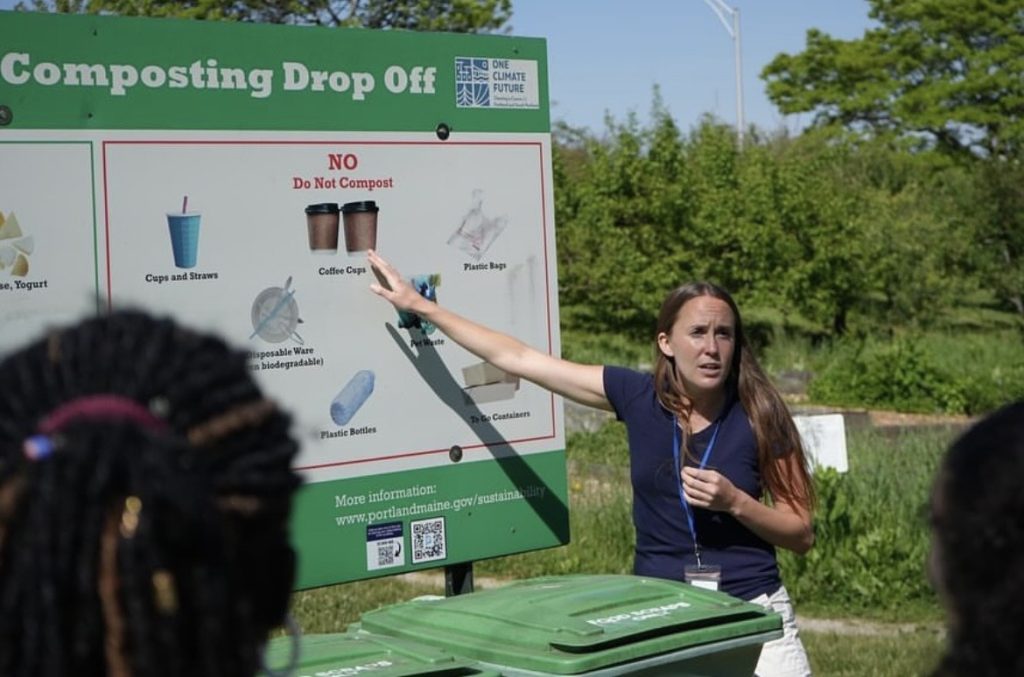
Tims continues to collaborate with Lee on Portland’s composting efforts. UMaine students and members of the MMRG designed the colorful, informational signs posted at each of Portland’s composting drop-offs. And when Lee was collecting data for Maine’s first comprehensive assessment of wasted food she collected data from Portland. Tims said, “Through data analysis, Susanne helped prove that Portland’s waste diversion program saves the city money.”
Another major effort for the Sustainability Office is their Electrify Everything! program which strives to make energy-efficient home upgrades accessible to all. The city, for example, provided rebates for electric bikes, do-it-yourself home weatherization projects, and electric appliances.
Composting and electrifying, guided by the “three P’s”, are top priorities for her office, but Tims believes that achieving a sustainable and climate resilient Portland also calls for strengthening community relationships. Tims’ cites studies showing that communities that are more socially connected are better prepared to face emergencies and extreme weather events.
Tims’ experience at the Mitchell Center exemplified the value and strength of community-led action for climate change, especially because Lee brought together diverse perspectives through her team’s collaboration with researchers, industry partners, and community members.
“In college, you’re typically surrounded by people who are studying the same thing as you and are probably pretty similar to you and your thoughts and views. My time at the Mitchell Center and the Honors College allowed me to work with people who truly view the world differently than I did.”
This is why Tims is helping to grow Portland’s Sustainable Neighborhoods Program. They recently offered a first round of mini-grants; funded projects included a community garden installing drip irrigation, an oral history project, and bicycle repair and maintenance workshops. The Sustainable Neighborhoods Program also hands out kits to help host neighborhood block parties or neighborhood cleanups.
Just as wasted food inspired Tims’ eventual career in community-engaged sustainability solutions — a job she never could have imagined — she hopes to inspire Portland residents to connect and collaborate on climate change, one compost bucket, one slumpin’ pumpkin, and one block party at a time.