
Bulletin #2366, Selecting, Planting, and Caring for Trees and Shrubs in the Maine Landscape

Bulletin #2366, Selecting, Planting, and Caring for Trees and Shrubs in the Maine Landscape (PDF)
Prepared by Diana George Chapin, Former Graduate Assistant, and Lois Berg Stack, Extension Ornamental Horticulture Specialist
For information about UMaine Extension programs and resources, visit extension.umaine.edu.
Find more of our publications and books at extension.umaine.edu/publications/.
 Table of Contents:
- Trees for Maine
- Shrubs for Maine
- Plant Selection
- Buying Plants from Nurseries
- Transplanting Wild Plants
- Planting Trees and Shrubs
All Maine landscapes may be embellished through the planting of native and introduced trees and shrubs. These woody plants add to a home landscape in many ways: they provide a source of shade to otherwise open areas and protect the home from forceful winds.
Trees and shrubs vary in leaf color and texture, bark texture, overall form, flowering qualities, and fall color. Many offer fragrance in addition to visual characteristics and some have fruits that are edible by either people or wildlife. Hundreds of species and varieties of woody plants can be grown in Maine — a tree or shrub exists for nearly every situation.
Trees for Maine
Trees are the most permanent plants we grow. Many live and enhance the landscape for 100 or more years if they are given proper care. Because of their permanence and importance in the landscape, take care to select the best tree for each situation. A tree improperly selected or cared for can detract from the overall landscape, and can become a liability.
A tree is a woody plant that produces one main trunk, supports a more or less distinctly elevated canopy of branches and reaches a height of 15 feet or more. Trees are divided into two main groups: deciduous and evergreen. Deciduous trees are those that lose their leaves each fall. Examples of deciduous trees are maples, oaks, and willows. A surprising member of this group is the larch, which has needles, yet is deciduous. Evergreen trees hold their leaves throughout the winter. Maine’s evergreen trees are all needled and include pine, spruce, and fir.
The distinction between deciduous and evergreen trees becomes important when planning a landscape. It is important to consider what the landscape looks like at all times of the year. Evergreens provide a classically beautiful winter scene, while the branching pattern of deciduous trees allows for an interesting visual texture during the winter months. The appearance of evergreens does not change dramatically over the year, while deciduous trees’ texture and color change greatly from season to season.
The differences between trees also become important when deciding on the functional aspects of a landscape. For example, evergreen trees make better year-round windbreaks than deciduous trees. Deciduous trees shade homes in summer and allow more light to penetrate in winter.
Shrubs for Maine
Shrubs add depth and interest to the landscape, within the framework formed by trees and buildings. Shrubs are often selected for their flowering and fruiting characteristics, but they are also valued for their form, texture and fall color.
Shrubs are generally smaller than trees and are typically multi-stemmed. The two groups overlap somewhat, since large shrubs can be limbed up to form small trees, and small trees are sometimes multi-stemmed. Like trees, shrubs can be deciduous or evergreen. Some of Maine’s deciduous shrubs offer both excellent flowering and fruiting, and outstanding fall color. Maine’s evergreen shrubs include needled types like junipers and broadleaf types like rhododendrons.
Plant Selection
Because there are so many woody plants available for use in the landscape, you should choose your plants carefully. It is all too easy to select a plant on impulse without considering the conditions your landscape offers. Rather than selecting a tree or shrub and then trying to fit it into your landscape, first assess your landscape. Determine the growing conditions of the site, and what function you want the plant to serve. Base your selection on these factors:
- Plant hardiness. Maine has a short, cool summer season and a long, cold winter. Hardiness is the most important factor in selecting trees and shrubs. The must thrive in the growing season, and survive the harsh winter season. Refer to the USDA Plant Hardiness Zone Map of Maine for more information about hardiness.
- Purpose of the plant. Think about what you want the tree or shrub to do in your landscape. If you want to fall color, choose a deciduous plant. If you want a winter windbreak, you might consider evergreens. If you are interested in feeding birds, you might choose a specimen that produces choice fruits. Some trees can be limbed up to provide shade, and most shrubs are branched to the ground so that they block undesirable views.
- Plant environment. There is a tree or shrub for most locations, but no single plant can adapt to every location. Assess the planting site for exposure, since some trees and shrubs require full sun and others perform best in shade. Test the soil to determine the acidity and nutrient levels. Watch the site after a rainfall and in early spring to see how well the soil drains.
- Plant characteristics. Trees and shrubs differ from one another in many traits: size, shape, branching patterns, texture, fall color, fruiting. Several different woody plants might fit your needs, but you might choose one over another based on these characteristics. Also, some types adapt to new sites more successfully and grow more rapidly. Plants vary in susceptibility to problems. Some trees and shrubs are prone to serious problems that limit their use. For example, some crabapples develop serious problems, including powdery mildew, scab, and firelight. (Refer to Bulletin #2058, Flowering Crabapples for Maine for a list of disease-resistant types.) Lombardy poplars grow rapidly but are ready hosts to a canker that kills them at a young age, making them a liability in the landscape. Silver maples are weak-wooded and have narrow crotch angles; they can split in storms and cause serious damage to buildings if they fall. When considering various trees and shrubs, learn about their liabilities as well as their assets, in order to make a good selection.
- Availability. Not every woody plant is available in the nursery industry. One good way to make your choices is to visit a nursery or browse through a catalog.
Buying Plants from Nurseries
Nurseries offer a wide selection of both native and introduced plants. Most nursery grown trees and shrubs transplant with great success into the landscape.
When selecting a tree or shrub from your local nursery, make sure it is healthy. Look for plants with few or no yellow leaves. Avoid plants that show signs of stress; they are less likely to transplant successfully. Some indications of plant stress include insect and disease damage, poor root development and leaf desiccation (drying of the leaves).
Purchasing woody plants from a local nursery offers some advantages over purchasing from other sources, such as distant mail-order companies. Local nurseries are excellent sources of information and service after the sale. A tree or shrub from a local nursery is more likely to be conditioned for local growing conditions, too.
Trees and shrubs that are not available at a local nursery may be found through mail-order nurseries, which ship plants directly to your home through the mail. Order early to ensure a good selection of type and quality. Late orders may be filled with plants that are too advanced (the plants may come from an area with an earlier growing season than ours), or substitutions may be necessary.
Transplanting Wild Plants
Wild trees and shrubs may be successfully transplanted into the landscape with some preparation. They should be dug only with permission from the landowner. Open pastures or fields are the best places to look for well-formed, vigorous specimens that have good root development.
When transplanting your specimen, try to match its new environment to its native one. For example, plant a tree found on a dry slope into a location with well-drained soil. Small plants generally transplant more successfully than more mature plants.
To enhance the likelihood of successful transplanting, consider using the same root pruning technique that many professional nursery people to use to encourage rood development. Root pruning is a simple method of dividing the circumference line of the root area into six or eight segments. At alternating segments, use a sharp spade to cut straight down through the root system. By cutting through these established roots, you enhance the likelihood of increased root development. The following season, dig one to two inches outside the previous year’s cuts, cutting a round root ball that captures the newly developed roots. Carefully lift the root ball onto a tarp, so that you can transfer it to its new site with minimal root ball disturbance.
Forms of Plants Available from Nurseries
Trees and shrubs are available from nurseries in three forms: bare-root, balled-and-burlapped (B&B) and container-grown. Each form has advantages and disadvantages, and all can be successfully transplanted if handled properly.
Bare-Root Plants: Bare-root plants are grown in the field, then harvested. The soil is washed or shaken from their roots after digging. Nearly all are deciduous trees or shrubs that are dormant. Most mail-order plants are bare-root because plants in soil are too heavy to ship economically. Many tap-rooted plants, such as nut trees and some fruit and shade trees, are handled this way.
Bare-root plants are typically available only in early spring before the buds begin to swell. Since these plants’ roots are bare, it is critical to keep them moist by packing their roots in moist material, such as sawdust, or covering their roots with wet burlap. Store the plants in a cool location (32 to 40 degrees F is best), and plant as soon as possible, before the roots and buds start to grow.
Plants available in nurseries in early spring with their roots wrapped in damp sphagnum and packed in cardboard or plastic containers are also bare-root. When planting, spread their roots out to a natural position.
It is important to plant bare-root trees and shrubs soon after you get them. Anticipate their arrival. Dig planting holes ahead of time. Keep roots moist but not wet by covering them with wet burlap, and do not hold them longer than a few days before planting. Just before planting, soak roots in water for six to 12 hours.
Balled-and-Burlapped Plants: Balled-and-burlapped (or B&B) trees and shrubs are likely to have been grown in nursery rows for some time. Some have been root pruned periodically, and have developed compact, fibrous, healthy root systems. Others may have had most of their absorbing roots removed at digging time. B&B plants with good root systems re-establish themselves rapidly after planting.
B&B plants’ root balls are wrapped in burlap, which may be either natural jute or plastic. If it is a natural fiber, the burlap can be folded into the bottom of the planting hole. If it is plastic, it must be removed. In either case, remove the ropes or twine that hold the ball together. If the root ball is large and in a metal basket, cut away the basket, so the roots can spread without any interference.
Always lift a B&B plant by its soil ball. Lifting a B&B plant by its stem places stress on the roots. When planting, carefully set the soil ball into the hole, loosen the burlap, and pull it back. Do not jostle it too much, especially if the soil in the ball is sandy; sandy soil falls away readily, exposing and damaging the roots.
You can plant B&B plants almost any time that the ground can be worked, but if you plant them in midsummer, take care to keep them adequately watered. As with most plants, spring planting is preferred. The next best time to plant B&B plants is October/November when they are dormant.
Container-Grown Plants: The term “container-grown” refers to a plant that has been grown in a container or one that has been transplanted into a container from the field. Many growers prefer to produce trees in containers because they are easily transported and their roots remain contained while they are in the display area.
Containers are convenient for nursery growers, but they provide limited space for roots. This can result in roots growing in a tight coil inside the bottom of the container. Also, some larger roots may coil around the base of the stem or trunk, resulting in root strangulation or “girdling.”
If you purchase a container-grown tree or shrub, remove it from its container even if the container is biodegradable. Check the plant’s roots. Tease out any large roots that are growing around the edge of the root ball, and redirect them so that they point outward radially from the plant. If fibrous roots are densely matted around the sides of the root ball, slice about an inch into the root ball from top to bottom in 3–4 evenly spaced places. Cut off any dense root mass that grows in a circle in the bottom of the container. Remove any roots that tightly encircle the base of the plant’s stem, just at or below the soil surface. All of these practices promote a healthier, more productive root system.
Container-grown trees and shrubs can be planted almost any time of the season, but are most successfully planted in either early spring before bud break, or in early fall (late August to mid-September) when roots can establish well before winter.
Planting Trees and Shrubs
Most trees and shrubs can be planted in Maine after the ground thaws and dries out in spring, and before the plants begin to leaf out. Plant bare-root plants promptly. B&B and containerized plants can be held much longer, but be sure to keep them watered during the holding period. Containerized plants have the longest “shelf life” before planting because their roots have not been disturbed. Fall planting is risky in much of Maine because fall growing conditions are not predictably favorable for good root development before the ground freezes.
Here are five basic guidelines for planting and caring for trees and shrubs.
- Choose the right plant for the location, and obtain the best specimen available. A healthy specimen thrives if planted properly in the right location, but even the best planting procedures cannot overcome poor plant selection. Shop in early spring for the best plant selection. Of course, native plants are adapted to Maine conditions, but introduced species can be more difficult to evaluate. Visit trial gardens, talk to knowledgeable nursery professionals, read catalogs and gardening books and call your local UMaine Extension County Office for help.
- Use native soil with limited soil amendments. If you have selected the best plant for the location, then soil amendments such as compost or peat moss are not necessary. However, construction site fill sometimes resembles rubble more than soil. If the soil is either gravel or very heavy, and you feel a soil amendment is necessary, then amend the soil not more than 25 percent by volume. This provides a good environment for roots to grow into, yet is not drastically different from the surrounding native soil. If the backfill in a planting hole is too different from surrounding soil, the roots may not penetrate out of the planting hole, and the resulting root mass may be limited and insufficient to support long-term growth.
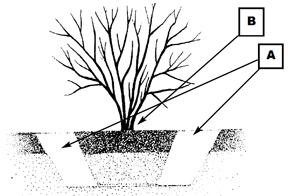 Dig a wide and shallow planting hole, and don’t plant too deeply. Roots grow outward, more than downward. It is important to provide loose soil around the root ball for roots to expand into. For most woody plants, about 90 percent of the root mass is in the top 12 inches of soil. Dig a planting hole at least three times as wide as small root balls, or at least 12 inches wider in all directions than large root balls. [A]While the planting hole can be dug as wide as you are willing to dig, it should not be dug any deeper than the root ball. If trees and shrubs are planted too deeply, or if they are placed on backfill that later settles and effectively “plants them” too deeply, then they are subject to two serious problems. First, roots require oxygen to function, and the oxygen level several inches below the surface is low. If roots cannot access oxygen, then they cannot grow, and the plant will decline and possibly die. Second, the juncture between the root and trunk of a woody plant should be planted at or even slightly above the ground level. If it is planted too deeply, then the plant is subject to decay and damage from girdling root development. [B]In a location with heavy soil, dig the planting hole a few inches more shallow than the depth of the root ball. Remember that you will cover the root zone with two to three inches of mulch after planting.When you plant, dig the hole, place the specimen into it on firm, native soil, and rotate as needed for best visual perspective. Remove the ball and burlap or container as described earlier. Prune off damaged roots and girdling roots, and redirect any roots growing around the circumference of the root ball so that they point outward.Backfill with either native soil or minimally amended soil to fill the hole halfway. Tamp firmly with the shovel handle to remove air pockets, and water thoroughly to settle the soil. Fill the rest of the hole, tamp and water thoroughly. Most nursery-grown trees and shrubs do not require any pruning of branches at planting time, because they were pruned for form during nursery production. Most trees also do not require staking, unless they are sited in a very windy location or in heavy clay soil. If you do stake, be sure to remove the stakes and cushioned wires one year after planting.
- Care for the specimen for at least the first three seasons, to promote good establishment. Of course, you will want to perform ongoing maintenance as needed, but that long-term maintenance will be less if you take special precautions during the first three years. Mulch around the base of the plant to prevent weed growth, preserve soil moisture, protect the bark of the trunk from lawn mowers and eliminate competition from the turf. If possible, mulch with two to three inches of organic matter, such as bark chips, at least as wide as the drip line of the plant. Pull the mulch away from the base of the plant, since the addition of the mulch would be the same as planting too deeply. Watering and mulching at planting time is only the first step in a successful maintenance program. If the planting site does not receive at least one inch of rainfall per week during the first few growing seasons, supplement with slow soaking irrigation. Base the amount of irrigation on prevailing conditions. Always water thoroughly, but water more frequently in hot weather and on sandy sites, and water less often in cool weather and on heavy clay sites. Fertilize for the first time in spring of the year after planting. Prune for form during the second or third year. (Refer to Cooperative Extension Bulletin #2169, Pruning Woody Landscape Plants, for more information about pruning.)
- Identify problems and resolve them before they become serious. Proper plant selection, good planting procedures and attentive early care are the keys to healthy plantings. Still, problems can develop. Monitor your plants and get to know what they look like when they are healthy and vigorous. If you notice any changes that suggest a problem, identify the problem, and resolve it before it becomes serious. Seek professional assistance if needed. Spot treating a problem early can reduce maintenance labor and pesticide use, and can prevent major damage.
Information in this publication is provided purely for educational purposes. No responsibility is assumed for any problems associated with the use of products or services mentioned. No endorsement of products or companies is intended, nor is criticism of unnamed products or companies implied.
© 2003, 2023
Call 800.287.0274 (in Maine), or 207.581.3188, for information on publications and program offerings from University of Maine Cooperative Extension, or visit extension.umaine.edu.
In complying with the letter and spirit of applicable laws and pursuing its own goals of diversity, the University of Maine System does not discriminate on the grounds of race, color, religion, sex, sexual orientation, transgender status, gender, gender identity or expression, ethnicity, national origin, citizenship status, familial status, ancestry, age, disability physical or mental, genetic information, or veterans or military status in employment, education, and all other programs and activities. The University provides reasonable accommodations to qualified individuals with disabilities upon request. The following person has been designated to handle inquiries regarding non-discrimination policies: Director of Equal Opportunity, 101 Boudreau Hall, University of Maine, Orono, ME 04469-5754, 207.581.1226, TTY 711 (Maine Relay System).