Field Guide - Aphids
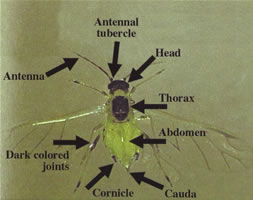
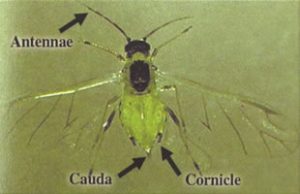
| Typical Aphid Structures
|
Aphid economic threshold:
Seed fields: 1 winged Green peach aphid Processing & Tablestock: 1 winged Green peach aphid |
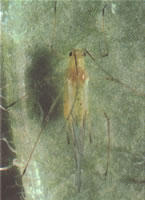
Winged Potato Aphid (right)
The potato aphid is the largest of the potato infesting aphids. This aphid has several color forms, ranging from yellow-green to light green to dark green to pink. The body is elongate, somewhat wedge shaped. The antennae are about the same length as the body.
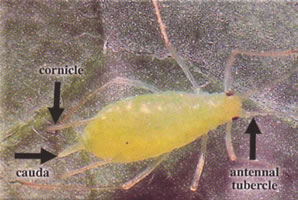
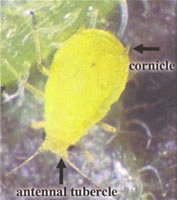
Wingless Potato Aphid (below)
The antennal tubercles are prominent and outward sloping. The cauda extends about the same distance as the cornicles.

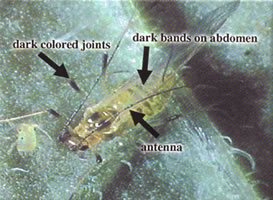
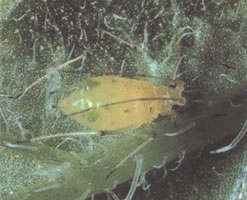
Winged Foxglove Aphid (right)
The Foxglove aphid will usually have a series of dark bands on the abdomen. The antennae will be slightly longer than the body. The leg joints will be dark colored. This aphid will also have some-what of a “spidery” appearance.
Wingless Foxglove Aphid (below)

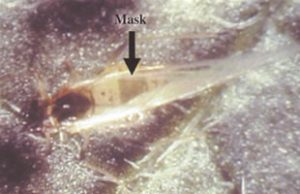
Winged Green Peach Aphid (right)
The key characteristic for winged Green peach aphid identification in the field is the prominent card colored mask on the abdomen.
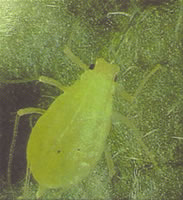
Wingless Green Peach Aphid (below)
The body of this aphid is egg/tear dropped shaped. The cornicles seem to bend towards the cauda. Antennal tubercles are prominent and inward pointing. The color and shape many times resembles a sesame seed. They can be light green to almost translucent, sometimes deep pink.

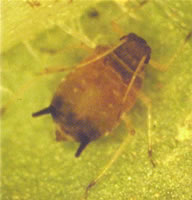
Wingless Buckthorn Aphid (right)
This aphid is the smallest of the potato infesting aphids. The antennae are much shorter that the body. The front of the head is flat and there are no prominent antennal tubercles.
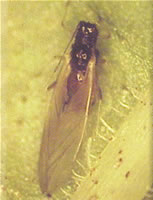
Winged Buckthorn Aphid (below)
This is a rather small aphid, with inconspicuous antennal tubercles. The antennae tend to be about half the length of the body. The area between the antennae is smooth. The cornicles tend to be rather short as compared to the body and are slighly shorter in length that the cauda.

![]() |
![]() |
Melon Aphid (right)
A species of aphid that occassionally infests potatoes. This aphid can be difficult to identify, because it can vary greatly in appearance. This aphid is closely related to the Buckthorn aphid.