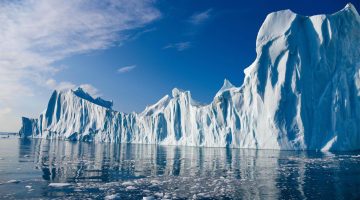
The Penobscot Bay Pilot wrote an article about the upcoming trip to Alaska by University of Maine climate change researchers to collect an ice core record of Arctic climate change over the past 1,000 years. Karl Kreutz, professor in UMaine’s Climate Change Institute and School of Earth and Climate Sciences; UMaine graduate student Seth Campbell; and Nobleboro Central School teacher Ken Williams are among the researchers who will take the trip to Denali National Park from April 29 to June 30.
The University of Alabama’s UA News published an article on research that found clamshells used in ancient funeral ceremonies offer more evidence as to how climate change may have contributed to the gradual collapse of the Moche, an early South-American civilization. The research, which was recently published in the scientific journal Geology, was conducted by University of Alabama scientists as well as representatives from the University of Maine, the U.S. Geological Survey, the Arizona Accelerator Mass Spectrometry Facility, the University of Arizona, the University of Trujillo in Peru and Harvard University. The researchers found El Nino and an intertwined ocean phenomenon likely contributed to the Moche’s downfall.
Russian geologists at the University of Silesia in Poland have discovered two minerals new to science and have named them “edgrewite” and “hydroxledgrewite” in honor of University of Maine geologist and research professor Edward Grew.
The new minerals were discovered by mineralogists Evgeny Galuskin and Irina Galuskin in the Chegem caldera in the Northern Caucasus, near Mount Elbrus in the Kabardino-Balkaria Republic in Russia. A caldera is a crater-like structure produced by very large explosive volcanic ash eruptions, like those found Yellowstone and Crater Lake national parks.
Grew began working with the Galuskins as associate editor of the journal American Mineralogist, when he helped them prepare papers for publication, and in person at the International Mineralogical Association meeting in Budapest in 2010. The Galuskins were familiar with Grew’s reputation for working successfully with Russian scientists throughout his career.
The honor of having a mineral named for him “is a lifelong dream come true,” says Grew, whose research focuses on rare minerals containing boron and beryllium, and the role of the two elements in the changes that rocks undergo at high temperatures and pressures in the Earth’s crust. “I have always valued my international collaborations in science, and so I was especially honored that colleagues in Europe proposed my name for the new minerals they discovered.”
A UMaine research faculty member for 28 years, Grew has been involved in the discovery and characterization of 13 new minerals, including six from Antarctica. He has been on nine expeditions to Antarctica with researchers from the former Soviet Union, Australia, Japan and the United States, in addition to research projects in Australia, India, Germany, Japan, Tajikistan and Siberia. His first expedition to the Antarctic was in 1972–74, when he wintered at Molodezhnaya Station. He has published extensively on the composition and evolution of minerals, and has served in leadership capacities for national and international professional organizations and mineralogical publications.
Identifying undiscovered minerals involves detailed microscopic analysis. Edgrewite and hydroxledgrewite were found as tiny crystals smaller than the period at the end of a sentence in a newspaper, according to Grew.
“Recognizing a new mineral involves a measure of good luck and familiarity with known minerals,” he says. “Several new minerals I have discovered simply looked different under the optical microscope. Chemical tests confirmed my hunch that the minerals were new. Sometimes a new mineral does not stand out optically under the microscope, but (its) distinctive chemical composition suggests it is new. Once a mineral is suspected to be new, it is studied in detail so its physical, chemical and crystallographic properties are fully characterized and then it must undergo a complex process of approval by an international commission.”
The Galuskins and research colleagues from four European countries discuss the discovery of the new minerals edgrewite and hydroxledgrewite in a peer-reviewed scientific report in the November–December issue of the journal American Mineralogist.
Contact: George Manlove, 207.581.3756
Otoliths of prehistoric Pacific cod function as paleothermometers, revealing how the species endured fluctuating ocean temperatures 500 years ago during the Little Ice Age, according to a research team led by a University of Maine anthropologist.
Fish have three pair of otoliths or ear stones — calcium carbonate structures found in the inner ear that are used for acoustic perception and balance. In Pacific cod, the largest and most useful for oxygen isotope analysis is the sagittae, which grows in daily, seasonal and yearly bands, much like tree rings. These growth rings can be counted to estimate the age of the fish and sampled to understand such factors as changes in the environment.
The sagittae’s size also increases the odds of it being preserved in the archaeological record.
Catherine West, a UMaine assistant professor of anthropology and climate change, has used oxygen isotopes in Pacific cod otoliths to reconstruct Little Ice Age ocean conditions and to assess the relationship among climate, fish biogeography and human foraging activity in the Gulf of Alaska.
Because oxygen isotope ratios in otolith growth bands are determined primarily by water temperature, West studies the growth rings as paleothermometers to understand conditions during the Little Ice Age.
Pacific cod are found throughout the North Pacific Ocean, from China’s Yellow Sea to Monterey Bay, California. The broad temporal and geographic distribution of Pacific cod makes their otoliths ideal for paleoenvironmental reconstruction.
For her most recent study of otoliths as paleothermometers, West and researchers from the Seattle-based International Pacific Halibut Commission and the National Marine Fisheries Service analyzed ear stones found at an archaeological site on Kodiak Island, Alaska. The site was occupied during the Little Ice Age that began in the Gulf of Alaska approximately 650 years ago. The 15 whole otoliths selected from the deposits representing a 500-year period clearly indicated that the Pacific cod living around the Kodiak archipelago experienced fluctuations in ocean temperature during the Little Ice Age.
The archaeological otoliths offer a long-term record of Pacific cod’s environmental interaction, contributing to understanding of the species’ survival in the face of changing climate in the North Pacific, according to the researchers writing in the Journal of Archaeological Science.
Contact: Margaret Nagle, 207.581.3745
Research confirms regional — not global — climate change in New Zealand and European glaciers during the preindustrial Holocene
Across the globe in the past century, mountain glaciers have been melting in response to warmer atmospheric temperatures. They include peaks in the European and Southern Alps — formations found on opposite sides of the globe.
New research led by scientists at the University of Maine’s Climate Change Institute has documented that unlike the concurrent, widespread melting occurring today, glaciers in the European and Southern Alps 11,500 years ago experienced regional climate and oceanographic variability.
The findings of the international research team, led by then UMaine Ph.D. student in Earth sciences Aaron Putnam, provide evidence that changes in glacier behavior in the preindustrial age were not caused by global atmospheric warming. As reported this week in Nature Geoscience, the researchers suggest that today’s glacier recession in New Zealand and Europe is unlike what occurred in those mountain ranges in the preindustrial Holocene period, and corresponds with human-produced greenhouse gases.
Putnam and his team worked on Cameron Glacier in the central Southern Alps. They reconstructed glacier fluctuations and associated temperature variations for the past 11,000 years using moraine geomorphology and high-precision beryllium-10 (10Be) surface exposure dating — a measure of the cosmogenic nuclide on rock faces to determine the age of landforms marking what were once the edges of glaciers. The researchers also used a geometrical method to reconstruct the height of past mountain snowlines, which are affected by atmospheric temperature.
Using this geologic record of mountain glaciers to quantify the history of atmospheric temperature, the research team found that Cameron and other glaciers in the Southern Alps retreated several centuries earlier than those in the European Alps.
Previous research has shown that beginning 11,500 years ago, glacier expansion occurred in the European Alps due to atmospheric cooling. That was followed in the 17th to 19th centuries by large-scale glacier retreat.
Putnam, a native of Chapman, Maine, now a postdoctoral researcher at Columbia University, collaborated in his research with George Denton of the UMaine Climate Change Institute and scientists from the Lamont-Doherty Earth Observatory, Columbia University, GNS Science in New Zealand, University of California, Berkeley and Victoria University.
Contact: Margaret Nagle, (207) 581-3745
Two years ago when Allison Byrd came to the University of Maine to begin her graduate research on loons, she didn’t know much about the large birds.
She quickly found out that’s not true for Mainers.
“Everybody in Maine has a loon story or has seen them,” Byrd says. “(Loons) are so iconic and well-loved. Even when I first came to Maine and stopped at a rest stop, there was a big picture of a loon.
“To be honest, I was a little intimidated at first. (Then) I realized, OK, I’m really going to have to know my stuff.”
Two years later, Byrd has gotten closer to more loons in Maine and around the country than most people ever will. Working under UMaine assistant professor Brian Olsen, Byrd is studying the potential effects of climate change on the loon population in Maine and the nation.
Loons — in Maine the species is the New England common loon (Gavia immer) — are not endangered, but there is much value in data about them. A loon can live more than 30 years, which is relatively long for a wild bird.
“It’s important to understand population dynamics as the long life span of a loon makes it harder to detect declines in abundance,” says Byrd, who graduated from the University of Rhode Island with a degree in wildlife biology. She went on to do fieldwork on black bears and had a job in a fish hatchery in her native New Jersey, worked as a zookeeper in Boston, and did fieldwork with birds in Australia, Mexico, Panama and the U.S. before coming to UMaine to work on her master’s in ecology and environmental science.
Initially, Byrd was interested in loons because of their unusually aggressive behavior. Loons will kill each other in fierce territorial clashes, which brings up a key question: Why defend one’s territory to the death when moving to another lake would seem simpler? That leads into Byrd’s research on why loons settle where they do, and how vulnerable the birds are to changes in their habitats and the climate.
“In Connecticut, for example, there are suitable lakes and habitat, but there are no loons,” she says. “There is something that’s limiting the edge of their range, whether it’s water clarity, lake surface temperatures, fish assemblages or dissolved oxygen levels. The question is: Are those the same things that are predicted to be affected by climate change?”
The research combines demographic analysis, physiological measures and behavioral observations of loons across a range of climatic conditions to predict how changes to lake characteristics could impact loon distributions.
To that end, Byrd spent the past two summers banding loons on lakes in the areas of Rangeley and Greenville in western Maine. She also traveled to Montana and Washington state, and recruited biologists in other regions with loon populations to gather behavioral observations of territorial loons.
Byrd will combine her more than 2,000 recorded observations with analyses of lakes — both with and without loons — to build a model that shows why loons locate where they do. That model will indicate what will happen to loons if there are climate change-related shifts to lake characteristics.
The process of loon banding presents a challenge even before a loon is ready for a band on its leg. If threatened by something such as an approaching boat, a loon will dive underwater, making it impossible for researchers to grab the bird. However, if a loon has chicks that are too young to dive, the adult is more likely to stay on the lake surface. Banders work at night, approaching quietly in the darkness, before turning on a spotlight when they close in on the loon. The light is so bright that the loon cannot see the boat, and the loon is scooped up with a net.
If a loon looks as if it might dive despite the light, banders imitate or play sounds of chicks in distress. The sounds momentarily confuse the loon, which will likely stay on the lake surface rather than abandon its chicks.
“Everything is very quiet and calm to that point, but things get a little more hectic when you scoop it up because the loon is huge and strong and fighting,” she says. “Then you get it into a position where it can’t hurt itself, hold it, take blood samples. If it’s not (already) banded, you put bands on it, and take bill measurements and other measurements for body size. You release the adult and chick together.”
Banding and behavioral observations gave Byrd two key statistics. First, she was looking at questions of presence/absence — where loons are living and successfully having chicks, and where they are living but not pulling off young. Second, she considered site fidelity — how likely loons are to return to the same lake year after year.
“Thanks to banding, I can look at how often birds come back to a territory, which is going to help understand if that’s a preferred habitat,” Byrd says. “If there’s one lake with a different bird every year, we can start to guess that that’s not a good territory or conversely, it’s a great territory and they’re fighting hard every year and every year someone is getting kicked out. But that’s a little less likely because loons are good at maintaining their territory.”
Byrd took blood samples from loons in Maine, New Hampshire, Montana and Washington state. Part of Byrd’s funding and her long-term dataset, which contains historical banding records and site fidelity information, comes from the Biodiversity Research Institute (BRI), a Gorham, Maine-based nonprofit whose mission is to assess emerging threats to wildlife and ecosystems through collaborative research. Byrd uses the blood samples to look at metabolite measures that indicate how well an individual loon is preparing for its winter migration. BRI is also interested in assessing the effects of mercury on ecosystems.
Because loons are usually near the top of the food chain in their environment, they are a good bioindicator of the accumulation of mercury in a system.
Spending so much time around loons, Byrd has learned something else about the species. Those loon calls we associate with the tranquility of summer on a Maine lake are actually, for the loon, an indication of something a lot less tranquil.
“When they call out in the middle of the night, it’s thought that they’re doing that because it’s quieter or the sound will travel farther, saying, ‘Here’s where I am, this is my territory,’” Byrd says. “If you hear the yodel, that beautiful sound that is so iconic, and if you look around, there might be another loon or an eagle flying overhead. They even respond sometimes to low-flying airplanes. What they’re saying is, ‘I’m ready to take you on if I need to.’”
Image Description:
Image Description:
Image Description:
Editor’s Note: This is the first in a series of blog posts from UMaine’s Climate Change Institute, which is currently conducting fieldwork in the Alaska Range. Seth Campbell, a University of Maine graduate student pursuing his Ph.D. through UMaine’s Climate Change Institute and Department of Earth Sciences, is getting ready to lead an expedition in Denali National Park in Alaska. This will be his fifth field season in Denali.
I am in Alaska already working on a couple of different projects I’m involved with before I go into the field for the Denali project on April 21. We have quite a team this year to help in the field research including myself; UMaine undergraduate Josh Plourde; former UMaine students Curtis Marston and Lyndsay Marston; Kristin Schild, who earned her master’s degree at UMaine’s Climate Change Institute and is now working on a Ph.D. in earth sciences at Dartmouth; Brad Markle: A Ph.D. student in glaciology student at the University of Washington; Dave Silverstone, an undergraduate student at the University of Alaska Anchorage; Adam Toolanen, an undergraduate student at Lund University in Sweden; and Hazel Shapiro, an undergraduate student at Dartmouth. (more…)
Just in time for Earth Day, anyone in the U.S. can see important environmental factors easily and instantly
Orono, Maine, April 12, 2012 – With 10Green, a new, interactive web tool (10Green.org) you can get a comprehensive assessment of the health of your local environment with just a few keystrokes. Just enter your zip code or the name of your community and 10Green gives you the health of your location on a simple 0 to 10 scale. This is the first time such a consumer-friendly environmental health tool has been made available. (more…)
California’s Sacramento Bee newspaper carried a news release about the new “10Green” interactive web tool designed by the University of Maine Climate Change Institute to provide 10 air quality measures of pollutants such as carbon monoxide, large and small particulates, ozone, sulfur dioxide and heavy metals. Institute Director Paul Mayewski said in an interview that 10Green utilizes years of ice core and climate change research to enable users to gauge air quality in various locales.
Contact: Margaret Nagle, (207) 581-3745
A Portland Press Herald report on the outlook for ticks this spring included a reference to UMaine Climate Change Institute research. Although reported cases of Lyme disease in Aroostook County are low, the article said, the Maine Medical Center’s Vector-borne Disease Laboratory in South Portland has used a 2011 model by the Climate Change Institute to predict that by 2050, a warming climate will lead to an increase in deer ticks throughout the state, even in northern areas.
Contact: Jessica Bloch, (207) 581-3777