
Artillery Fungus

Pest Management Fact Sheet #5103
Authors: Dr. Alicyn Smart, Dr. Bruce Watt, and Abigayl Novak
For information about UMaine Extension programs and resources, visit extension.umaine.edu.
Find more of our publications and books at extension.umaine.edu/publications/.
Other Name: Shotgun fungus
Pathogen: Sphaerobolus stellatus
Introduction
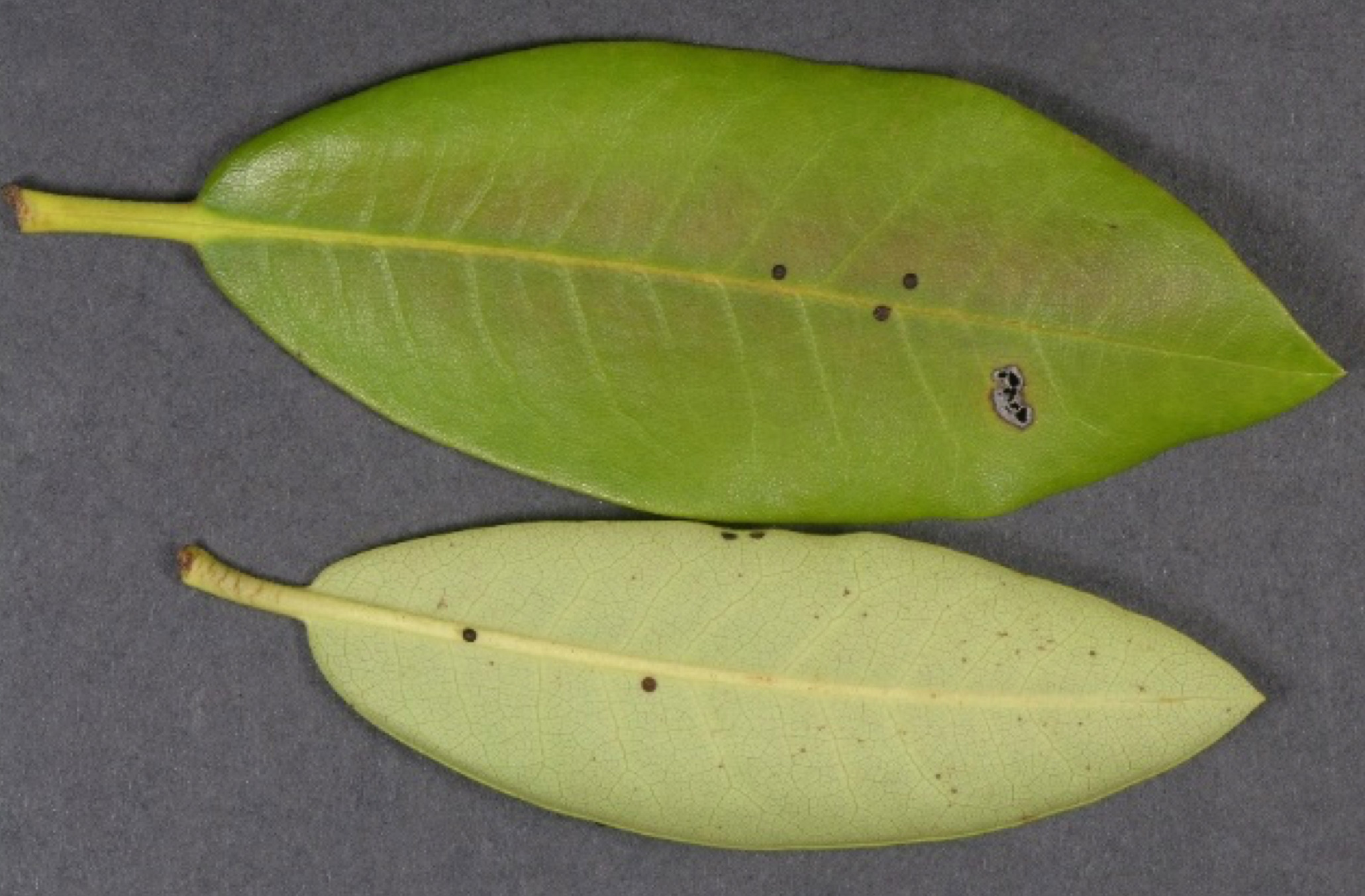
The artillery fungus (Sphaerobolus spp.) is a wood-decaying fungus responsible for causing unsightly spots on objects located in its immediate vicinity. These spots are often mistaken for tar spots, scale insects, or insect frass. The spots are actually glebal masses (peridioles) that have been forcibly ejected from the tiny cup-like structures of the fungus (see Figure 1.). The firing mechanism, estimated to 1/10,000 hp and powered by a build-up of osmotic pressure, can shoot the glebal mass a distance of up to 20 feet. The ejection is said to be accompanied by an audible sound. When the mass hits a surface, a sticky coating causes it to adhere, producing a small black spot about 1/10 inches in diameter. Once the mass has adhered to a surface, it is nearly impossible to remove without damaging the surface itself.
Host
- Wood mulch
Symptoms and Signs
Artillery fungus produces black spots and are actually masses of mature cup shaped spores and can be misdiagnose as bird’s nest fungus. Damage of Sphaerobolus tends to occur most frequently during the cool, wet days of spring and autumn due to fruiting bodies not being produced at temperatures above 77°F. High temperatures are advantageous to the fungus because the glebal mass is less likely to land on a moist surface, which will favor fungal growth. Sphaerobolus grows in moist organic matter, such as dung and rotting wood, and prefers sunny locations. The fruiting body tends to discharge toward a strong light source such as the sun or a bright, reflective surface. Commonly, when Sphaerobolus damage occurs, organic mulches have been used in the area, but any rotting wood should be suspected as a potential source for the fungus to grow. Occasionally damage is seen inside of houses when mulches have been used in houseplants.
Management
Control strategies consist mainly of altering the habitat so the fungus does not grow. Where mulch is suspected as the fungus source, it should be removed and new mulch put down in its place. Alternatively, a new layer of mulch may be placed on top of the old mulch to act as a barrier. Large-nugget bark mulches of pine, Atlantic white cedar, or cypress are more suppressive to Sphaerobolus than most other organic mulches, but inorganic mulches would not support any growth of the fungus and would be a more permanent solution. Some examples include rubber mulch and stone mulch. No fungicides have been registered for use against this fungus.
References
Alasoadura, S. O. “Fruiting in Sphaerobolus with special reference to light.” ANN BOT, 1963. 123-145. Volume 27 Issue: 105.
Brantley, Elizabeth A., Donald D. Davis and Larry J. Kuhns. “Biological control of the artillery fungus, Sphaerobolus stellatus, with Trichoderma harzianum and Bacillus subtilis .” Journal of Environmental Horticulture, 2001. 21-23. Volume: 22 Issue 1.
Davis, Donald D., et al. “Artillery fungus sporulation on 27 different mulches – A field study.” Journal of Environmental Horticulture, 2001. 117-123.
Dykstra, M. J. “A CYTOLOGICAL EXAMINATION OF SPHAEROBOLUS-STELLATUS FRUITING-BODIES.” Mycologia, 1982. 44-53. Volume: 74 Issue: 1.
Geml, Jozef, Donald D. Davis and David M. Geiser. “Influence of selected fungicides on in vitro growth of artillery fungi (Sphaerobolus spp.).” Journal of Environmental Horticulture, 2005. 63-66. Volume: 23 Issue: 2.
Hazelrigg, Ann. Artillery Fungus. n.d. <https://pestid.msu.edu/plant-diseases/artillery-fungus/>
WHEN USING PESTICIDES, ALWAYS FOLLOW LABEL DIRECTIONS!
Alicyn Smart, DPM
Plant Pathologist and Director of the Plant Disease Diagnostic Laboratory
University of Maine Cooperative Extension
Information in this publication is provided purely for educational purposes. No responsibility is assumed for any problems associated with the use of products or services mentioned. No endorsement of products or companies is intended, nor is criticism of unnamed products or companies implied.
© 2004, 2010, 2013, 2019
Call 800.287.0274 (in Maine), or 207.581.3188, for information on publications and program offerings from University of Maine Cooperative Extension, or visit extension.umaine.edu.
The University of Maine is an EEO/AA employer, and does not discriminate on the grounds of race, color, religion, sex, sexual orientation, transgender status, gender expression, national origin, citizenship status, age, disability, genetic information or veteran’s status in employment, education, and all other programs and activities. The following person has been designated to handle inquiries regarding non-discrimination policies: Director of Equal Opportunity, 101 North Stevens Hall, University of Maine, Orono, ME 04469-5754, 207.581.1226, TTY 711 (Maine Relay System).