
Septoria Leaf Spot of Tomato

Pest Management Fact Sheet #5088
Authors: Dr. Alicyn Smart, Dr. Bruce Watt, and Abigayl Novak
For information about UMaine Extension programs and resources, visit extension.umaine.edu.
Find more of our publications and books at extension.umaine.edu/publications/.
Pathogen: Septoria lycopersici
Introduction
Septoria leaf spot is one of the most common foliar diseases of tomato in Maine. It can be highly destructive, given the proper conditions and has been known to cause complete crop failure. Although the causal fungus will not directly infect the fruit, losses are the result of defoliation, which can lead to the failure of fruit maturation and sunscald of exposed fruit.
The disease usually begins to be seen in early to mid-August when the foliage has become sufficiently dense, restricting air movement within the canopy. After canopy closure, the humidity remains high, and any free water on leaf surfaces tends to dry more slowly. Infection can occur when the relative humidity has been at 100% for more than 48 hours. These conditions are cumulative and can be spread over several days. The optimal temperature range for Septoria is between 68°F and 77°F. The disease usually starts on the lowest leaves where the humidity tends to be the highest and where the fungal spores are most likely to land.
Septoria survives the winter on infected plant debris, including tomato and related plants. The fungus may also be transmitted by infected seed and spores can be present around growing facilities such as greenhouses, cold frames, flats, etc. Where spores have survived the winter, initial infections may begin early in the year. Otherwise, infection is delayed due to the fungus not sporulation below 59°F. Spores are splashed by rain, blown by the wind, or carried by insects and other animals (including humans) and once the initial infection as started the fungus can produce new spores which rapidly increases the rate at which the disease spreads.
Host Plants
Tomatoes, ground cherries, and some Solaneceous weeds
- Jimsonweed (Datura stramonium), nightshade and horsenettle (Solaneceous), to name a few.
Symptoms and Signs
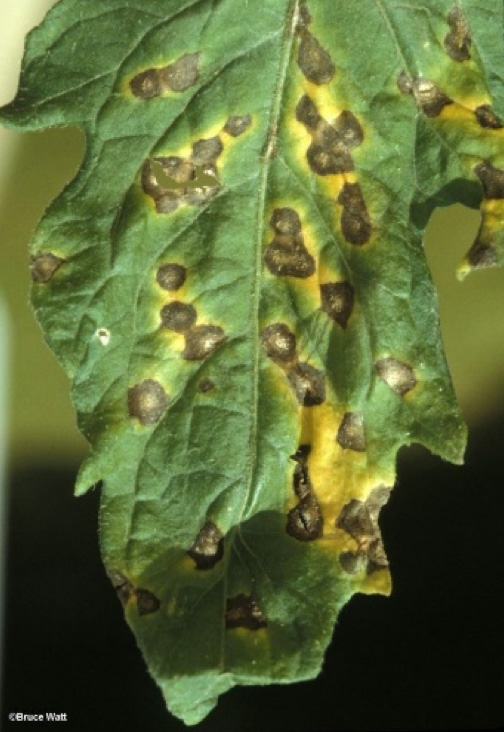
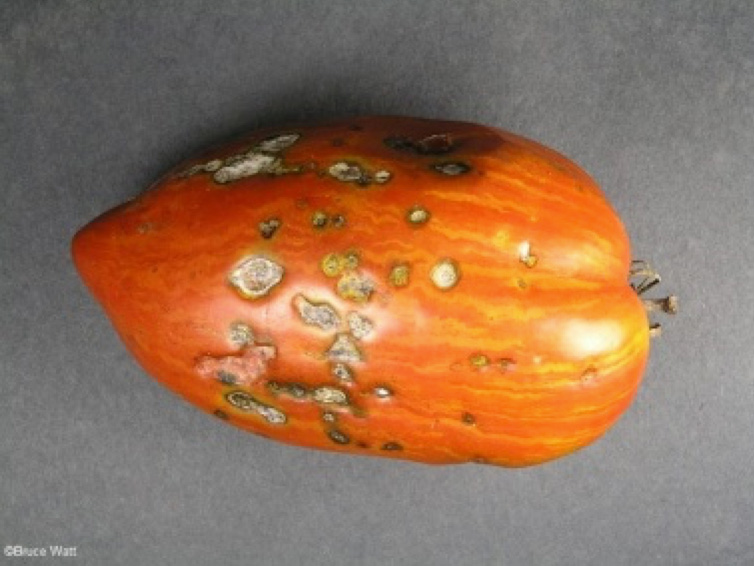
Septoria can infect all above-ground parts of the plant and in rare cases, the fruit (Figure 1). The infections are most obvious and extensive on the foliage. Beginning signs appear on the lower leaves and after the first fruit set produced. Lesions also appear and are characterized by small (1/8″), circular lesions with dark borders and grayish centers. Close inspection reveals tiny black or brownish dots within the lesions. These are the spore producing structures (pycnidia) of the fungus. The leaves eventually wither and die. The disease progresses up the stem, and total defoliation of the plant may occur.
Management
- Use disease-free seed or if the seed is suspect use a hot water treatment (122°F for 25 min.). This practice may reduce seed viability.
- Remove and destroy crop debris at the end of the season. Where this is not practical, plow the plant into the soil at the end of the season which will promote rapid breakdown by soil micro-organisms.
- Practice rotation to non-susceptible crops for three years. The most effective rotations will also try to exclude susceptible weeds like nightshade (Solanaceae), jimson weed (Datura stramonium), and horse nettle (Solanum carolinense).
- Promote good air circulation by spacing plants properly.
- Hand-picking infected leaves will reduce the number of spores available for new infections.
- Stay out of growing areas when the foliage is wet.
- Water early in the day and, if possible, avoid wetting the foliage.
- Stake plants.
- Be sure plants have adequate nutrition.
- The table to the right lists available fungicides that can be used for managing this disease.
| Fungicide | Typical Application Interval | Examples of Trade Names |
|---|---|---|
| azoxystrobin | 7 to 14 days | Quadris, Amistar® Top |
| Bacillus mycoides Isolate J | See label for application. | LifeGardOrganic |
| chlorothalonil | 7 to 14 days | Daconil, Bravo Weather Stik, Echo, and others |
| copper products | 7 to 14 days | Kocide, and others |
| hydrogen dioxide plus peroxiacetic acid | See label for application. | Oxidate2.0Organic |
| mancozeb | 7 to 14 days | Dithane, Penncozeb |
| tetraconazole | Before disease onset, no more than 2 consecutive applications | Mettle 125 ME |
| ziram | 7 to 14 days | Ziram |
*Table by Ned Tisserat, Kansas State University and adapted for Maine
You should check your local town ordinance for any pesticide restrictions prior to application.
WHEN USING PESTICIDES, ALWAYS FOLLOW LABEL DIRECTIONS!
Alicyn Smart, DPM
Plant Pathologist and Director of the Plant Disease Diagnostic Laboratory
University of Maine Cooperative Extension
Information in this publication is provided purely for educational purposes. No responsibility is assumed for any problems associated with the use of products or services mentioned. No endorsement of products or companies is intended, nor is criticism of unnamed products or companies implied.
© 2010, 2019
Call 800.287.0274 (in Maine), or 207.581.3188, for information on publications and program offerings from University of Maine Cooperative Extension, or visit extension.umaine.edu.
The University of Maine is an EEO/AA employer, and does not discriminate on the grounds of race, color, religion, sex, sexual orientation, transgender status, gender expression, national origin, citizenship status, age, disability, genetic information or veteran’s status in employment, education, and all other programs and activities. The following person has been designated to handle inquiries regarding non-discrimination policies: Director of Equal Opportunity, 101 North Stevens Hall, University of Maine, Orono, ME 04469-5754, 207.581.1226, TTY 711 (Maine Relay System).