
Maine Home Garden News — April 2012
- April is the month to . . .
- How to Have Your Own Cranberry Garden
- Deer Resistant Ornamental Plants
- Maine AgrAbility
By Barbara Murphy, Extension Educator, University of Maine Cooperative Extension, Oxford County, barbara.murphy@maine.edu.
- Finish pruning your fruit trees, raspberries and blueberries.
- Start vegetable seedlings such as tomatoes, peppers, eggplant, and early crops of lettuce, greens and spinach. See Bulletin #2751, Starting Seeds At Home.
- Sow peas when the soil is workable.
- Clean and sharpen your gardening tools.
- Clear winter debris from around the base of foundation plants and hedges.
- Consider a new design for your landscape. See Bulletin #2701, Designing Your Landscape for Maine.
- Learn more about ticks and Lyme disease. See Bulletin #5047, Ticks and Bulletin #2357, Lyme Disease.
- Get the mower ready for the season by sharpening the lawn mower blade, changing the oil, changing the spark plug, checking wheels and tires, checking safety features, etc.
- Head to your favorite garden centers to view or purchase new products, supplies, and plant materials.
- Check online or through the “app store” for garden planning applications.
- Evaluate your lawn, gardens, and property to determine if possible repairs are needed.
- Learn about mulches and how to select and use them for weed control in landscape plantings.
- Consider extending the gardening season – start now. See Bulletin #2752, Extending the Gardening Season.
- Consider making a cold frame for early crops or for hardening off transplants.
- Clean out birdhouses and clean bird feeders.
How to Have Your Own Cranberry Garden
By Charles Armstrong, Cranberry Professional, University of Maine Cooperative Extension, charles.armstrong@maine.edu.
Contrary to popular belief, cranberries do not grow in water, and unfortunately the bulk of the advertising for cranberry products that you see on television does little to dispel that belief, showing nothing but cranberries floating in seemingly endless oceans of water. While it is true that cranberries are a wetlands plant and are better than most plants at tolerating flooded conditions, after about two weeks of being completely saturated, the roots begin to run out of oxygen. Cranberries do, however, require a moist, well-aerated, acidic (pH of 4.0 to 5.5) growing medium such as sand or peat, or a combination thereof. But, there is actually very little to prevent anyone from having their very own garden of cranberry plants.
About the Plant
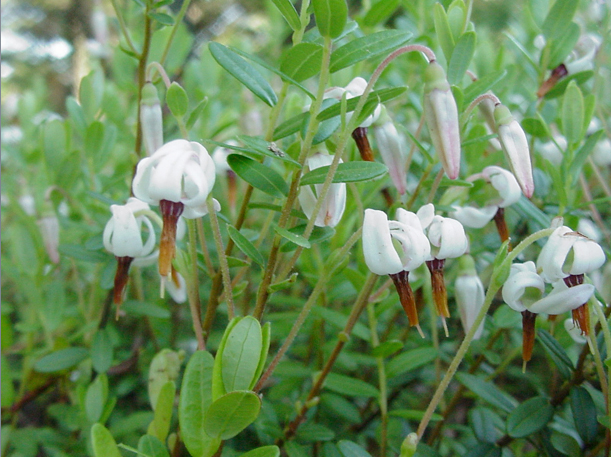
Cranberries are in the genus Vaccinium, which—together with the likes of blueberries, lingonberries and huckleberries—belong to the Ericaceae, or heather family. They are sun-loving (the more sun the better), produce flowers and fruit year after year, and are adapted for nutrient-poor acid soils. Their roots, most of which are very shallow, are associated with mycorrhizal fungi that are essential to the survival of the plants, greatly increasing the ability of the roots to absorb nutrients and water. The plants themselves are characterized by two different types of growth habits: runners, which are vines that trail along the ground, not unlike a strawberry plant, and uprights, which arise upwards from nodes along the runners and it is the uprights which bear the flowers and hence, the berries. A typical upright stores up enough nutrients and sugars to be able to support, on average, just two cranberries, but sometimes a number closer to five berries may be seen on an occasional upright.
Preparing the Bed
- Grab a shovel and start digging (the hardest part of the process). Dig out an area to the dimensions you desire. An area 4×8 would be considered a large plot, and a general rule of thumb is that for every 5 square feet of bed, one should expect about a pound of cranberries, assuming the plants are healthy and at least 3 years old.
- Dig to a depth of anywhere from a minimum of 8 inches to as deep as a foot (a few cranberry roots will eventually venture down to this depth, even though the vast majority of them will remain just 4 to 6 inches from the surface). Use what you dig out to form a protective wall or berm around your bed, to help slow the encroachment of weeds and to maintain good separation between the bed and your lawn. You can also cover the berm with wood and/or plastic, which works very well at keeping out the weeds.
- Fill your entire plot with peat moss, or a mixture of peat moss and sand (but save out some of your sand for later use). Add in some slow-release fertilizer if you desire. Also, it doesn’t hurt to add a little potting mix and/or compost, especially closer to the surface, to help give some additional body and nutrients to the mixture. Moisten it all gradually, and mix it frequently, to expose any dry pockets. Once you are finished mixing and wetting, it helps to add some additional sand to the uppermost layers (and an inch or two on top). The sand will help to anchor the plants, and it will also aid in weed prevention. Adding an additional half inch to 1 inch of sand every two to three years after planting will yield additional benefits, helping with not only weed control, but insect and disease control as well. This periodical sanding also encourages greater upright formation from the runners, having essentially a pruning effect on the vines.
- What about water needs? Except during extended dry periods or on extremely hot days, you needn’t worry too much about watering the bed. Peat moss holds moisture extremely well, so as long as it is moist 1” below the surface, that’s fine. But if you have the time, and can spare the water, giving them some during questionable times isn’t a bad idea, especially when berries are present in order to ensure that they remain nice and plump.
Acquiring Plants and Planting the Bed
- Where do I find plants? Searching online using keywords such as “purchase cranberry plants” will yield some good choices for plants, including a Maine grower-owned option, where you can also find some additional planting and care instructions for your new bed. Another alternative that some folks have attempted, with varying success, is to transplant existing cranberry plants found in the wild, if you know them to be good producers. Planting from seed is generally not a good idea simply because most seeds fail to germinate. Also, since any of the resulting offspring are not genetically identical to the parent, usually you are left with mostly vegetative, non-fruiting genotypes when all is said and done. In other words, with seeds, you can never be sure what you’re going to get.
- How many plants? I would encourage one to begin with a minimum of four to six pots (ideally 6″ diameter pots) of cranberry plants—assuming your bed is large enough to accommodate that many, with each plant having about a 2’ x 2’ spacing—simply because in my own experience they will take hold and spread faster that way, and also starting with older plants (at least 3 years old) is a sensible strategy, as you won’t have to wait three to four years before seeing any significant fruit.
- When to plant? Cranberries in Maine can be planted in the fall through as late as the first part of November, but I believe the best time to plant is in the spring, during the month of April. This will give the plants an entire growing season in which to establish themselves and to adapt to their surroundings. It will also ensure that they are ready for winter, having had the full time to respond to the shortening daylight cues, and to more fully develop their root systems.
Winter Protection and Frost Control
- Winter Protection: Mulch your cranberry plants, each year, shortly before the ground freezes (around late November). You can use peat moss, pine needles, leaves, or any combination thereof. Pine needles are especially acidic, so they help your bed maintain the low pH that the cranberries like, but sometimes tree leaves provide a better covering on the very top as they don’t simply fall through the empty spaces as much. However, if it is a particularly snowy winter, snow by itself will insulate the plants, but as our most recent winter has demonstrated extremely well, you cannot always depend on having a pile of snow over your bed for the entire winter. Note: The barrier that the snow and mulch create is not for the purpose of insulating against low temperatures nearly as much as it is meant to insulate the plants from the desiccating nature of the wind. Since cranberry leaves are evergreen, they are subject to drying out in the presence of winter winds. Growers refer to cranberry tips and leaves damaged this way as having died due to “winter kill.” Often the plants will recover, but not if the injury is too severe.
- Uncover the plants around April 1st, but be on guard against dangers from frost. Cover them up again if you suspect a dangerous frost event.
- Frost Control: New shoots that are starting to elongate from the buds in the spring need to be protected from frost. The tolerance levels vary somewhat depending on what variety you have and what growth stage most of your plants are at. For Stevens, new shoots in the spring can withstand temperatures as low as 29.5° – 30° F (as low as 20° F if the buds are still dormant and not growing). In the fall, by the end of October, Stevens vines will tolerate temperatures down to 23° F. Perhaps just apply your winter protection a little early if there is a real danger of frost at that time. You can find a table of both spring and fall frost tolerances, tied to variety and growth stage, on the web at https://extension.umaine.edu/cranberries/growing-cranberries/frost-tolerances/
Additional Information
Please take a peek at UMaine Extension’s cranberry website for information on additional topics such as pest ID, fertilizer questions and recommendations, grower services, cranberry health benefits, cranberry educational activities for kids, and much, much more.
Deer Resistant Ornamental Plants
By Donna Coffin, Extension Educator, University of Maine Cooperative Extension, Piscataquis County, donna.coffin@maine.edu.
Although many people enjoy deer, these animals can be destructive to gardens, orchards, and landscaped areas. Deer damage to ornamental plants is associated with a variety of factors, including increasing numbers of deer, human population shifts to rural and suburban areas, landowners prohibiting deer hunting, and neighbors deer feeding stations.
Although a deer-proof fence is the best insurance against deer damage, landscaping with deer-resistant plants is a more aesthetically pleasing alternative. Deer are selective feeders; they prefer some foods over others. Plants deer usually avoid are considered deer-resistant. Deer eat a variety of vegetation including woody plants, grasses, fruits, nuts, ornamental trees, shrubs, vines, and garden vegetables. Landscaping based on a knowledge of deer feeding habits can reduce or eliminate costly browsing damage to ornamentals.
A plant can be deer resistant for several reasons. Many of the most deer-resistant plants are poisonous–some at all times, and others only at certain growth stages.
Tastes, preferences, and digestibility also vary with plant parts, plant age, growth stage, and time of year. The availability of natural food can greatly affect the amount of damage caused by deer. If an adequate supply of natural browse is available, deer are less likely to eat ornamental plants. When the natural food supply is low, however, few ornamental plants will be resistant, and deer may cause heavy browse damage. A large deer population can create competition for food, causing deer to eat many plants that they normally would avoid. Deer damage usually occurs from late fall through early spring.
Oregon Cooperative Extension developed a list of deer-resistant plants as a general guide. Some plants included on this list are: Foxglove, Iris, Narcissus, Daffodil, Common Lilac, Russian Olive (invasive), Norway Spruce, Colorado Blue Spruce, and Red Pine. Oregon Cooperative Extension also offers a general reference: Reduce Deer Damage in Your Yard (EC 1557).
Sources:
- Deer-resistant Ornamental Plants, J.L. Horton and W.D. Edge, Department of Fisheries and Wildlife, Oregon State University; and W. Daniel Edge, Extension wildlife specialist; Oregon State University. extension.oregonstate.edu/catalog/pdf/ec/ec1440.pdf. February 2003.
- Reduce Deer Damage in Your Yard (EC 1557), E. Henning, J. Kelly and N. Allen, Oregon State University Cooperative Extension, http://ir.library.oregonstate.edu/xmlui/bitstream/handle/1957/19669/ec1557.pdf. November 2002.
By Bettina Voight, Maine AgraBility Coordinator, University of Maine Cooperative Extension, bettina.voight@maine.edu.
Maine AgrAbility is an educational outreach between the University of Maine Cooperative Extension, Alpha One Independent Living, and Goodwill Industries of Northern New England. Our primary goal is to keep farmers farming! We assist farmers who have a chronic health condition or disability that makes farming harder than it used to be.
Gardening is a lot like farming – if you have a flower, fruit, or veggie operation, no matter how big or small, you know what I mean! Planting, weeding, digging, tilling, and more – these things can sometimes leave you sore at the end of the day. That’s because it’s hard work! What are you doing to protect your body?
Maine AgrAbility recently participated in the Portland Flower Show at which we displayed an array of tools that are considered “adaptive” or “assistive” because they help ease the burden of hard work! For example, we displayed telescopic tools with adjustable handles that allow you to make them shorter or longer, which may help in easing back pain. We also displayed some ergonomic tools, which are tools that have been designed to help your body maintain neutral, natural body positions. Ergonomic tools tend to be lightweight and bent to help keep your body (your wrist, your back, etc) in a neutral position while using them. The goal of ergonomics is to reduce twists, torques, awkward angles, and uneven weight distribution.
Experts agree that gardening is a great form of exercise and that it’s good for your mental health. It’s important to stop and take a moment to evaluate how your body is feeling throughout your day of gardening. Some questions you may ask yourself are:
- How is my body? Do a simple body scan and think about any areas that may need attention (i.e. do you have any pain in your back, neck, shoulders, knees, etc?)
- How is my posture? Am I using my core strength to keep myself upright?
- When is the last time I took a stretching break?
- When I have to carry a heavy load, am I keeping it close to my body? Am I bending at the knees to lift it up?
- When is the last time I took a break to stretch out my hands?
- Have I had enough water today?
The most important, take-home message is to make sure you are working within your body’s limits. As with any exercise, it’s important to warm your muscles up before using them to prevent injury. Consider taking 5 minutes before you start your time of gardening to stretch your major muscle groups, or the muscle groups you know you will be using a lot of. You may want to consider stretching afterward, too. You can contact Maine AgrAbility at 207.944.1533 or 1.800.287.1471 (in Maine) or maine.agrability@maine.edu. Also visit our website at umaine.edu/agrability.
University of Maine Cooperative Extension’s Maine Home Garden News is designed to equip home gardeners with practical, timely information.
Let us know if you would like to be notified when new issues are posted. To receive e-mail notifications fill out our online form.
Maine Home Garden News was created in response to a continued increase in requests for information on gardening and includes timely and seasonal tips, as well as research-based articles on all aspects of gardening. Articles are written by UMaine Extension specialists, educators, and horticulture professionals, as well as Master Gardener Volunteers from around the state, with Professor Richard Brzozowski serving as editor.