
Maine Home Garden News — March 2012
By Katherine Garland, Horticulturist, University of Maine Cooperative Extension, Penobscot County, katherine.garland@maine.edu
- Get to know the new All America Selections (AAS) winners. AAS is an independent, non-profit organization that tests new varieties then introduces only the best garden performers as AAS winners. See the list of current and past winners here.
- Build a seed starting stand and start the following seeds indoors: early – celery, celeriac, onions and leeks; late – peppers, broccoli, Brussels sprouts, cabbage, cauliflower, and eggplant.
- Prune fruit trees, ornamental woody plants, and highbush blueberries while they are still dormant.
- Tap maple trees. The exact best time to start depends on the weather. Watch for when temperatures are freezing at night and 40-45° during the day.
- Connect with your local food pantry to find out what vegetables their clients might like to receive next season and sign up to participate in Maine Harvest for Hunger in 2012.
- Force branches for indoor color (see Cornell gardening resources; scroll down to “‘Forcing’ Twigs for Indoor Bloom”). Forsythia isn’t your only option! Other woody plants that are easy to force include: tamarack, apple, quince, pussy willow, cherries, alder, and birch.
- Grow sprouts. Fresh greens can be grown indoors with just the following ingredients: mason jar with screw-top ring, small piece of cheesecloth, aluminum foil, seeds, and water.
- Try new recipes for vegetables that you plan to grow next year. Planning meals ahead will help you take advantage of your bountiful harvest.
- Keep composting! You may not see a lot of activity in your pile right now, but keep contributing those kitchen scraps. You’ll be amazed at how fast the pile shrinks when the outdoor temperature begin to rise.
- Plan your next botanical adventure. Warm thoughts of gorgeous gardens are fun to entertain this time of year. We’re lucky to have some great gardening playgrounds nearby such as Coastal Maine Botanical Gardens in Boothbay and Rogers Farm Demonstration Garden in Old Town. If you’re willing to travel, there are many to choose from. Looking for travel suggestions? Consider visiting the botanical gardens in Montreal, Quebec or St. Louis, Missouri.
- Plant highbush blueberries. UMaine Extension Master Gardener Volunteers are having a blueberry plant sale to benefit their programs. Consider taking advantage of this sale.
By Kathryn Hopkins, Extension Educator, University of Maine Cooperative Extension, Somerset County, khopkins@maine.edu

At Christmas time, my husband did a good deed and received an orchid as a token of appreciation. Since we knew nothing about raising orchids except for their alleged finicky and difficult reputation we went into panic mode when the giver also said, “By the way it needs repotting!” So now what were we to do with this thing?
The first step was to decide what type of orchid this was in order to provide the best growing conditions. There are five major orchid types: Cattleya, Paphiopedilum, Phalaenopsis, Dendrobium, and Oncidium. Phalaenopsis (moth orchids) and some Paphiopedilum varieties (slipper orchids) are best suited for home environments. Flowers on these orchids are long lasting. Phalaenopsis flowers can last from two to six months. My orchid arrived without a tag, but had the leaf and flower structure of a Phalaenopsis orchid and arrived potted in sphagnum moss rather than regular potting mix, suggesting that it was epiphytic and not terrestrial.
Once you identify your orchid, you will be able to plan for its care. Orchids really seem very easy to grow if you supply the correct potting mix, light requirements, water, and fertilizer. The correct conditions usually allow you to successfully grow any plant.
Because many orchids are tropical in origin and are found in nature growing on trees or tree branches, they require a potting mix that is composed of bark, sphagnum moss or a fibrous potting mix. They get most of their water and nutrients from the air through aerial roots. The potting mix should let the water flow through freely and orchids should never be left in standing water. Water again when the potting mix has dried out some but not completely. The roots should not be trimmed. Because many orchids are native to the tropics, they may benefit from a more humid environment than we typically have in our Maine homes in the winter. Putting your orchid on a tray of gravel and water with the roots above the water level will provide some humidity.
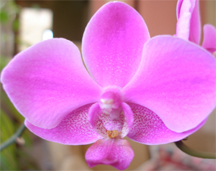
Orchids need good light and warm temperatures — about 68-75 degrees during the day and about 10 degrees cooler at night — in order to set buds. Orchids may fail to bloom if night temperatures are the same or very close to daytime temperatures. A two-week period in spring or fall where temperatures at night are kept ten to fifteen degrees cooler than during the day should initiate flower development, assuming the plant is receiving adequate light levels.
Orchids are intolerant of temperatures that are either too low or too high, so you may need sheer curtains in the summer to reduce temperatures in south or west-facing windows. You may choose to grow orchids under fluorescent lights if you don’t have an east, south or west-facing window. The lights should be about 8-12 inches above the orchids’ foliage, and should be on from 12-14 hours a day.
Orchids need fertilizer for good growth and flowering, and are also very sensitive to over-fertilization that can cause root damage. Only fertilize actively growing plants and do not fertilize during the plant’s rest period. Use a special orchid fertilizer or a good houseplant fertilizer and feed plants potted in bark every two weeks and plants in sphagnum once a month following the label directions.
For more information on growing orchids go to:
- Growing Orchids Indoors, University of Vermont Extension
- Orchids, Clemson Cooperative Extension
- Orchids, University of Wisconsin Extension
- Phalaenopsis and Paphiopedilum Species; Easy Orchids to Grow as Houseplants, University of Minnesota Extension Service
For more information on orchids and to see videos on orchid care, go to the American Orchid Society website and click on the tab “All About Orchids.”
By Barbara Murphy, Extension Professor, University of Maine Cooperative Extension, Oxford County, barbara.murphy@maine.edu
In August, we gardeners are typically awash in produce, so much so that putting it to good use becomes a challenge. Our friends, neighbors, and co-workers grimace as they see us coming with yet another bag full of zucchini, carrots, and beans. So, rather than doing the same thing this year, commit now to making a plan about where your high-quality excess produce is going to go.
Why It Matters
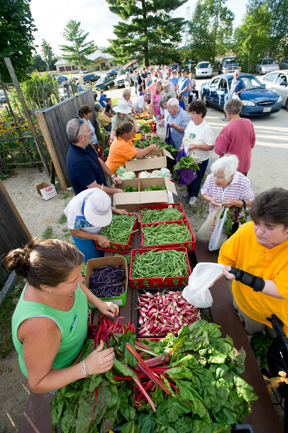 Both nationally and regionally, Maine’s food insecurity ranking is frightening; third highest in the nation, highest in New England.
Food insecurity in wealthy nations like the US doesn’t look like the stereotypical images of swollen bellies and stick-like arms and legs. Rather, in Maine and elsewhere, it is more likely to look like obesity; the result that in America, calorie-dense, nutrient poor food is generally less expensive than nutrient rich food. So, making a plan to donate your garden produce to those with limited access to fresh produce just might start to turn the tide against food insecurity here in Maine.
What You Need To Do
- Think about how much you plan to donate either by designating a row in your garden for this purpose, or estimating how much excess you generally have and of what.
- Think about the resources in your area — where would you go to find good “homes” for your garden vegetables and fruits? Some possibilities include senior centers, summer feeding programs, food pantries, senior lunches, and neighbors.
- Once decided, schedule a meeting with the head of the organization, or have a conversation with your neighbor to discuss what their vegetable needs are. Are some items more desirable than others? How much can they deal with each week? How do they want them to arrive — bagged, loose, washed? If appropriate, include recipes from the Maine Harvest for Hunger website to give people some suggestions on use.
- Keep the recipient notified about pending harvests. A quick reminder that you will be bringing a bag of beans next week will help insure that they are ready to put them to good use.
- Finally, record an estimate of the weight of the donation and where it went, and send this to your UMaine Extension county office so that we can include your donation in our Maine Harvest for Hunger total.
- Even small donations matter. Providing the ingredients for a salad or side dish of vegetables is a great way to let someone know you care.
- To see what a difference fresh produce makes, watch the video:
University of Maine Cooperative Extension’s Maine Home Garden News is designed to equip home gardeners with practical, timely information.
Let us know if you would like to be notified when new issues are posted. To receive e-mail notifications fill out our online form.
Contact Colleen Hoyt at colleen.hoyt@maine.edu or 1-800-287-1471 (in Maine).
Visit our Archives to see past issues.
Maine Home Garden News was created in response to a continued increase in requests for information on gardening and includes timely and seasonal tips, as well as research-based articles on all aspects of gardening. Articles are written by UMaine Extension specialists, educators, and horticulture professionals, as well as Master Gardener Volunteers from around Maine, with Professor Richard Brzozowski serving as editor.
Information in this publication is provided purely for educational purposes. No responsibility is assumed for any problems associated with the use of products or services mentioned. No endorsement of products or companies is intended, nor is criticism of unnamed products or companies implied.
© 2012
Published and distributed in furtherance of Acts of Congress of May 8 and June 30, 1914, by the University of Maine Cooperative Extension, the Land Grant University of the state of Maine and the U.S. Department of Agriculture cooperating. Cooperative Extension and other agencies of the U.S.D.A. provide equal opportunities in programs and employment.
Call 800-287-0274 or TDD 800-287-8957 (in Maine), or 207-581-3188, for information on publications and program offerings from University of Maine Cooperative Extension, or visit extension.umaine.edu.