Mainely Progress, Summer 2009
Volume 6, Number 1
Edited by Dr. Martin Stokes
UMaine Animal Health Lab Update
In last summer’s edition of Mainely Progress we described a $5,000,000 proposal that we had submitted to the Maine Technology Asset Fund (MTAF) to construct and equip a new building for the Maine Veterinary Diagnostic Laboratory (MVDL). This was to provide state-of-the-art laboratory facilities to support Maine’s agricultural and aquatic animal industries with technology transfer and bio-analysis relative to disease control and diagnostics. A major component of this proposal was a necropsy facility that could handle large animals, such as cattle or moose, and then dispose of these carcasses that could be contaminated with pathogenic organisms. Although we were recommended for funding we did not receive an interview and were not funded. However, we did receive very useful feedback from the evaluation panel so we modified and resubmitted our proposal in year two of the bond proposal. Initially there were more proposals seeking more funds than in year one, but many proposals rapidly fell to the wayside. We scored better in year two and this time received an interview, but to no avail, no funding. Six UMaine projects were funded by MTAF last year and four more were added to the list this year. The university is also involved as a Research and Development partner in seven other projects, totaling over $16.1 million out of the $50 million available over two years.
One of the last comments from the MTAF interview panel was that maybe there was a more appropriate place for us to seek funding for this building, which was an indirect reference to the billions of dollars of stimulus funds that are becoming available. As part of the American Recovery and Reinvestment Act of 2009, signed into law by President Obama on February 17, 2009, the National Institutes of Health has been allocated $10.4 billion, of which $1 billion will be administered by the National Center for Research Resources for federal awards to institutions seeking to construct, renovate or repair biomedical or behavioral research facilities. Consequently, we have expanded our unsuccessful MTAF proposal to apply for a greatly expanded $15 million bio-secure facility to help fulfill our goals of clinical service, research and teaching. We have requested support to build the Maine Center for Animal-Based Biomedical Research, Diagnostics and Technology Transfer, a high-containment research building for the study of highly pathogenic infectious diseases using terrestrial and aquatic animal models.
This building will have in excess of 23,700 square feet and will contain the only Bio-Security Level 3 and Animal BSL-3 facilities in the state. The Center will have two floors with BSL-1 and BSL-2 microbiology labs, histopathology, digital microscopy, and molecular diagnostic labs with support areas. The ABSL-3 zone has laboratory animal housing, aquaria (including a zebra-fish lab), and a necropsy room with capacity for both small and large animals. There will also be BSL-3 level facilities for storage and bio-secure disposal of solid and liquid infectious wastes, with a suite of three BSL-3 labs with support areas. The ABSL-3 zone will include two barrier-type lab animal housing rooms, a cage wash support area, two aquatic animal housing rooms with support areas and a secure loading dock. The large animal necropsy room has an enclosed loading dock, cold rooms, support services room and a walk-in freezer. All work areas in BSL-3 and ABSL-3 zones will be equipped with bio-containment hoods and infectious solid and liquid waste will be decontaminated by alkaline digestion of animal tissues or thermal effluent decontamination of contaminated liquids. There will also be the necessary office spaces, stairs, elevator, rest rooms, corridors, custodial and mechanical support areas.
Fixed equipment for this facility has also been requested including: the alkaline digester/effluent decontamination unit, twelve bio-containment hoods, two pass-through and one standard autoclave, two reverse osmosis water pre-treatment units, zebra fish support racks, closed-ventilation rodent cages and a cage washer, large and small hydraulic necropsy tables, a hanging rack system for large animal carcasses, three walk-in cold rooms and a walk-in freezer, a closed-circuit video/audio monitoring system for necropsy viewing, and an integrated sentinel system for bio-security and environmental condition monitoring.
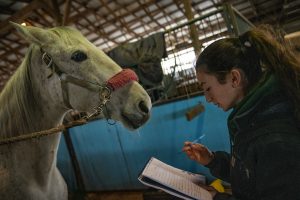
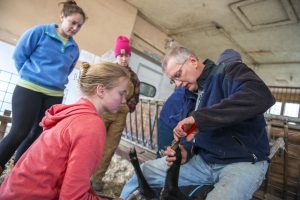
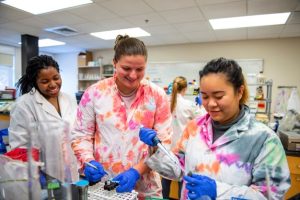
This facility will help the UMaine Animal Health Lab fulfill our goals of clinical service, research and teaching for Maine’s terrestrial and aquatic animal producers and for our students who come not just from Maine but from many states around the US. These activities include our participation in a number of service projects, such as disease surveys of “species of concern” (rainbow smelt and sturgeon) and regional lobster stocks. We are performing research in lobster health during post-capture impoundment, and developing innovative approaches to maintaining health in several species via the use of probiotics.
John ‘Jack” Goater, 1924-2009, died January 9, 2009, at a local hospital. Jack obtained his BS in animal science at Virginia Tech and his MS from UNH. Jack came to UMaine in 1954 as an Extension Animal Science Specialist and later became an assistant professor of animal science. He was advisor for the university’s horse club, organized the annual horse show, directed the sheep and equine programs in 4-H, led the summer 4-H sheep and equine programs and was heavily involved in the North Country Cheviot Sheep Association. He was one of the first four members inducted into the Maine 4-H Hall of Fame for his tireless dedication to the program.
We also learned by email that Erik M. Daly, 1975-2008, BS, AVS, 1997, DVM, UFL, 2000, died on December 5, 2008. Erik was born in Würzburg, Bavaria, Germany, on December 28, 1975, the son of Francis Xavier Daly, Jr. and Paula Marie (Granato) Rearick. He worked as a veterinarian for the Riverside Animal Hospital in East Providence, RI.
Please pass this newsletter to your friends and especially to any UM or AVS alumni for whom we do not have an address. If you send us their address we’ll include them in our next mailing. Please remember to let us know when you change your address as we continue to get 20 to 30 copies returned for every issue.
Please let us know more about you. Tell us about your experiences since graduation and about important happenings in your life that we can print in our alumni news corner. Also let us know what you would like us to include in future issues. You can contact us most easily by email – Stokes@maine.edu.
Our most sincere thanks to all our friends and alumni for their generous donations. Your financial support helps us expose our students to opportunities that would otherwise be impossible.
This newsletter cost about $500 to print and mail to our alumni, friends and stakeholders around Maine and New England. If you would like to sponsor an issue your name, or the name of your company could be HERE.